Origins After the Norman Conquest
The Tower of London dates back to the autumn of 1066, when William the Conqueror defeated Harold Godwinson at the Battle of Hastings and marched on London. William needed to establish control over a city that had not yet fully submitted to his rule, and a fortress was essential to that plan.
He chose a site in the southeast corner of the old Roman city walls, where the Thames provided a natural defensive boundary on one side. The first structure was likely a simple wooden fortification, thrown up quickly to assert Norman authority over the Saxon population. It was a statement of power as much as a military installation.
The White Tower Takes Shape
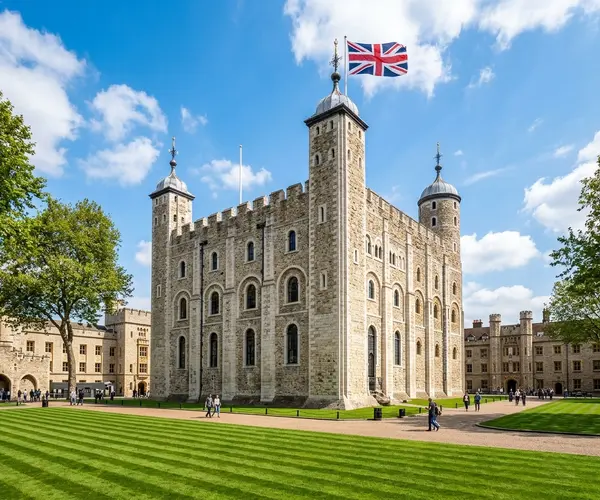
Within a decade, William ordered the construction of a great stone keep to replace the temporary wooden defences. This became the White Tower, the imposing rectangular structure that still dominates the complex today. Construction began around 1078, and the building was largely complete by 1100, though some work continued under William's successor, William Rufus.
The White Tower was enormous by the standards of the time. At roughly 27 metres tall, it would have towered over the low wooden buildings of medieval London. The walls at the base are nearly 5 metres thick, designed to withstand siege weapons and direct assault. For the people of London, this massive stone building was an unavoidable reminder of who held power.
How the Fortress Grew
The Tower of London as visitors see it today is far larger than William's original fortification. Every century brought new additions, walls, towers, and buildings that expanded the complex into a sprawling 12-acre site.
The Inner and Outer Walls
Richard the Lionheart began constructing the inner curtain wall in the 1190s, creating a ring of defensive walls and towers around the White Tower. His brother King John continued this work, and Henry III completed the inner wall and added several towers during the 1200s. Henry also had the White Tower whitewashed for the first time in 1240, giving it the name it still carries.
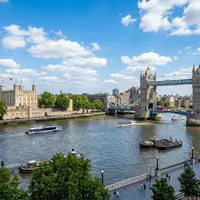
Edward I, who reigned from 1272 to 1307, was responsible for the most dramatic expansion. He built the outer curtain wall, dug a new moat, and essentially created the concentric castle layout that survives today. His work doubled the size of the fortress and made it one of the most formidable strongholds in Europe. The fortress would stand alone on the riverbank for another six centuries before Tower Bridge rose beside it in 1894.
Later Additions
The Tudor period saw the construction of the Queen's House (now home to the Resident Governor) and modifications to several towers. The Victorians carried out extensive restoration work in the 19th century, including rebuilding sections of wall and restoring the chapel of St John inside the White Tower.
What Survives From Each Era
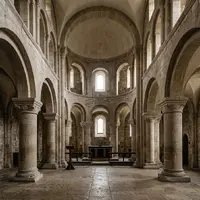
Walking through the Tower today, you pass through layers of history. The White Tower's chapel of St John, with its heavy Norman arches and plain stone columns, is one of the finest surviving examples of Norman church architecture in England. It has remained largely unchanged since the 11th century.
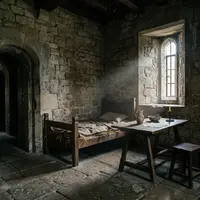
The Beauchamp Tower, built by Edward I in the 1280s, still bears the carved inscriptions of prisoners who were held there over the centuries. The Medieval Palace, reconstructed in the style of Edward I's time, gives visitors a sense of how the royal apartments once appeared.
The Moat and Outer Defences
The moat that surrounds the Tower was drained in 1843 on the orders of the Duke of Wellington, who was then Constable of the Tower. It had become stagnant and a serious health hazard. Today the dry moat is used for events and ceremonies, but its outline still traces the defensive perimeter that Edward I established more than 700 years ago.
A Fortress That Never Stopped Changing
One of the remarkable things about the Tower's age is that it has never been a static monument. It served as a royal residence, prison, armoury, treasury, zoo, and mint at various points in its history. Each new role brought physical changes, and the building adapted to meet the needs of whoever controlled it.
Even during the Second World War, the Tower was put to military use, holding prisoners of war and serving as a headquarters for various units. Rudolf Hess was briefly held there in 1941, making him one of the last state prisoners in the Tower's long history.
The fact that the Tower of London has survived nearly a millennium of use, conflict, and changing purposes is testament to the solidity of its original construction and the care taken by successive generations to maintain and adapt it.