What the Collection Contains
The Crown Jewels at the Tower of London represent one of the most complete collections of royal regalia in the world. The roughly 100 objects span centuries of British monarchy and include crowns, orbs, sceptres, swords of state, rings, spurs and ceremonial robes.
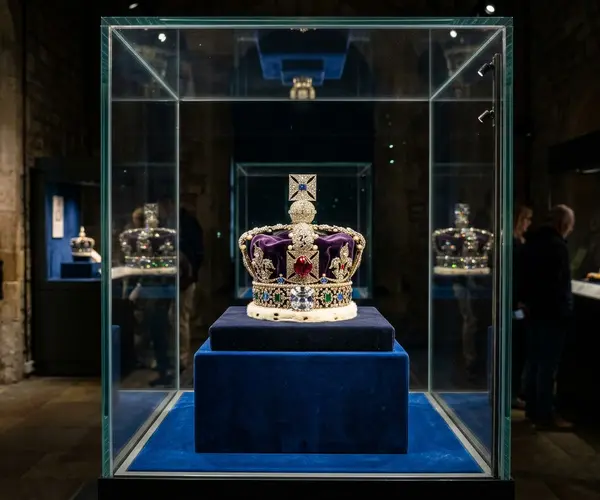
The most recognisable piece is the Imperial State Crown, worn by the monarch at the State Opening of Parliament. It contains 2,868 diamonds, 17 sapphires, 11 emeralds, 269 pearls and 4 rubies. Among its notable stones is the Stuart Sapphire and the Black Prince's Ruby, which is actually a large red spinel that dates back to the 14th century.
The Sovereign's Orb, a hollow golden sphere topped with a cross, symbolises the monarch's role as Defender of the Faith. It was created for the coronation of Charles II in 1661 after Oliver Cromwell ordered the original medieval regalia melted down during the Commonwealth period.
The Koh-i-Noor Diamond
One of the most discussed stones in the collection is the Koh-i-Noor, a 105.6 carat diamond with origins in India. It was presented to Queen Victoria in 1849 and was most recently set in the Queen Mother's Crown, made for the 1937 coronation of George VI. The diamond has a long and contested history, with several countries maintaining claims to it.
Where They Are Displayed
The Crown Jewels are kept in the Jewel House, a purpose-built vault in the inner ward, close to the original Norman keep that gave the fortress its name. Visitors pass through the collection on a moving walkway that carries them slowly past the most important pieces, displayed in reinforced glass cases under carefully controlled lighting.
The vault itself is protected by some of the most advanced security in the country. The details of the security arrangements are not made public, but the Jewel House is staffed around the clock and the Tower is guarded by both Yeoman Warders and armed military personnel.
Earlier Display Locations
Before the current Jewel House opened in 1994, the Crown Jewels were displayed in several other locations within the Tower grounds. For much of the 20th century they were kept in the basement of the Waterloo Barracks. Before that, they were shown in the Martin Tower, where visitors could handle some of the pieces for an additional fee paid to the Keeper of the Jewels.
A History of Theft and Near Misses
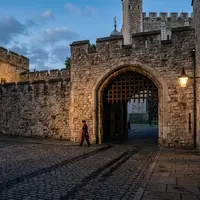
The most famous attempted theft occurred in 1671 when Colonel Thomas Blood, an Irish adventurer, managed to physically seize the crown, orb and sceptre. He flattened the crown with a mallet to fit it under his coat and had an accomplice file the sceptre in half. Blood was caught at the Tower gates but, remarkably, was pardoned by Charles II and even given lands in Ireland.
Still in Active Use
Unlike many royal collections around the world, the Crown Jewels are not purely historical artefacts. They continue to serve their original purpose. The St Edward's Crown was used at the coronation of King Charles III in 2023, maintaining a tradition that stretches back centuries. The Imperial State Crown is worn annually at the State Opening of Parliament, and other pieces are used at investitures and state banquets throughout the year.
The fact that these objects remain working symbols of the British state, rather than museum pieces, is part of what makes the collection at the Tower of London unique among the crown jewel collections of Europe.