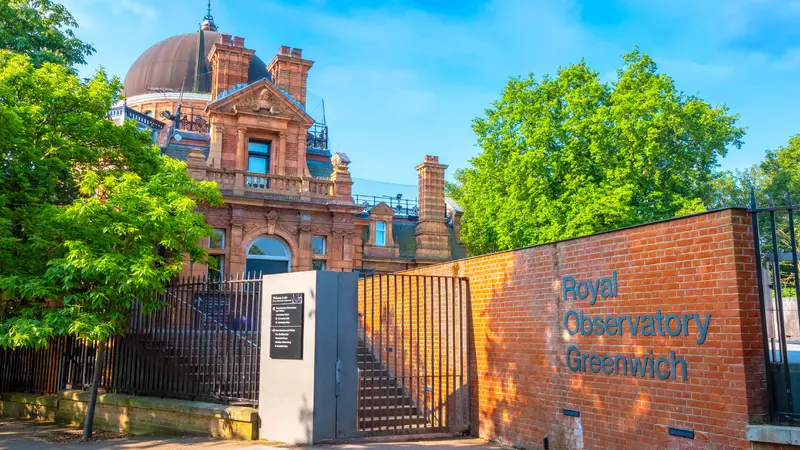
Royal Observatory Greenwich
Home of the Prime Meridian Line and Greenwich Mean Time — straddle east and west hemispheres at longitude zero
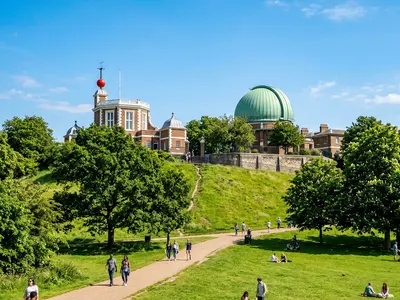
Home of the Prime Meridian Line and Greenwich Mean Time — straddle east and west hemispheres at longitude zero
The Royal Observatory sits atop Greenwich Park, on the spot where longitude zero was established in 1884. This is where Greenwich Mean Time was born, where Flamsteed mapped the stars and where Harrison built the chronometers that solved the longitude problem.
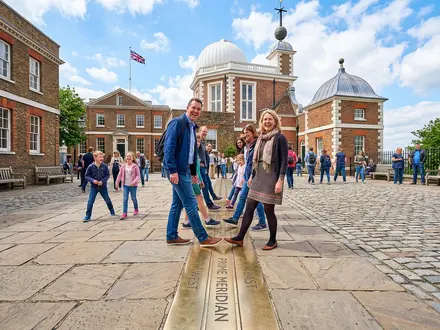
Today you can straddle the Prime Meridian Line, explore Wren's Flamsteed House and watch the red Time Ball drop at 1pm as it has since 1833. The Peter Harrison Planetarium next door runs daily shows beneath London's only public planetarium dome.
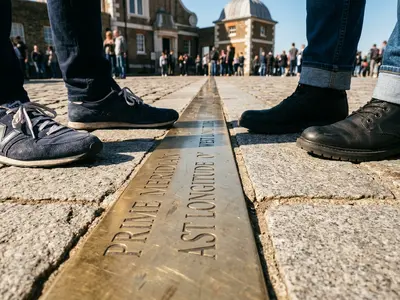
The Prime Meridian Line is the reason most visitors climb the hill. The brass strip in the courtyard marks longitude zero, the reference from which every time zone on earth is measured. Standing with one foot in each hemisphere is the classic Greenwich photo — arrive early to avoid queuing.
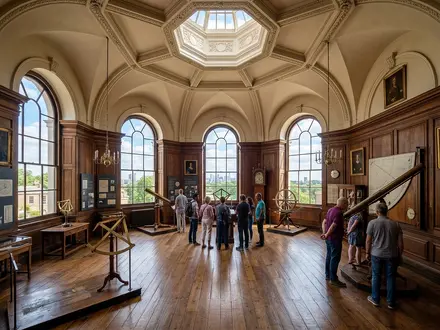
Inside Flamsteed House, galleries trace the history of navigation and timekeeping. The Shepherd Gate Clock on the outside wall, installed in 1852, was one of the first to show Greenwich Mean Time publicly. The red Time Ball still drops at exactly 1pm daily, a tradition started in 1833 so ships on the river could calibrate their instruments. After dark, a green laser projects the meridian northward across the London sky.
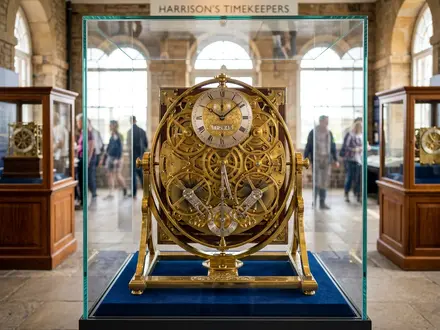
The Observatory's most precious objects are John Harrison's four marine chronometers, H1 through H4. Harrison, a self-taught Yorkshire carpenter, spent over 30 years solving the longitude problem — how to determine a ship's east-west position at sea by keeping accurate time on a moving vessel.
H1 is a brass mechanism weighing over 30 kilograms with interlocking gears designed to resist the motion of a ship. By H4, completed in 1759, he had reduced the mechanism to a pocket watch just 13 centimetres across. The bitter dispute with the Board of Longitude over the prize money is told through original documents. All four chronometers are still in working order.
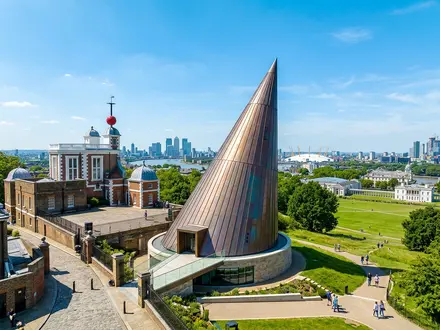
The Peter Harrison Planetarium, housed in a bronze-clad cone beside the Observatory, is London's only public planetarium. Digital shows projected onto the tilted dome cover topics from the solar system to black holes. Shows last around 30 minutes and booking ahead is recommended as they sell out quickly.
The Great Equatorial Telescope, a 28-inch refractor installed in 1893, sits beneath the distinctive onion dome on the hilltop. It is the largest refracting telescope in the United Kingdom and is still used for public astronomy evenings on clear nights. The views from the Observatory terrace stretch across Greenwich Park, the Naval College, the Thames, Canary Wharf and the City skyline beyond.
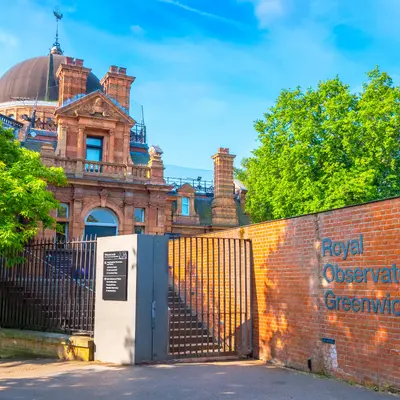
Included with London Pass
Included with London Pass — save up to 50% across 80+ London attractions.
A joint ticket with Cutty Sark offers a saving — book online for guaranteed entry and a small discount on walk-up prices
The Meridian Line courtyard gets crowded by mid-morning, especially on weekends. Arriving at opening time gives you space for photos without queuing.
Shows sell out regularly, particularly at weekends and during school holidays. Book online when you buy your Observatory ticket to guarantee a seat.
The walk up from Greenwich town centre through the park is 12 to 15 minutes on a steady incline. The path is paved but the climb is noticeable — the view from the top rewards the effort.
The red ball on the roof of Flamsteed House rises to the top of its mast at 12:55 and drops at exactly 1pm. It is a small but satisfying moment of precision.
Walk downhill after your visit to reach Cutty Sark and the Old Royal Naval College within five minutes. A joint ticket with Cutty Sark saves money and a half-day covers all three comfortably.

London Travel Writer · 12+ years covering UK attractions and tourism
Last reviewed: March 6, 2026