The Classic Photo Opportunity
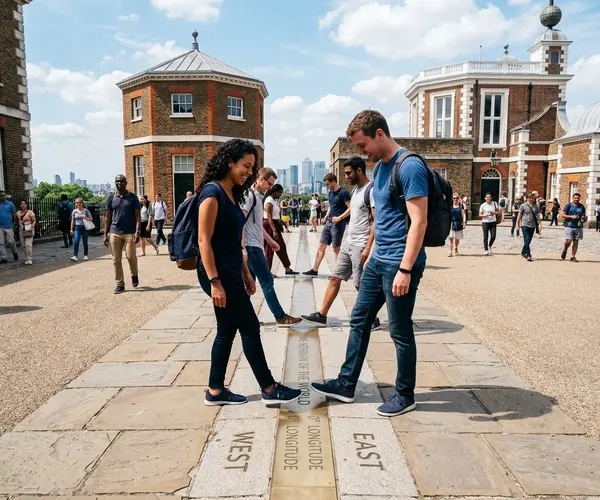
Standing on the Prime Meridian line at the Royal Observatory Greenwich is one of London's most iconic visitor experiences. The line, marked by a brass strip set into the cobblestones of the Observatory courtyard, runs north to south and represents longitude zero degrees, the boundary between the Eastern and Western hemispheres.
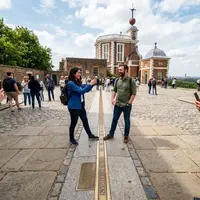
Visitors queue to stand directly on the line, typically placing one foot on each side so they can say they are simultaneously in two hemispheres. It is a simple concept, but there is something genuinely satisfying about standing on the exact point from which all longitude on Earth is measured. The photo of a person straddling the line has become one of the most recognisable tourist images in London.
Inside the Courtyard
The Meridian Courtyard is part of the Observatory complex and the brass line runs through its centre. The strip is clearly visible and extends across the full width of the courtyard, so there is plenty of room for visitors to position themselves for photographs.
During busy periods, particularly on summer weekends and school holidays, there can be a queue to stand on the most photographed section of the line. Most visitors take their photo and move on quickly, so the wait is rarely long. The courtyard also has markers on the ground showing the longitude and latitude of the spot, adding context to the experience.
Seeing the Line for Free
If you want to see the Meridian line without entering the Observatory buildings, you can view part of it from outside the courtyard fence. A section of the line extends beyond the paid area and is visible from the public paths in Greenwich Park. This gives you a view of the line and the Observatory building behind it, though you will not be able to stand directly on the brass strip in the courtyard.
The green laser beam that marks the Meridian at night is also visible for free from anywhere in north London with a clear sightline toward Greenwich. The laser is projected from the Observatory roof along the line of the Meridian, creating a striking green beam that cuts across the night sky. It is best seen on clear, dark evenings and is visible from several miles away.
The Best Time to Visit
For the most relaxed experience of standing on the Meridian line, weekday mornings are ideal. The Observatory opens at 10am and the first hour tends to be the quietest, giving you time to take photographs without a crowd waiting behind you.
Weekend afternoons are the busiest times, especially during school holidays and in the summer months. If you are visiting at a peak time, arriving shortly after opening or in the late afternoon as crowds thin out will give you a better experience.
More Than Just a Line
While the Meridian line is the single most popular feature of the Observatory, the courtyard and surrounding area offer more to see. The time ball on the Observatory roof, which has dropped at exactly 1pm every day since 1833, is visible from the courtyard. This daily signal is one of the tangible connections to the Observatory's role in establishing Greenwich Mean Time as the global standard. The views from the Observatory terrace across Greenwich Park to the River Thames, the Queen's House and Canary Wharf are among the finest panoramas in London.
The combination of standing on a line of genuine global significance, in a building where fundamental advances in astronomy and navigation were made, with one of London's best views spread out below you, makes the Royal Observatory worth visiting even if all you do is stand on a brass strip and take a photograph.