The First Purpose-Built Observatory
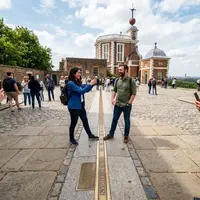
Flamsteed House at the Royal Observatory Greenwich is where the story of the Observatory begins. King Charles II founded the Royal Observatory in 1675 with a specific mission: to improve celestial navigation for the benefit of British shipping. He appointed John Flamsteed as the first Astronomer Royal and commissioned Sir Christopher Wren, already at work rebuilding London's churches after the Great Fire, to design a suitable building.
Wren was given a modest budget of around 520 pounds, and the building was constructed partly from recycled materials including bricks from a demolished gatehouse at the Tower of London and wood and iron from a dismantled fort at Tilbury. Despite these constraints, Wren produced an elegant building that combined the practical requirements of an observatory with rooms grand enough to reflect the royal appointment.
The site chosen was the highest point of Greenwich Park, on the foundations of an old castle watchtower. The elevated position gave clear views of the sky in all directions and placed the Observatory above the worst of London's smoke and fog.
The Octagon Room
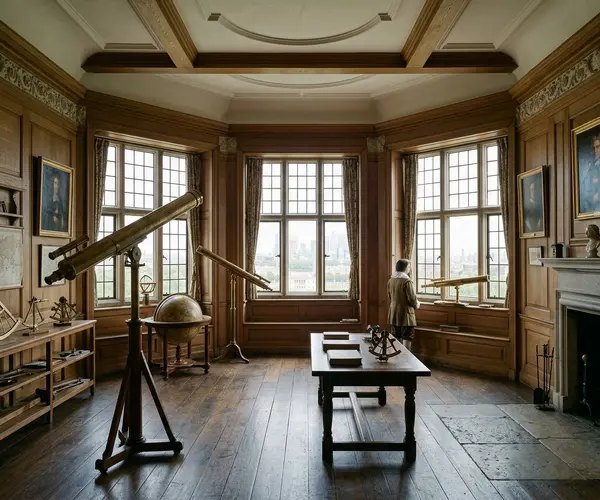
The most impressive space in Flamsteed House is the Octagon Room on the upper floor. This tall, airy room with its high windows was designed as the main observing room, though Flamsteed quickly discovered that it was not ideally suited to precise astronomical work because the windows faced in fixed directions rather than providing a view of the meridian.
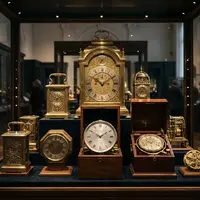
Despite its limitations as an observatory, the Octagon Room is architecturally beautiful. The tall windows flood the space with light, and the proportions of the room reflect Wren's mastery of harmonious design. Two clocks by Thomas Tompion, the greatest clockmaker of the age, were installed here in 1676. These clocks, with their distinctive long pendulums, were among the most accurate timepieces in the world and were essential to Flamsteed's work of cataloguing the positions of stars.
The room has been restored to reflect its appearance during Flamsteed's time, with reproduction instruments and furnishings that give visitors a sense of what it was like to work here in the late 17th century.
Flamsteed's Living Quarters
Flamsteed House was not just a workplace but a home. The lower floors contained the Astronomer Royal's living quarters, where Flamsteed and his wife Margaret lived for more than 40 years. The apartments were modest, reflecting the limited funding the Observatory received from the Crown.
Flamsteed complained frequently about the lack of proper instruments and funding. He was expected to supply many of his own tools and was paid a salary of just 100 pounds per year. Despite these hardships, he produced a catalogue of nearly 3,000 star positions, the most comprehensive and accurate survey of the heavens that had been made up to that point.
The living quarters now house displays about the daily lives of the early Astronomers Royal and the domestic side of running what was simultaneously a scientific institution and a family home.
The Time Ball
One of the most recognisable features of Flamsteed House is the time ball mounted on its roof. Installed in 1833, long after Flamsteed's death, the bright red ball rises to the top of its mast and drops at precisely 1pm every day. Ships on the Thames would watch for the ball to drop and use it to set their chronometers, ensuring accurate timekeeping for navigation.
The time ball still operates daily and is one of the earliest public time signals in the world. It is visible from a considerable distance and has become an iconic part of the Greenwich skyline, a physical connection between the building's 17th-century origins and its ongoing role in the story of timekeeping.
Wren's Enduring Design
Flamsteed House has been modified and extended over the centuries, but Wren's original structure remains at its core. The building's red brick exterior, tall windows and rooftop turrets give it a distinctive silhouette that has been a feature of Greenwich Park for 350 years. It is both a working part of London's museum landscape and a monument to the moment when Britain committed to understanding the heavens for the practical purpose of navigating the seas. Nearby, the Peter Harrison Planetarium continues that mission with digital fulldome shows about space and astronomy.