London's Only Planetarium
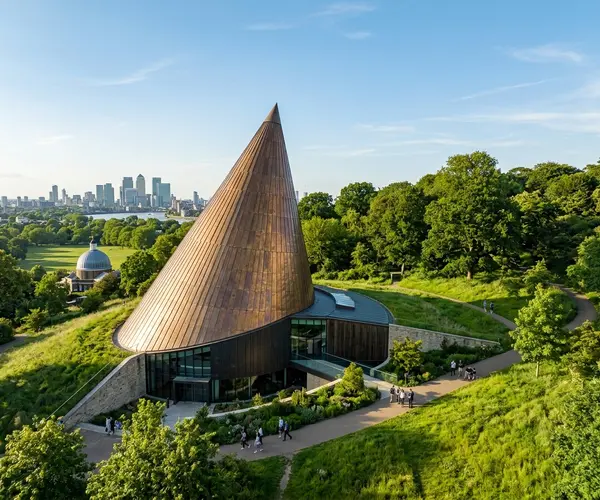
The Peter Harrison Planetarium sits within the grounds of the Royal Observatory Greenwich and holds the distinction of being the only planetarium in London. Its 120-seat auditorium is housed inside a striking truncated cone clad in bronze, a piece of modern architecture that sits in deliberate contrast to the 17th-century Observatory buildings nearby.
The planetarium opened in May 2007, funded by a donation from the Peter Harrison Foundation. Before its arrival, London had been without a dedicated planetarium since the closure of the London Planetarium on Marylebone Road in 2006, when that venue was absorbed into Madame Tussauds. Greenwich filled the gap and gave London a planetarium that was purpose-built from the ground up with the latest projection technology.
What You See Inside
The planetarium uses a digital fulldome projection system that covers the entire domed ceiling above the audience. Unlike older planetariums that used a mechanical star projector to show points of light on a dome, the digital system can display full-colour imagery including planets, galaxies, nebulae, spacecraft and animated visualisations of astronomical concepts.
The effect is immersive. When the lights dim and the projection begins, you are surrounded by the night sky or transported through the solar system, depending on the programme being shown. The system can simulate the sky as seen from any point on Earth at any time in history or the future, and it can zoom out to show the scale of the observable universe.
The Shows
The planetarium runs a programme of shows throughout the day, typically lasting around 30 minutes each. The content ranges from introductory shows suitable for young children to more in-depth programmes aimed at adults and older students.
Some shows focus on the night sky visible from London, pointing out constellations, planets and notable stars that you can look for yourself. Others take the audience on journeys through the solar system, explaining the characteristics of each planet and the missions that have explored them. More advanced programmes tackle subjects like black holes, the life cycle of stars, dark matter and the search for exoplanets.
The planetarium also hosts special events including live talks by astronomers, evening observation sessions and shows tied to astronomical events such as meteor showers, eclipses and planetary conjunctions. These events offer a chance to learn directly from practising scientists and often include time with telescopes on the Observatory terrace.
The Building
The bronze cone of the planetarium is one of the most distinctive modern buildings in Greenwich. It was designed by architects Allies and Morrison, who shaped the building to echo the form of astronomical instruments while using materials that would develop a patina over time and eventually match the aged copper of nearby historic buildings.
The cone tilts at an angle of 51.5 degrees, matching the latitude of Greenwich. This alignment is a deliberate reference to the Observatory's role in measuring the Earth's position in space. At 45 tonnes, the bronze cladding gives the building a solid, permanent presence in the landscape.
Visiting the Planetarium
The planetarium operates on a timed entry system with specific showtimes throughout the day. Shows run regularly from the Observatory's opening time, with the last show typically in the late afternoon. During school holidays and weekends, additional shows are often added to meet demand, and popular shows can sell out, particularly during half-term weeks and the summer holidays.
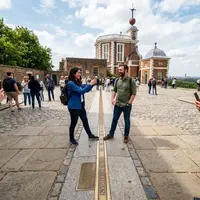
The auditorium is fully accessible, with wheelchair spaces and an induction loop for hearing aid users. The raked seating gives every seat a clear view of the dome, though seats toward the centre of the room tend to offer the most immersive experience as the projection wraps around you from all angles. After a show, many visitors walk across to the Prime Meridian line in the courtyard to straddle the boundary between hemispheres.