Where GMT Comes From
Greenwich Mean Time has its origins in the work of astronomers at the Royal Observatory Greenwich, founded by King Charles II in 1675. The Observatory's primary purpose was to improve navigation at sea, and accurate timekeeping was essential to that mission.
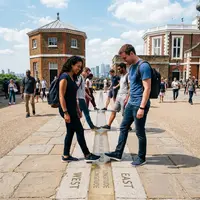
The astronomers at Greenwich calculated time by observing the moment the sun crossed the Prime Meridian each day. "Mean" time refers to the average position of the sun, because the actual solar day varies slightly throughout the year due to the Earth's elliptical orbit and axial tilt. By averaging these variations, GMT provided a consistent and predictable time standard.
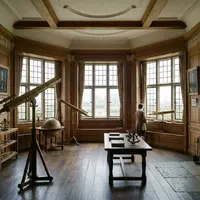
The first Astronomer Royal, John Flamsteed, working from the original observatory building that now bears his name, began systematic observations in 1676, and his successors refined the measurements over the following centuries. By the early 19th century, Greenwich time was recognised as the most accurate time standard available, and it began to spread beyond the Observatory walls.
How GMT Became the Global Standard
Before standardised time zones, every town and city kept its own local time based on the position of the sun overhead. This worked well enough when the fastest form of travel was a horse, but the arrival of railways in the 1830s and 1840s created chaos. Train timetables were impossible to coordinate when every station ran on a different clock.
In Britain, the Great Western Railway adopted GMT in 1840, and other railway companies followed. By 1880, GMT was legally established as the standard time for the whole of Britain. The International Meridian Conference of 1884, which selected Greenwich as the location of the Prime Meridian, effectively made GMT the reference point for time zones worldwide.
Each time zone was defined as an offset from GMT. New York was GMT minus five hours, Tokyo was GMT plus nine hours, and so on. This system brought order to international timekeeping and made it possible to coordinate shipping schedules, telegraph communications and eventually airline timetables across the globe.
The Shift to UTC
In 1972, Coordinated Universal Time (UTC) replaced GMT as the international standard for civil timekeeping. UTC is based on atomic clocks, which measure time with extraordinary precision, far exceeding anything achievable through astronomical observation.
The difference between GMT and UTC is negligible for everyday purposes. UTC occasionally adds a "leap second" to stay synchronised with the Earth's slightly irregular rotation, but for practical matters the two are functionally interchangeable. Most people in the UK still refer to their winter time zone as GMT rather than UTC, and the term remains deeply embedded in common usage.
Why Greenwich Was Chosen
Greenwich became the home of the world's time standard through a combination of scientific achievement, maritime power and practical dominance. By the time of the 1884 conference, two-thirds of the world's ships already used charts based on the Greenwich Meridian, and British naval supremacy meant that Greenwich time was already the de facto standard for much of global navigation.
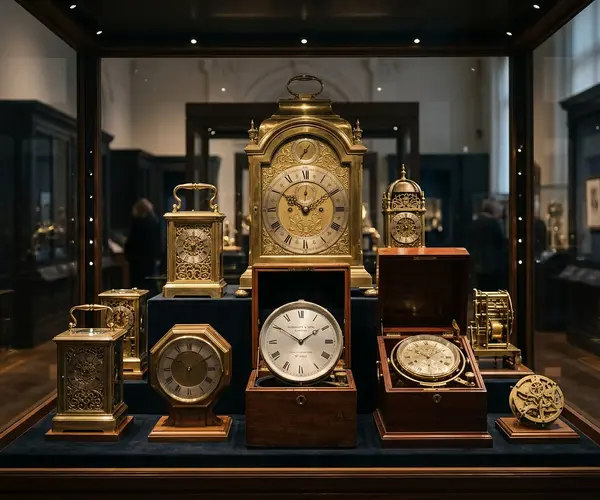
The Observatory's reputation for accuracy was also crucial. The work of successive Astronomers Royal had made Greenwich synonymous with precision timekeeping, and the time ball on the Observatory roof, which dropped at precisely 1pm each day so ships on the Thames could set their chronometers, was a visible demonstration of that reliability.
GMT Today
Although no longer the official global time standard, GMT remains a living concept. The UK uses GMT as its winter time zone, switching to British Summer Time (GMT+1) between March and October. International organisations, broadcasters and airlines frequently reference GMT when communicating across time zones.
The time ball at Greenwich still drops at 1pm every day, maintaining a tradition that began in 1833. And the Observatory's connection to the very idea of standardised time gives the site a significance that extends far beyond its role as a historic building.