The Idea
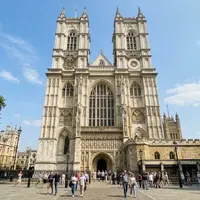
The concept of burying an unidentified soldier with full honours was proposed by the Reverend David Railton, an Army chaplain who had served on the Western Front. During the war, Railton had noticed a grave in a garden at Armentieres marked with a simple cross and the words "An Unknown British Soldier." The image stayed with him, and in 1920 he wrote to the Dean of Westminster suggesting that an unidentified body be brought home and buried in Westminster Abbey to represent all those who had died and had no known grave.
The idea was initially met with hesitation. King George V was reportedly concerned that it might reopen the wounds of grieving families. But the proposal gained support from the Prime Minister, David Lloyd George, and was eventually approved.
The Selection
The process of choosing the Unknown Warrior was designed to ensure that his identity could never be established. On the night of 7 November 1920, bodies were exhumed from four of the major British battle areas on the Western Front, specifically the Aisne, the Somme, Arras and Ypres. The bodies were brought to the chapel at St Pol near Arras, where Brigadier General L.J. Wyatt, commander of British troops in France and Flanders, selected one at random.
The three remaining bodies were reburied. The selected remains were placed in a plain pine coffin, which was then enclosed in a casket made from oak timber from the royal estate at Hampton Court Palace. The casket was fitted with a medieval Crusader's sword from the Tower of London and an iron shield bearing the inscription "A British Warrior who fell in the Great War 1914-1918 for King and Country."
The Funeral
On 11 November 1920, exactly two years after the Armistice, the Unknown Warrior was brought across the English Channel aboard HMS Verdun. The destroyer's name was chosen deliberately as a reference to the longest and one of the deadliest battles of the war. The casket was transported by train to Victoria Station and then carried on a gun carriage through silent, crowded streets to the Abbey.
King George V walked behind the gun carriage, and the route was lined with thousands of mourners. At the Abbey, the Unknown Warrior was buried in soil brought from the battlefields of France. The grave was filled with earth from each of the major theatres where British troops had fought.
The congregation included around 100 women who had each lost their husband and all of their sons in the war. Over the following days, an estimated 1.25 million people filed past the grave to pay their respects.
The Grave Today
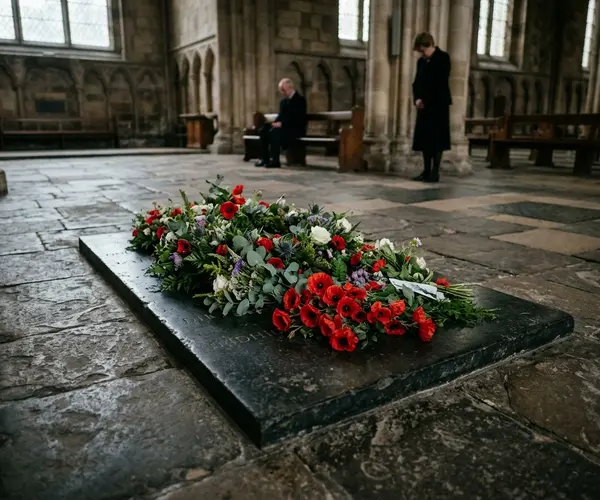
The black marble gravestone was installed in 1921, with an inscription composed partly by Herbert Ryle, Dean of Westminster. The text reads in part that the warrior was buried "among the most illustrious of the land" and describes him as one who "gave the most that man can give, life itself."
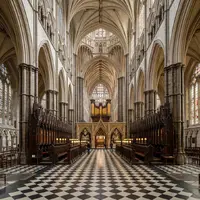
The grave is the only stone in the Abbey that visitors are never permitted to step on. A rope barrier and the watchful presence of Abbey stewards ensure this rule is observed. Poppies and small crosses are frequently left at the edges of the stone, and the grave remains a focal point for Remembrance Day services each November. The tomb sits near the west entrance of a building that has stood on this site for over a thousand years, accumulating layer upon layer of national memory.
The grave of the Unknown Warrior is the most visited spot in Westminster Abbey, drawing more attention than the tombs of monarchs, scientists or poets. Its power lies in its anonymity. The soldier could be anyone's father, brother, husband or son, and that universality is what makes the memorial so enduring.