The Saxon Origins
The history of Westminster Abbey stretches back far beyond the Gothic building that stands today. Around 960 AD, a community of Benedictine monks established a monastery on Thorney Island, a marshy patch of land at the confluence of the River Tyburn and the Thames. This early religious house gave the area its name. "Westminster" derives from "West Minster," referring to the monastery's position west of the City of London.
Little is known about this first church, and no physical remains have been conclusively identified. It was a modest foundation, quite different from the grand building that would eventually replace it.
Edward the Confessor's Abbey
The first major church on the site was built by Edward the Confessor between approximately 1042 and 1065. Edward chose to rebuild the monastery on a grand scale, creating a Romanesque church that was among the largest in England at the time. He also built a royal palace adjacent to it, establishing Westminster as the centre of English royal and political life.
Edward's church was consecrated on 28 December 1065, just days before his death on 5 January 1066. He was buried before the high altar, and his tomb became a place of pilgrimage after he was canonised in 1161. Harold Godwinson was crowned in Edward's church the day after Edward died, and William the Conqueror was crowned there later that same year. That first Norman coronation began an unbroken tradition of 40 coronations at Westminster Abbey stretching to the present day.
Henry III's Rebuilding
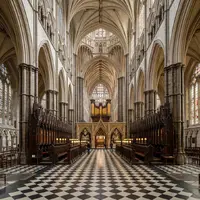
The building visitors see today is largely the result of Henry III's ambitious rebuilding programme, which began in 1245. Henry was devoted to the cult of Edward the Confessor and wanted to create a fitting shrine for the royal saint. He demolished most of Edward's Romanesque church and replaced it with a new structure in the French Gothic style, inspired by cathedrals he had seen in France, particularly Reims and the Sainte-Chapelle in Paris.
The eastern end of the church, including the sanctuary and the chapter house, was completed relatively quickly. But the nave took far longer. Construction continued intermittently through the 14th and 15th centuries, with different architects maintaining Henry's original Gothic vision with remarkable consistency. The nave was not fully completed until 1517, nearly 300 years after Henry III laid the first stones.
Later Additions
The most significant later addition is the Lady Chapel at the eastern end, built by Henry VII between 1503 and 1516. This late Gothic masterpiece, with its extraordinary fan-vaulted ceiling, is widely regarded as one of the finest examples of Perpendicular Gothic architecture in existence.
The western towers, which define the Abbey's appearance from the front, were not completed until 1745. Designed by Nicholas Hawksmoor in a Gothic style that deliberately harmonised with the medieval building, they are the most "modern" part of the exterior, though they are themselves nearly 300 years old.
Survival Through the Centuries
Westminster Abbey has survived remarkably intact through periods that destroyed many other English religious buildings. During the Dissolution of the Monasteries under Henry VIII in the 1530s, the Abbey was spared demolition because of its royal connections. It was briefly made a cathedral, then given the unique status of a Royal Peculiar, answerable directly to the monarch rather than to any bishop or archbishop.
The Abbey also survived the Great Fire of London in 1666, which destroyed much of the City to the east, and the Blitz during the Second World War, when incendiary bombs damaged the roof of the lantern but the main structure remained intact. Its survival through these events has allowed it to accumulate over a thousand years of continuous history on a single site, making it one of the oldest and most layered religious buildings in Britain.