How It Began
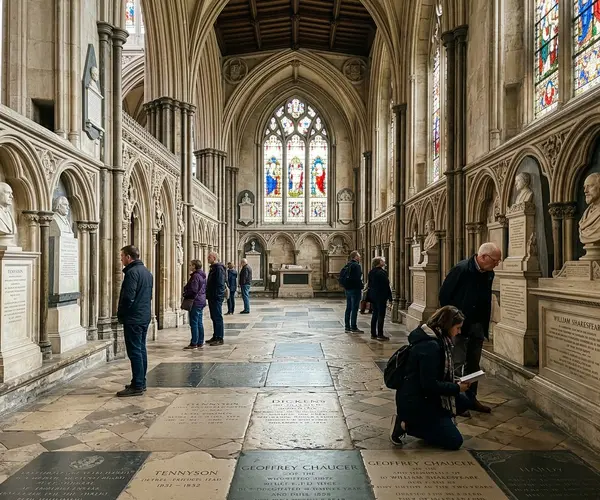
Poets' Corner occupies the south transept of Westminster Abbey, and its origins are more accidental than planned. Geoffrey Chaucer was buried here in 1400, though his interment was likely due to his role as a court official and his tenancy of a house in the Abbey precincts rather than his literary fame. He is just one of over 3,300 people buried or memorialised at Westminster Abbey, a list that spans monarchs, scientists and national heroes alongside the literary figures concentrated in Poets' Corner. It was not until 1556, when a more prominent tomb was erected in his honour, that his presence began to attract other literary burials.
Edmund Spenser, author of The Faerie Queene, was buried near Chaucer in 1599. According to tradition, fellow poets threw their own compositions and the pens they had written them with into his grave. From that point on, the area became increasingly associated with English literature, and subsequent generations of writers either requested burial here or were commemorated by admirers after their deaths.
Who Is Buried Here
The distinction between burial and memorial is important in Poets' Corner. Some of the most famous names have their actual remains interred beneath the floor or in wall tombs. Charles Dickens was buried here in 1870 against his own wishes. He had asked for a simple, private funeral, but public pressure was so great that the Dean of Westminster intervened and arranged for burial in the Abbey. His grave was kept open for two days so that mourners could pay their respects.
Alfred, Lord Tennyson was buried in Poets' Corner in 1892, and Robert Browning in 1889. Rudyard Kipling joined them in 1936. Thomas Hardy's heart was buried at his parish church in Dorset, but his ashes were placed in Poets' Corner, creating an unusual situation where the writer's remains are divided between two locations.
Who Is Memorialised but Not Buried
Many of the names associated with Poets' Corner belong to people whose remains are elsewhere. William Shakespeare has a memorial here, but he is buried in Stratford-upon-Avon. Jane Austen's memorial stone was installed in 1967, though she lies in Winchester Cathedral. The Bronte sisters are commemorated with a plaque placed in 1947, though all three are buried in Yorkshire.
This practice of memorialising writers regardless of their burial location has broadened Poets' Corner well beyond its original scope. It now serves as a national literary hall of fame, recognising contributions to English literature regardless of where the writer lived, died or was interred.
Beyond Poetry
Despite its name, Poets' Corner has never been limited to poets. Novelists, dramatists, essayists and other writers are well represented. Samuel Johnson, the great lexicographer, has a memorial here. So does George Frideric Handel, whose presence stretches the definition of "poet" even further. In more recent decades, memorials have been added for writers including D.H. Lawrence, T.S. Eliot, W.H. Auden and Ted Hughes.
The most recent additions continue to expand the range of voices represented. A memorial to Philip Larkin was unveiled in 2016, and there are ongoing discussions about which contemporary writers might eventually be honoured here.
The Experience of Visiting
Walking through Poets' Corner is a concentrated encounter with centuries of English literature. The memorials are densely packed, with floor stones, wall plaques, busts and full statues competing for space. It is easy to miss significant names in the crowd of monuments, and many visitors find themselves returning to the area multiple times during a single visit.
The atmosphere is different from the rest of the Abbey. While other sections are dominated by royal and political history, Poets' Corner belongs to the imagination. The writers commemorated here shaped the English language, and standing among their memorials offers a tangible connection to the literary tradition that runs from Chaucer in the 14th century through to the present day.