Trafalgar Square
London's iconic public square — Nelson's Column, Landseer's bronze lions, the Fourth Plinth and the National Gallery

London's iconic public square — Nelson's Column, Landseer's bronze lions, the Fourth Plinth and the National Gallery
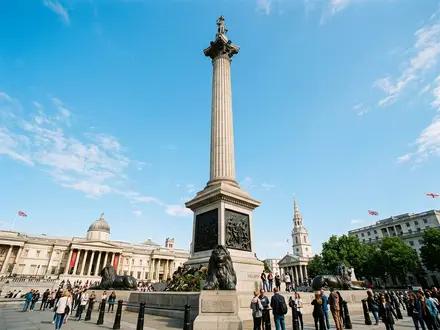
Trafalgar Square has been London's symbolic heart since the 1840s. Built to commemorate Nelson's victory at Trafalgar, it sits where the Mall, Whitehall and the Strand converge — linking Buckingham Palace, Parliament and the City.
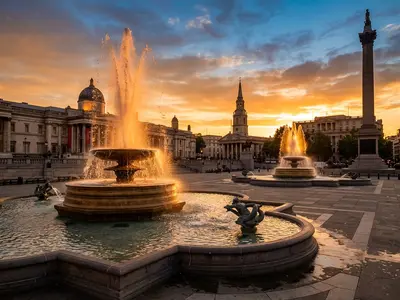
Nelson's Column rises 52 metres, guarded by four bronze lions, with the National Gallery filling the north side. The square hosts New Year countdowns, the Norwegian Christmas tree and rotating sculpture on the Fourth Plinth — a place of celebration, protest and public life at any hour.
Trafalgar Square was designed by Charles Barry and completed in the 1840s on the site of the old King's Mews. Nelson's Column, a single shaft of Dartmoor granite, rises 52 metres topped with a statue of the admiral gazing toward the Admiralty and the sea beyond.
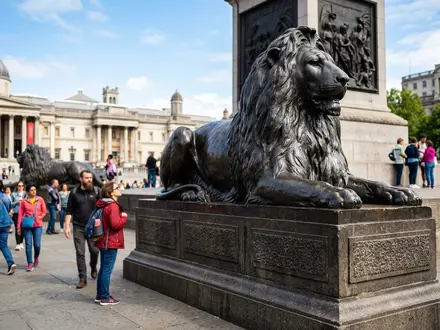
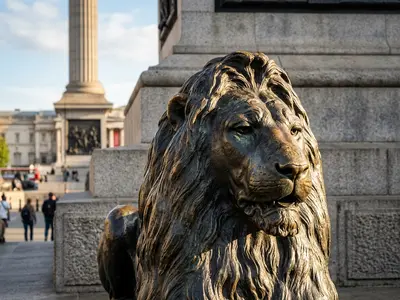
At the base, four bronze relief panels depict the battles of the Nile, Copenhagen, Cape St Vincent and Trafalgar — each cast from captured enemy cannons. The four lions, designed by Sir Edwin Landseer and installed in 1867, were the artist's first attempt at sculpture. The two fountains, redesigned by Lutyens in 1939, draw locals and visitors to the surrounding steps on warm evenings.
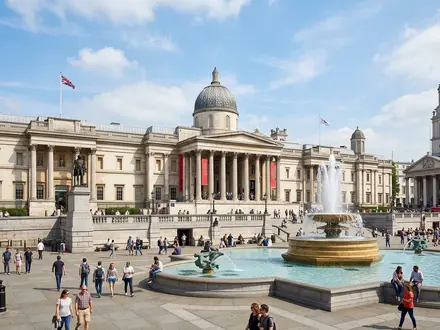
The National Gallery fills the north side of the square and holds one of the finest collections of Western European painting in the world. Over 2,300 works span the thirteenth century to 1900, including masterpieces by Leonardo da Vinci, Rembrandt, Vermeer, Turner, Van Gogh and Monet.
The Sainsbury Wing houses the oldest paintings, including van Eyck's Arnolfini Portrait and Leonardo's Virgin of the Rocks. The main galleries cover the Renaissance, Baroque and Impressionist periods. Even a quick visit will bring you face to face with some of the most important paintings ever made. The National Portrait Gallery on St Martin's Place is another world-class collection worth combining with the square.
Trafalgar Square has hosted public gatherings since it was built — from the VE Day crowds in 1945 to the annual St Patrick's Day parade, Chinese New Year celebrations and Pride in London. It remains a natural rallying point for cultural festivals and national moments of reflection.
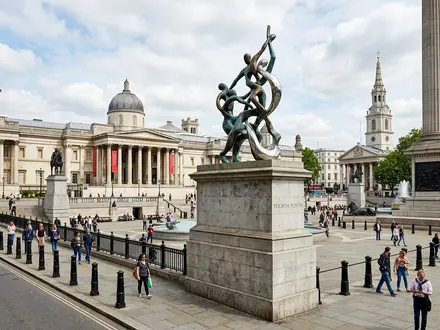
Every December, the Christmas tree arrives from Norway, a tradition dating to 1947 that symbolises gratitude for British support during the Second World War. The tree-lighting ceremony draws thousands and marks the unofficial start of London's Christmas season. The Fourth Plinth programme, running since 1999, has turned the empty northwest plinth into one of the city's most talked-about art spaces, with commissions changing every one to two years.
The square, the National Gallery and the National Portrait Gallery are all completely free — Trafalgar Square is one of the best-value stops in London
The square is busiest between 11am and 4pm. Early morning and early evening offer the best light and fewest crowds for photographs of the column, lions and National Gallery facade.
The National Gallery is free and right on the square. Even if you only have an hour, pick up a highlights map at the entrance and see the 30 must-see paintings — it is one of the best free experiences in London.
The square hosts regular free events including cultural festivals, film screenings and live performances. Check the London.gov.uk events page before your visit to see if anything is on.
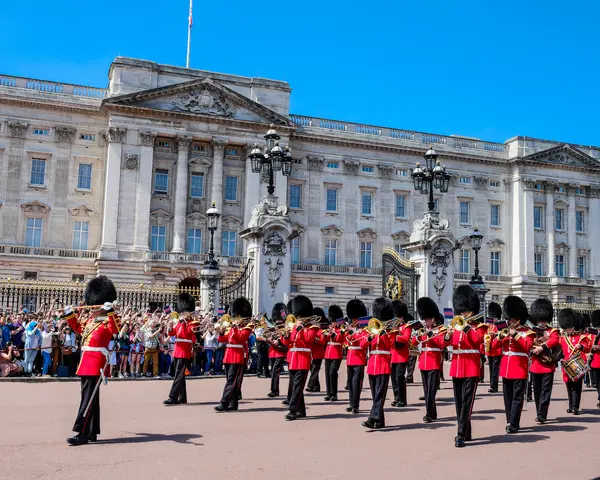
The Mall leads directly from the southwest corner of the square through Admiralty Arch to Buckingham Palace — a 15-minute walk through one of London's most ceremonial routes.
The church on the northeast corner has a free crypt cafe with good food and regular free lunchtime concerts. It is a calm retreat from the busy square above.

London Travel Writer · 12+ years covering UK attractions and tourism
Last reviewed: March 5, 2026