From King's Mews to Trafalgar Square
The area now known as Trafalgar Square has a history that long predates its current name. For centuries, the site served as the King's Mews, royal stables where the monarch's horses and hunting hawks were kept. The mews were demolished in the 1820s as part of a grand urban improvement scheme led by the architect John Nash, who envisioned a new public square at the heart of London.
The name "Trafalgar Square" was suggested by the architect George Ledwell Taylor in 1830 and officially adopted shortly afterwards. It was a deliberate choice to honour the most significant British naval victory of the Napoleonic Wars, a battle that had taken place 25 years earlier but remained fresh in the national memory.
The Battle of Trafalgar
The Battle of Trafalgar was fought on 21 October 1805 near Cape Trafalgar on the southwestern coast of Spain. Admiral Horatio Nelson commanded a British fleet of 27 ships against a combined Franco-Spanish force of 33 vessels. Nelson's innovative tactics, particularly his decision to attack the enemy line at right angles rather than in the traditional parallel formation, resulted in a comprehensive victory.
The British captured or destroyed 22 enemy ships without losing a single vessel of their own. The victory effectively ended Napoleon's plans to invade Britain and established the Royal Navy's dominance of the world's oceans for more than a century.
Nelson's Death
The battle's triumph was overshadowed by Nelson's death. He was struck by a musket ball fired from the rigging of the French ship Redoutable while walking the quarterdeck of HMS Victory. He was carried below decks, where he died approximately three hours later. His final hours and reported last words have become some of the most retold moments in British military history.
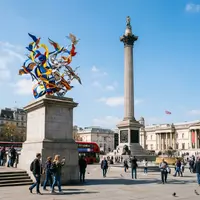
Nelson's body was preserved in a barrel of brandy for the journey home and he was given a state funeral at St Paul's Cathedral in January 1806. The public outpouring of grief was enormous, and the desire for a permanent memorial eventually led to the construction of Nelson's Column in the centre of the square that bore the battle's name.
Why "Trafalgar"?
The name Trafalgar itself comes from the Arabic "Taraf al-Ghar," meaning "cape of the cave" or "cape of the west." Cape Trafalgar is a headland on the Atlantic coast of Spain, near the town of Barbate in the province of Cadiz. The battle was fought in the waters off this cape, and the British named their victory after the geographical landmark, as was customary for naval engagements.
The Square Takes Shape
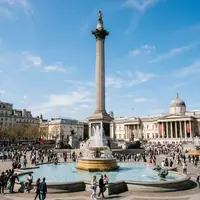
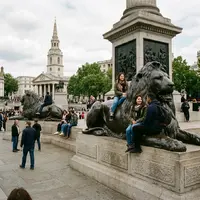
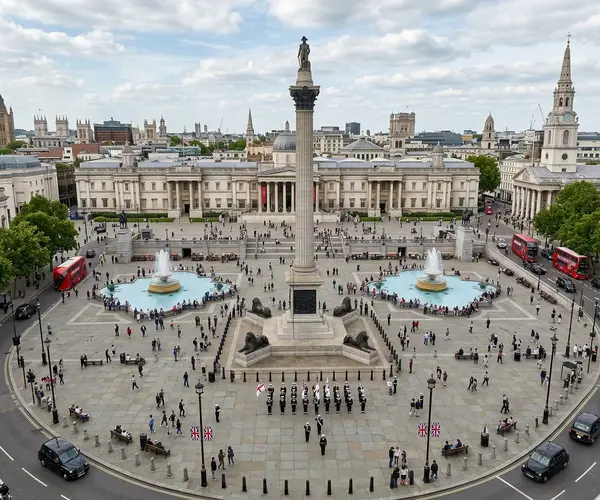
After the name was adopted in 1830, the square was developed over the following decades. Charles Barry designed the layout, including the terraces and fountains. Nelson's Column was completed in 1843, and the Landseer Lions were added in 1867. The National Gallery, which dominates the north side of the square, opened in 1838. By the late 19th century, Trafalgar Square had become the iconic public space it remains today, carrying the memory of a 200-year-old naval battle into the daily life of the capital.