Cutty Sark
The last surviving tea clipper ship, dry-docked in Greenwich — walk the decks and beneath the hull of this 1869 maritime icon

The last surviving tea clipper ship, dry-docked in Greenwich — walk the decks and beneath the hull of this 1869 maritime icon
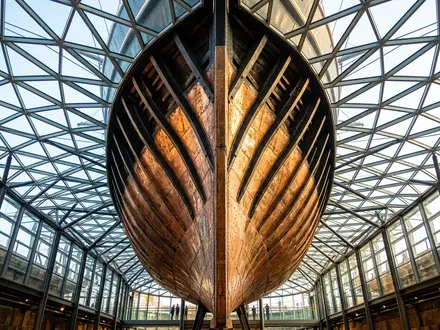
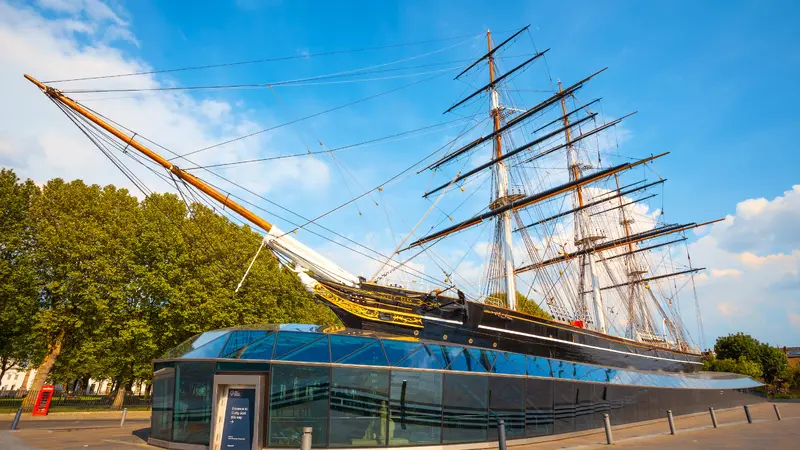
Cutty Sark is the last surviving tea clipper in the world. Launched in 1869 to race tea home from China, she now sits in a Greenwich dry dock, raised on a glass canopy that lets visitors walk beneath her gleaming copper hull.
Restored after a devastating 2007 fire, three decks of cargo holds, crew quarters and the master's saloon chart the story of 19th-century global trade. Looking up at the copper-clad hull from below is one of London's most unexpectedly striking experiences.
Cutty Sark was built in Dumbarton, Scotland, in 1869, designed for one purpose — to be the fastest ship on the China tea run. Her composite construction of iron frames and timber planking, topped by a rig carrying over 32,000 square feet of sail, gave her both strength and speed. She could make 17 knots, extraordinary for a sailing vessel.
The tea trade era was short. By the early 1870s the Suez Canal gave steamships a faster route, and clippers could not compete. Cutty Sark switched to the Australian wool trade, and her 1885 passage from Sydney to London in 73 days remains one of the fastest runs ever recorded. She was retired in 1954 and brought to Greenwich.
The most striking feature of the modern Cutty Sark experience is the glass-walled dry dock that suspends the ship above ground level. Walking beneath the hull, you can look up at the original copper sheathing that protected the timbers from shipworm in tropical waters, and trace the lines of her iron ribs.
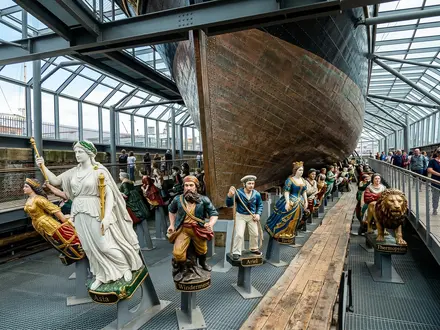
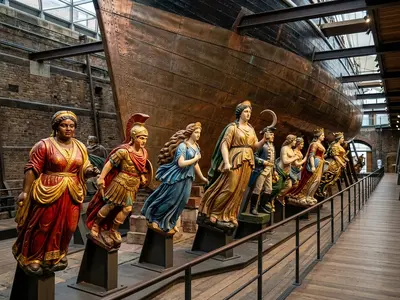
The dry dock also houses the world's largest collection of merchant ship figureheads — over 80 carved figures from the bows of 19th-century vessels, ranging from classical goddesses to turbaned merchants.
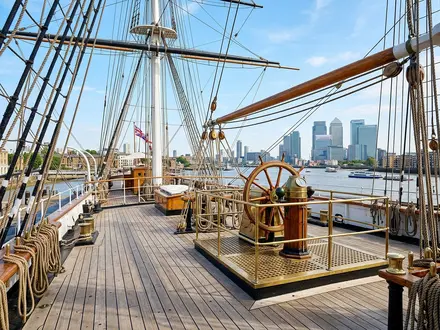
Climbing aboard brings you onto the main deck, where teak planking, brass fittings and miles of hemp rigging have been restored to sailing condition. The ship's wheel and binnacle are original, and the views from the stern across Greenwich to the Thames and Canary Wharf are excellent.
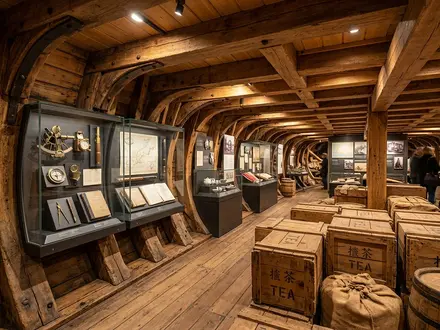
Below deck, the cargo hold and crew quarters house exhibitions on the tea and wool trades. Navigation instruments, cargo samples and crew diaries bring the story to life, and the master's saloon shows the quarters enjoyed by the captain on months-long voyages. Interactive elements for families include ropes to pull, cargo to weigh and a simulator that challenges you to beat the record passage time.
Included with London Pass
Included with London Pass — save up to 50% across 80+ London attractions.
Book online for a small discount — a joint ticket with the Royal Observatory offers better value if you plan to visit both
Many visitors head straight on deck and miss the dry dock space below. Start underneath the hull for the most dramatic first impression and the figurehead collection.
A combined ticket covering Cutty Sark and the Royal Observatory is cheaper than buying separately and covers two of Greenwich's three headline attractions.
Weekends and school holidays draw large family groups. Weekday mornings before 11am offer the quietest conditions and shorter queues at the entrance.
The figureheads beneath the hull are easy to rush past, but they are a unique collection — over 80 carved figures from ships that have long since disappeared.
Cutty Sark pairs naturally with the Old Royal Naval College next door and the Royal Observatory up the hill. All three fit into a comfortable half-day itinerary.

London Travel Writer · 12+ years covering UK attractions and tourism
Last reviewed: March 6, 2026