The Move to Greenwich
The Cutty Sark arrived at Greenwich in 1954, but her journey there was the result of decades of effort to find the ship a permanent and fitting home. After being rediscovered in a Portuguese port in 1922 and brought back to Britain by Captain Wilfred Dowman, the ship had served as a training vessel in Falmouth and later at Greenhithe on the Thames.
By the early 1950s, it was clear that the Cutty Sark needed a permanent berth where she could be properly preserved and opened to the public. The Cutty Sark Preservation Society, formed in 1952 with the Duke of Edinburgh as its patron, campaigned to secure a suitable location.
Greenwich was chosen because no other place in Britain had a stronger connection to the sea.
Greenwich's Maritime Heritage
Greenwich has been at the heart of British maritime history for centuries. The area's connection to the sea runs extraordinarily deep, touching almost every aspect of naval history, navigation and exploration.
The Royal Observatory, founded in 1675, was established at Greenwich specifically to solve the problem of determining longitude at sea. The Prime Meridian passes through the observatory grounds, and the entire system of global timekeeping is based on Greenwich Mean Time. These contributions to navigation directly shaped the history of ocean voyaging.
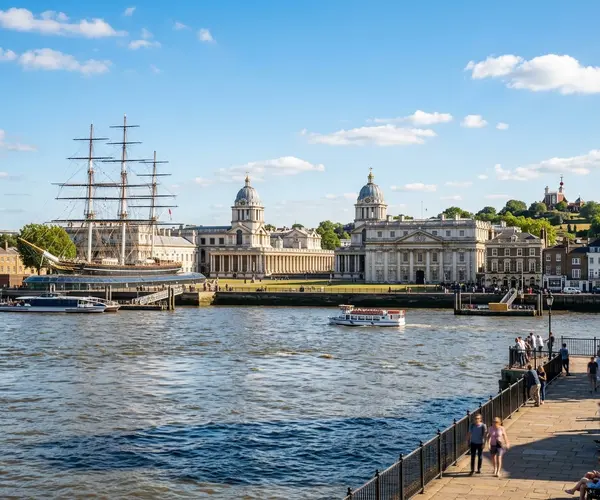
The Old Royal Naval College, designed by Sir Christopher Wren, stands on the waterfront as one of the finest examples of Baroque architecture in Britain. Originally built as a hospital for retired sailors, it later served as a training establishment for the Royal Navy.
The National Maritime Museum, the world's largest museum dedicated to maritime history, sits in Greenwich Park. Together, these institutions form the Maritime Greenwich UNESCO World Heritage Site, designated in 1997 in recognition of the area's outstanding contribution to naval and maritime history.
Why the Cutty Sark Belongs Here
Placing the Cutty Sark in Greenwich was not simply a matter of convenience. It was a decision that made historical and cultural sense. The ship represents the peak of commercial clipper ship design, and Greenwich represents the peak of British maritime achievement. The two belong together.
The Cutty Sark's dry dock sits at the foot of Greenwich town centre, directly beside the Thames and within sight of the Old Royal Naval College. Visitors can walk from the ship to the National Maritime Museum, the Royal Observatory and the Painted Hall in a single visit, experiencing centuries of maritime history in one location.
The Dry Dock
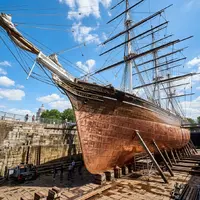
A purpose-built dry dock was constructed for the Cutty Sark beside the river. This allowed the ship to be displayed out of the water, preventing the deterioration that would occur if she remained afloat. The dock was designed to give visitors access to the exterior of the hull as well as the interior of the ship.
After the 2007 fire and subsequent restoration, the display was enhanced by raising the ship three metres above the dock floor and enclosing the space beneath in glass. This created a dramatic exhibition area where visitors can walk beneath the hull and see the copper sheathing and construction details up close.
A Living Landmark
Today, the Cutty Sark is one of the most visited landmarks in Greenwich and serves as a gateway to the wider maritime heritage of the area. Her position at the heart of the UNESCO World Heritage Site means she is seen by millions of visitors each year, many of whom go on to explore the surrounding museums and historic buildings.
The decision to bring the ship to Greenwich in 1954 has been thoroughly vindicated. In this setting, the Cutty Sark is not an isolated exhibit but part of a larger story about Britain's relationship with the sea.