Sir John Soane's Museum
An architect's obsessive collection crammed into a Georgian townhouse — hidden panels, a pharaoh's sarcophagus and Hogarth originals
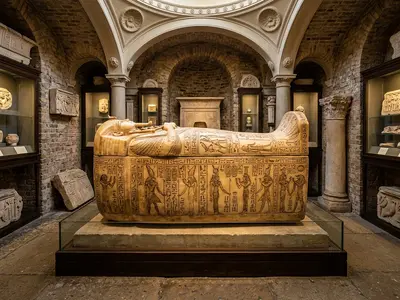
An architect's obsessive collection crammed into a Georgian townhouse — hidden panels, a pharaoh's sarcophagus and Hogarth originals
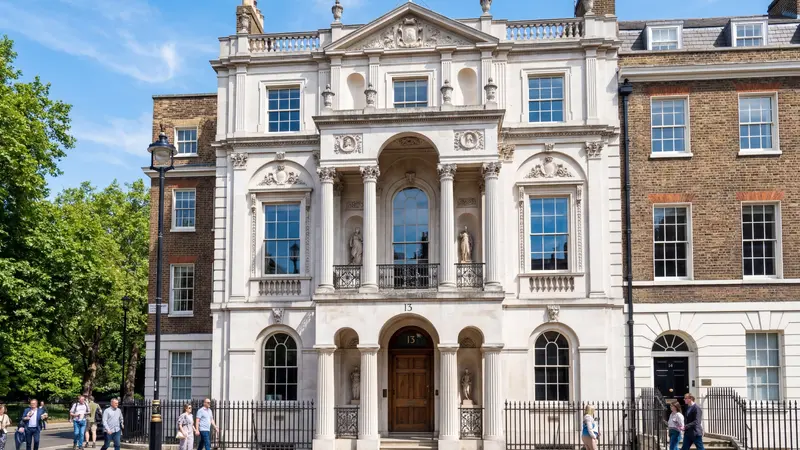
Behind an unassuming Georgian facade on Lincoln's Inn Fields lies one of London's most extraordinary interiors. Sir John Soane spent 40 years filling three interconnected townhouses with over 30,000 antiquities, sculptures and paintings — arranging them so densely that every surface, ceiling and corridor became part of the display.
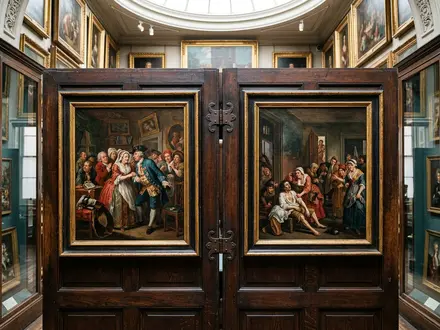
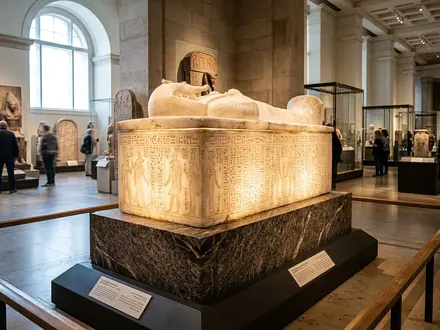
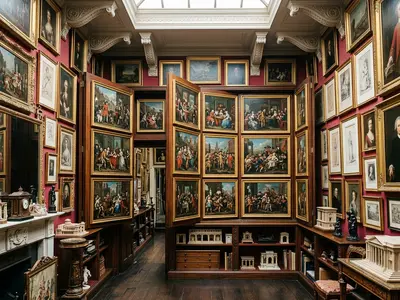
Visitors navigate a labyrinth of mirrors, skylights and hidden picture panels that Soane designed to manipulate light and space. The collection ranges from a 3,000-year-old Egyptian sarcophagus in a basement crypt to Hogarth's complete A Rake's Progress, revealed on ingenious folding walls.
Sir John Soane (1753–1837) was the son of a bricklayer who rose to become one of Britain's most influential architects. His career spanned over fifty years, during which he designed the Bank of England, Dulwich Picture Gallery and numerous country houses. He purchased 13 Lincoln's Inn Fields in 1792 and over the next three decades acquired the two neighbouring properties, gradually transforming all three into a single extraordinary residence and museum.
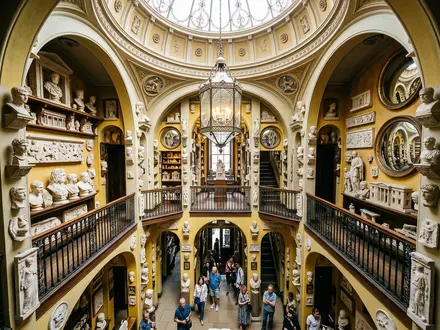
Soane was not simply a collector — he was an architect who used his home as a laboratory for spatial ideas. Every room demonstrates his preoccupation with light, mirrors and layered perspectives. Skylights channel daylight deep into the building, convex mirrors create unexpected views around corners, and coloured glass casts shifting tones across classical casts and architectural models. The result is a house that feels simultaneously intimate and impossible, far larger inside than its Georgian facade suggests.
The ground-floor Picture Room is the museum's most celebrated space. Soane designed hinged panels that open in sequence to reveal Hogarth's A Rake's Progress (1733) and An Election Entertainment (1754), alongside works by Canaletto, Turner and Piranesi. The mechanism triples the hanging space available on the walls and still operates for visitors during guided demonstrations.
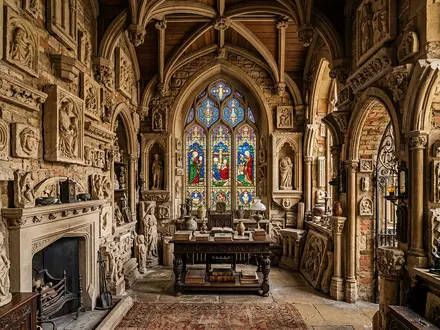
Below ground, the Sepulchral Chamber houses the museum's greatest treasure — the alabaster Sarcophagus of Seti I, dating from around 1290 BC. Discovered in the Valley of the Kings in 1817, it was offered first to the British Museum, who declined the asking price. Soane acquired it for two thousand pounds and celebrated with a three-day lamp-lit party attended by nearly 900 guests. Adjacent to the crypt, the Monk's Parlour is a fictional medieval ruin that Soane created as an architectural joke, complete with carved fragments and the grave of his dog Fanny.
Upstairs, the recently restored Drawing Office is the oldest surviving example of an architect's studio and is open to visitors for the first time in its 200-year history. The Model Room displays cork and plaster models of classical ruins, including a detailed replica of Pompeii as it appeared after partial excavation in 1820.
The museum is small and corridors are narrow, so visitor numbers are naturally limited. Arriving early on a weekday gives the best chance of exploring without crowds. Highlights Tours run daily at midday with additional slots on Fridays, Saturdays and Sundays — book in advance as places are limited to 15 per tour.
Lincoln's Inn Fields itself is London's largest public square and a pleasant spot for a break before or after your visit. The Hunterian Museum at the Royal College of Surgeons reopened on the south side of the square in 2023. The British Museum is a 10-minute walk north via Great Russell Street, and Covent Garden's shops and restaurants are 15 minutes south-east on foot. The museum shop sells architectural prints, books on Soane and reproduction items from the collection.
Entry is free — no ticket or booking required for general visits, just walk in during opening hours
The museum is small with narrow corridors, so it feels crowded quickly. Arriving at opening on a Wednesday or Thursday gives the most comfortable experience.
Staff open the hinged panels in the Picture Room at set times during the day. Ask at the desk when the next demonstration is scheduled so you do not miss the Hogarth reveal.
The guided tour covers rooms and details you might otherwise walk past. Tours run daily at midday with 15 places — book online in advance to secure a spot.
The Hunterian Museum is directly across Lincoln's Inn Fields and also free. Together they make an excellent free morning of two of London's most unusual museums.
Soane's architectural ingenuity is often overhead. Domed skylights, convex mirrors and coloured glass panels create effects that are easy to miss if you only look at eye level.

London Travel Writer · 12+ years covering UK attractions and tourism
Last reviewed: June 2, 2026