Royal Academy of Arts
Britain's oldest art institution — founded in 1768, still championing contemporary and historic works from its Piccadilly home


Britain's oldest art institution — founded in 1768, still championing contemporary and historic works from its Piccadilly home
The Royal Academy of Arts has held an exhibition every single summer since 1769 — the longest-running open submission show in the world. Founded by 36 artists and architects with the backing of George III, it was the first institution in Britain dedicated to promoting the fine arts, and it has occupied Burlington House on Piccadilly since 1868.
Today the RA spans two interconnected buildings linked by a David Chipperfield-designed bridge. Free galleries display treasures including a Michelangelo marble tondo, while ticketed blockbuster exhibitions fill the main galleries upstairs.
King George III granted the Royal Academy its founding charter on 10 December 1768, making it the first institution in Britain established specifically to promote the fine arts through education and exhibition. Sir Joshua Reynolds, the leading portrait painter of his age, became the first president and delivered a series of fifteen Discourses on Art that shaped British artistic thought for generations. Among the 36 founding members were two women — Angelica Kauffmann and Mary Moser — though the Academy would not elect another female member for nearly 170 years.
The RA moved through several London addresses before settling at Burlington House in 1868. The Palladian mansion on Piccadilly, originally built for the Earl of Burlington in the 1660s and remodelled by Colen Campbell in the 1720s, gave the Academy a permanent home at the heart of the West End. In 2018, architect David Chipperfield completed a major renovation that linked Burlington House to the neighbouring Burlington Gardens building for the first time, adding 70 per cent more gallery and learning space.
The free Collection Gallery is the place to start. Its centrepiece is the Taddei Tondo, an unfinished marble relief by Michelangelo dating from around 1504–1505 and the only marble by the artist in the United Kingdom. Alongside it hang diploma works — pieces given by each new Royal Academician on election — spanning Constable's landscapes, Reynolds's portraits and Hockney's vibrant canvases. The John Madejski Fine Rooms, with their gilded ceilings and silk-lined walls, display these works in the setting of a grand Mayfair townhouse.
Ticketed exhibitions fill the main galleries and typically include two or three major shows running simultaneously. Past blockbusters have covered Monet, Anish Kapoor, Ai Weiwei and the annual Summer Exhibition — the world's longest-running open-submission art show. The Gabrielle Jungels-Winkler Galleries in Burlington Gardens host architecture and contemporary art, offering a different tempo from the classical main building.
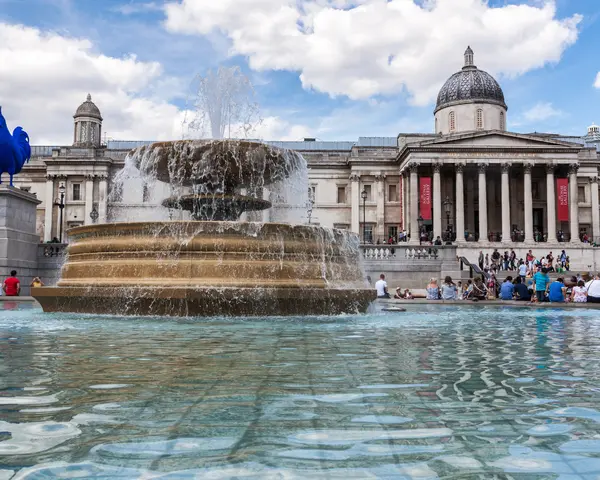
Burlington House sits at the junction of Piccadilly and Bond Street, surrounded by some of London's finest galleries and cultural landmarks. The National Gallery and National Portrait Gallery are a ten-minute walk east along Piccadilly to Trafalgar Square. Bond Street's commercial galleries stretch north, and Green Park — one of the Royal Parks — lies directly to the south, providing a quiet green space within two minutes' walk.
The RA Shop in the courtyard stocks exhibition catalogues, prints and artist-designed gifts. Dining options include the RA Cafe in the Burlington Gardens wing and the more formal Poster Bar in the vaulted basement. Friday evenings are worth planning for: the galleries stay open until 9pm, the atmosphere is relaxed, and the courtyard often hosts live events.
Under-16s enter all exhibitions free when accompanied by a paying adult — Friends of the RA receive unlimited free exhibition entry
The Collection Gallery and John Madejski Fine Rooms are free and uncrowded. Start here to see the Michelangelo tondo and diploma works before the ticketed shows.
The RA stays open until 9pm on Fridays. Crowds thin out after 6pm, giving you quieter access to exhibitions and a relaxed atmosphere in the courtyard.
Visitors aged 16 to 25 pay half price for all ticketed exhibitions. Under-16s enter free with a paying adult. Bring valid ID to the ticket desk.
Most visitors enter from Piccadilly. The quieter Burlington Gardens entrance on the north side avoids queues and is closer to Bond Street and Oxford Circus stations.
Cork Street and the surrounding Mayfair streets are packed with commercial art galleries showing free exhibitions. Walk north from the RA for a full afternoon of art.

London Travel Writer · 12+ years covering UK attractions and tourism
Last reviewed: June 2, 2026