London Museum
London's story told through seven million objects — from Roman ruins to the digital age, housed in Smithfield's Victorian market vaults
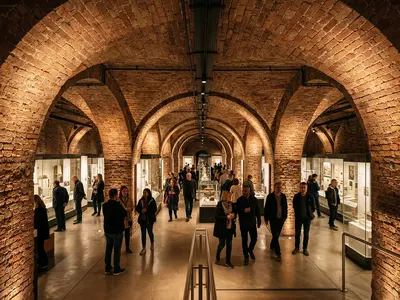
London's story told through seven million objects — from Roman ruins to the digital age, housed in Smithfield's Victorian market vaults
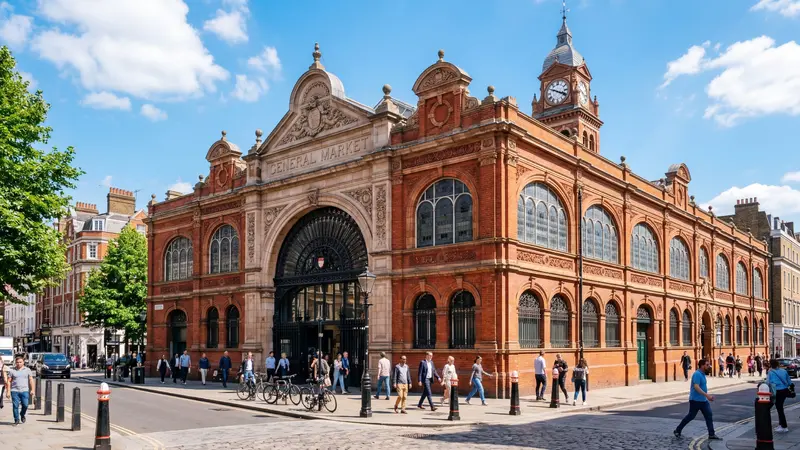
Buried beneath one of London's oldest market sites, the London Museum opened in 2026 inside the Victorian General Market at Smithfield — a building whose own brick vaults sat sealed and forgotten for decades. The collection spans seven million objects covering 10,000 years of the capital's history, from Roman burial goods to protest placards from the 2010s.
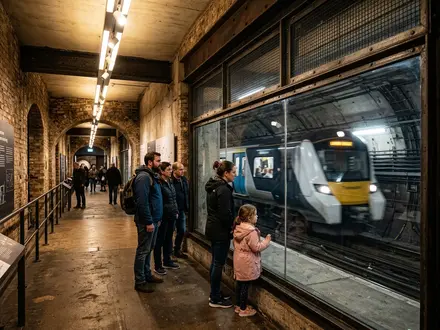
Visitors descend from the restored market hall into atmospheric underground galleries where a live Great Northern Railway line runs alongside the displays. A window cut into the old salt store lets you watch Thameslink trains pass through Farringdon, connecting the museum's deep past with London's present in a way no other institution manages.
Smithfield has been a marketplace since the twelfth century, trading livestock, cloth and eventually meat across a site that also served as an execution ground, jousting arena and the home of Bartholomew Fair. The Victorian General Market building, designed by Sir Horace Jones (who also designed Tower Bridge), opened in 1883 as part of the vast Smithfield Meat Market complex. When the market operations consolidated, the General Market fell into disuse and the building's lower levels were sealed off entirely.
The idea of moving the Museum of London from its Barbican roundabout home to Smithfield emerged in the mid-2010s. A decade of planning, fundraising and construction followed, with architects Stanton Williams, Asif Khan and Julian Harrap Architects transforming the market buildings while preserving 10,000 square metres of cleaned Victorian brickwork. The museum closed its London Wall premises in 2022 and reopened here in 2026, renamed simply as the London Museum to mark the new chapter.
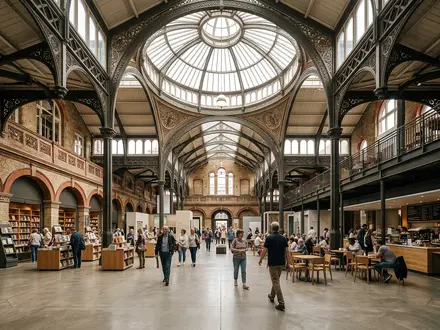
The ground floor — called Our Time — retains the open, social character of a marketplace. Beneath the restored domed ceiling, displays on contemporary London sit alongside a restaurant, bookshop and an events space that hosts everything from talks and debates to festivals and performances. It is designed to feel more like a public square than a traditional museum gallery.
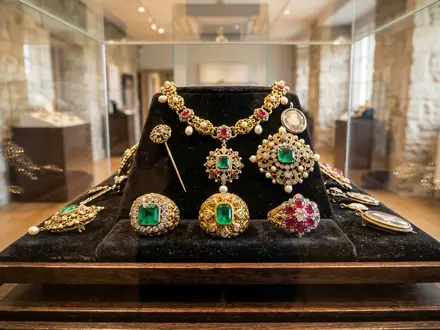
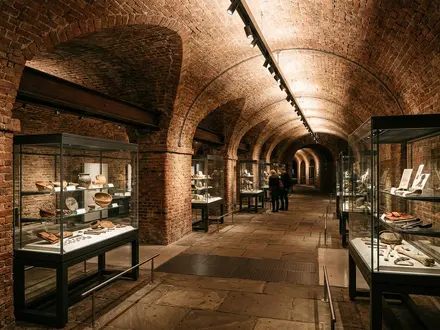
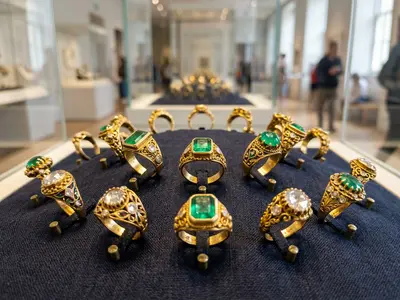
The real depth lies below. Descending into Past Time, visitors enter a subterranean world of exposed brick vaults and atmospheric chambers where 10,000 years of London history unfold through object-rich, theatrical and interactive displays. The Cheapside Hoard — over 500 pieces of Elizabethan and Jacobean jewellery discovered beneath a Cheapside cellar in 1912 — occupies the dedicated Goldsmiths' Gallery. Nearby, the rediscovered Victorian vaults house an immersive archaeological experience blending physical artefacts with multi-sensory storytelling. Throughout, a live railway line runs alongside the galleries, its passing trains an ever-present heartbeat of the city above.
The museum sits at a crossroads of central London neighbourhoods. Clerkenwell's restaurants and cafes line St John Street to the north, while the Barbican Centre — with its cinemas, concert halls and art galleries — is a ten-minute walk east. St Paul's Cathedral is fifteen minutes south on foot, and Hatton Garden, London's jewellery quarter, runs parallel one block to the west. The Charterhouse, a medieval monastery turned almshouse, stands directly across the square and offers guided tours.
Farringdon is the nearest station, with the Elizabeth line providing fast connections to Heathrow, Paddington, Liverpool Street and Canary Wharf. The museum is designed to open early and close late, reflecting London's character as a city that rarely sleeps. Thursday and Friday late openings make an evening visit possible after work, and the ground-floor restaurant and bookshop are accessible without entering the galleries.
Entry to the permanent galleries and ground-floor displays is free. Some temporary exhibitions in the Poultry Market building may carry a charge when it opens in 2028
The ground floor is impressive but the real treasures are below. Head straight down to the vaults and work your way back up — you will avoid the crowds who linger at ground level first.
Late openings until 9pm mean fewer visitors and a different atmosphere in the underground galleries. The ground-floor restaurant stays open too, making it easy to combine culture with dinner.
The old salt store window where you can watch live trains is easy to miss. Ask a member of staff for directions — it is one of the most unusual features in any London museum.
The Goldsmiths' Gallery deserves at least 30 minutes. The emerald watchcase and Tudor diamond rings are extraordinary up close and the display lighting rewards slow, careful looking.
The medieval Charterhouse sits directly across West Smithfield square. Guided tours run several times daily and the two sites together give you 900 years of London history in one morning.

London Travel Writer · 12+ years covering UK attractions and tourism
Last reviewed: June 2, 2026