The King's Gallery, Buckingham Palace
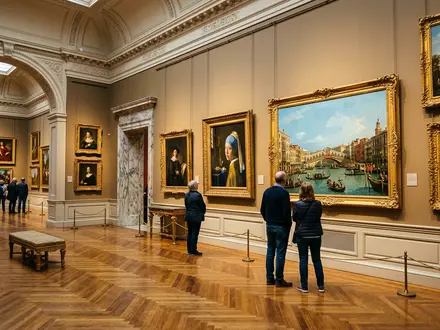
The Royal Collection's public gallery at Buckingham Palace — masterworks from Vermeer to Canaletto in rotating exhibitions

The Royal Collection's public gallery at Buckingham Palace — masterworks from Vermeer to Canaletto in rotating exhibitions
When a Luftwaffe bomb destroyed Buckingham Palace's Private Chapel in September 1940, nobody imagined the rubble would one day house Vermeer, Rembrandt and Leonardo da Vinci. Yet in 1962, at the suggestion of Prince Philip, the ruined chapel was rebuilt as a public gallery to display treasures from the Royal Collection — one of the largest and finest art collections in the world, assembled by British monarchs over five centuries.
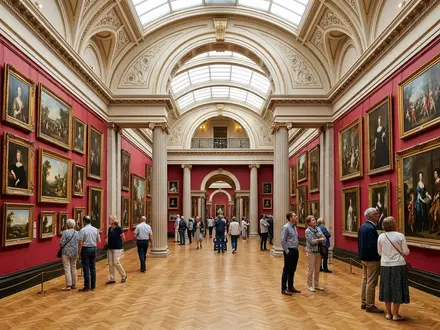
The gallery closed in 1999 after welcoming five million visitors and reopened in 2002 with three-and-a-half times more exhibition space, marking the most significant addition to Buckingham Palace in 150 years. Originally named The Queen's Gallery, it was renamed The King's Gallery in 2024 following the accession of King Charles III. Today it stages a changing programme of exhibitions drawn from over a million objects including paintings, drawings, furniture, jewellery and photographs.
The story of The King's Gallery begins with destruction. On 13 September 1940, during the height of the Blitz, a Luftwaffe bomb fell in the quadrangle of Buckingham Palace and destroyed the Private Chapel. The ruins stood untouched for over two decades until Prince Philip, Duke of Edinburgh, proposed converting the site into a public gallery for the Royal Collection. The gallery opened in 1962 and quickly became one of London's most visited cultural spaces, welcoming five million visitors over the next 37 years.
By the late 1990s the gallery had outgrown its original design. In 1997, architect John Simpson won a competition to expand and modernise the space as a Golden Jubilee project. The £20 million renovation was the most significant building work at Buckingham Palace in 150 years. When Queen Elizabeth II reopened the gallery on 21 May 2002, it boasted three-and-a-half times more exhibition space, a new Doric entrance portico on Buckingham Palace Road, and purpose-built climate-controlled galleries. The gallery was renamed from The Queen's Gallery to The King's Gallery in 2024, following the coronation of King Charles III.
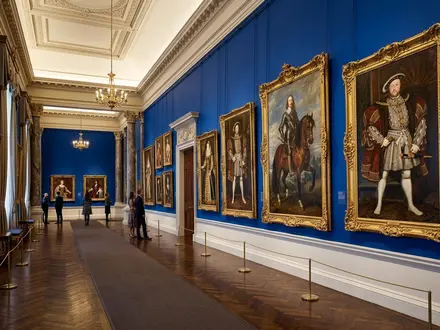
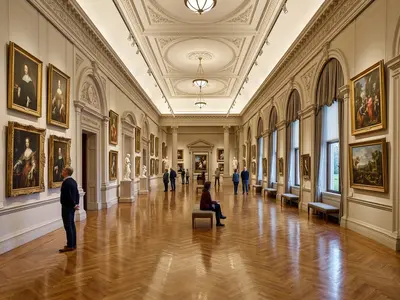
The works displayed at The King's Gallery are drawn from the Royal Collection, one of the largest and most important art collections in the world. Assembled by monarchs over five centuries, it comprises over a million objects: 7,000 paintings, 500,000 prints and drawings, 30,000 watercolours, photographs, tapestries, furniture, ceramics, clocks, arms and armour, and the Crown Jewels. The collection includes masterpieces by Vermeer, Rembrandt, Rubens, Canaletto, Holbein and Leonardo da Vinci, as well as one of the finest collections of Faberge outside Russia.
Because the Royal Collection is held in trust for the nation rather than owned personally by the sovereign, the gallery plays a vital role in making these treasures publicly accessible. Exhibitions change regularly, each one curated around a theme and typically running for several months. Past exhibitions have ranged from Renaissance masterpieces to royal photography, from Indian art to jewellery and silverware.
The King's Gallery has its own entrance on Buckingham Palace Road, separate from the main palace entrance. The nearest Tube station is Victoria, a six-minute walk away — exit via the Buckingham Palace Road exit and turn left. Green Park and St James's Park stations are each around 12 minutes on foot. Bus routes 11, 211, C1 and C10 stop nearby.
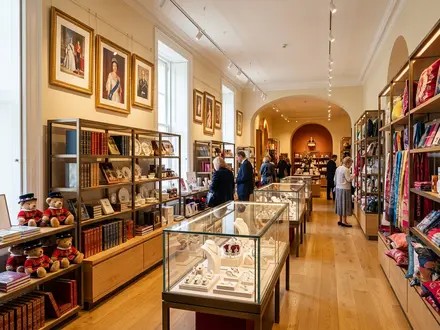
Advance booking online is recommended and saves up to £4 per adult ticket. Tickets are donation-based, which means if you choose to pay the Gift Aid price you receive free unlimited return visits for a year — excellent value if you plan to see more than one exhibition. A multimedia guide is included with every ticket and is available in several languages. Allow around 90 minutes to two hours for a comfortable visit, including time to browse the Royal Collection Shop, which stocks exclusive exhibition merchandise and gifts.
Advance booking online is recommended and saves up to £4 per adult ticket. A free access companion ticket is available for disabled visitors. Tickets are donation-based — Gift Aid pricing gives a year of unlimited return visits.
Advance tickets are up to £4 cheaper than on-the-day prices. Book on the Royal Collection Trust website before you visit and skip the queue.
If you pay the slightly higher Gift Aid price, your ticket becomes a year-long pass for unlimited return visits to see future exhibitions.
A multimedia guide is included free with every ticket and is available in several languages. It adds real depth to the exhibition and is well worth using throughout your visit.
During summer (late July to September), Buckingham Palace State Rooms open to the public. A combined ticket covers both the State Rooms and the gallery at a reduced rate.
The gallery is busiest at weekends and during school holidays. Arriving when the doors open at 10am on a weekday gives you the quietest experience.

London Travel Writer · 12+ years covering UK attractions and tourism
Last reviewed: March 10, 2026