Why the Rosetta Stone Matters
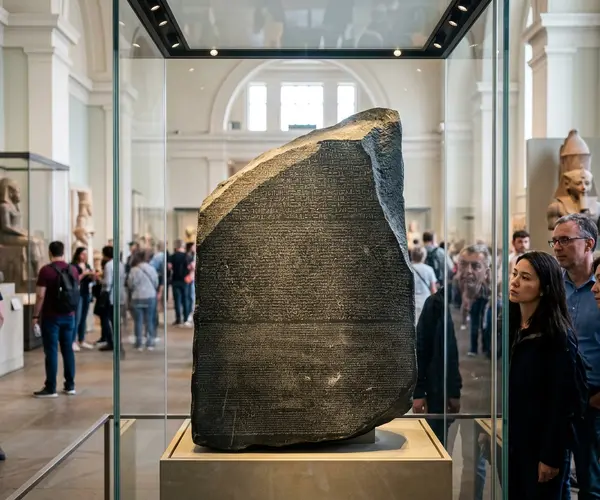
The Rosetta Stone is arguably the single most important object in the British Museum and one of the most famous artefacts in the world. Its significance lies not in its content, which is a fairly routine priestly decree, but in the fact that the same text appears in three different scripts. The top section is written in hieroglyphics, the middle in Demotic script and the bottom in Ancient Greek.
Because scholars could already read Ancient Greek, the stone provided a way to work backwards and crack the code of Egyptian hieroglyphics, a writing system that had been unreadable for over a thousand years. The breakthrough came in 1822 when the French scholar Jean-Francois Champollion used the stone to demonstrate that hieroglyphics were not purely symbolic but included phonetic elements representing sounds.
The History of the Stone
The decree on the stone was issued in 196 BC during the reign of Ptolemy V. It was written by a council of priests affirming the royal cult of the young pharaoh. The stone itself is a fragment of a larger slab, and the hieroglyphic section at the top is the most damaged, with only the last 14 lines surviving.
The stone was discovered in July 1799 by French soldiers who were strengthening the defences of Fort Julien near the Egyptian port town of Rashid, known in French as Rosette. Napoleon's expedition to Egypt included a team of scholars, and they immediately recognised the stone's potential importance.
How It Came to Britain
After the French defeat in Egypt, the stone was handed over to British forces under the terms of the Treaty of Alexandria in 1801. It arrived in Britain in 1802 and was placed in the British Museum, where it has remained ever since. It is one of the most visited objects in the museum.
Where to Find It
The Rosetta Stone is displayed in Room 4 on the ground floor, in the Egyptian Sculpture gallery. It sits in a specially designed case at the centre of the room. The gallery is usually busy, particularly during school holidays and weekends, so visiting early in the morning or late in the afternoon can make it easier to get a close look.
The stone is smaller than many visitors expect. It stands about 114 cm tall, 72 cm wide and 28 cm thick. The dark grey surface is covered in dense, neatly carved text that is still clearly legible after more than two thousand years.
The Race to Decipher Hieroglyphics
The stone sparked an intense academic rivalry between Thomas Young in England and Jean-Francois Champollion in France. Young made early progress, correctly identifying that some hieroglyphs in oval frames called cartouches spelled out royal names phonetically. But it was Champollion who made the full breakthrough, publishing his findings in 1822 and opening up the entire field of Egyptology.
Without the Rosetta Stone, our understanding of ancient Egyptian civilisation would be dramatically different. Temples, tombs and papyrus scrolls that had been silent for centuries suddenly became readable, transforming what had been mystery and speculation into detailed historical knowledge. The Rosetta Stone is just one of many remarkable objects worth seeking out; for a broader look at what else deserves your time, see our guide to the best exhibits at the British Museum.