Built from Fire
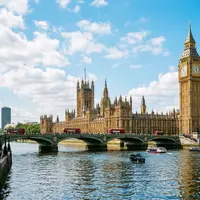
The story of Big Ben begins not with the bell itself but with a catastrophic fire. In 1834, the old Palace of Westminster burned down in a blaze visible across London. Only Westminster Hall and a few other fragments survived. Parliament needed a new home, and the rebuilding project that followed would take decades and produce one of the most recognisable buildings in the world.
The architect Charles Barry won the competition to design the new Palace of Westminster in 1836. His design called for a clock tower at the northern end, and he enlisted Augustus Pugin to handle the decorative details. Pugin, who was responsible for much of the Gothic Revival character of the palace, designed the tower's exterior in a style that blended medieval inspiration with Victorian ambition.
The Tower Takes Shape
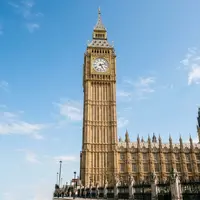
Construction of the tower began in 1845 and continued for over a decade. The structure was built from Anston limestone quarried in Yorkshire, with a brick interior and cast-iron spire. The clock mechanism was designed by Edmund Beckett Denison and installed in 1858, though disputes between Denison and the clockmaker Edward Dent delayed completion significantly.
The tower reached its full height of 96 metres by 1858. The following year, on 31 May 1859, the Great Clock started keeping time. The Great Bell, cast at the Whitechapel Bell Foundry, was hauled up the tower shaft and first sounded on 11 July 1859.
A Cracked Bell
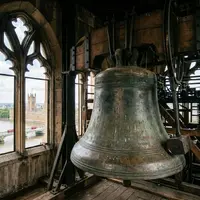
Within two months of its first use, the Great Bell cracked. A heavy strike hammer was blamed for the damage, and the bell fell silent. Rather than recasting the bell entirely, engineers rotated it by a quarter turn so the hammer would strike an undamaged section, and a lighter hammer was fitted. The bell returned to service, but the crack was never repaired. It remains there today and gives Big Ben its distinctive, slightly imperfect tone that distinguishes it from other large bells.
Surviving the Blitz
During the Second World War, the Palace of Westminster suffered significant bomb damage. On 10 May 1941, the House of Commons chamber was destroyed in an air raid. The Elizabeth Tower was struck by bombs and incendiary devices during the Blitz, and the clock dials were damaged. The south dial clock face was hit, and the glass was blown out.
Despite this, the tower's structure held firm and the clock continued to operate throughout the war. The sound of Big Ben striking was broadcast by the BBC during wartime, and its continued operation became a symbol of London's resilience. The bongs were transmitted live across occupied Europe as proof that London still stood.
The 2017 to 2022 Restoration
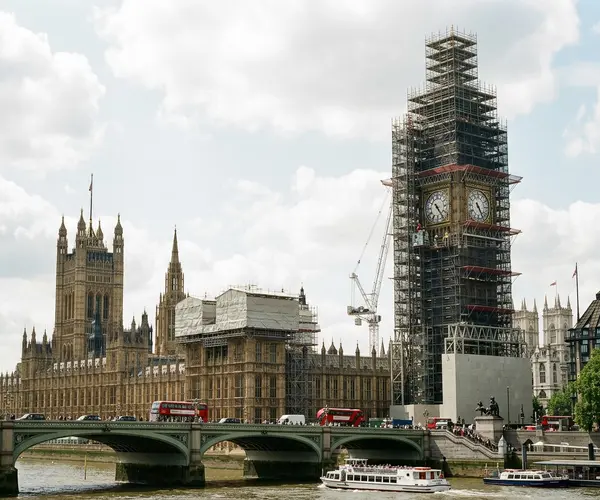
By the 21st century, the Elizabeth Tower was showing its age. The stonework was crumbling, the iron roof was corroding, and the clock mechanism needed attention. In 2017, Parliament authorised a comprehensive restoration programme.
The work involved removing decades of grime from the stonework, repairing structural damage, replacing worn components in the clock, and repainting the clock dials in their original Victorian blue and gold colour scheme. Research during the restoration revealed that the dials had originally been Prussian blue, not the black they had appeared for much of the 20th century.
Big Ben was largely silenced during the restoration, with the bell only ringing for significant occasions such as New Year's Eve and Remembrance Sunday. The scaffolding came down in 2022, revealing a tower that looked brighter and sharper than it had in generations, its full 96-metre height gleaming once again above Westminster.