The Exhibit
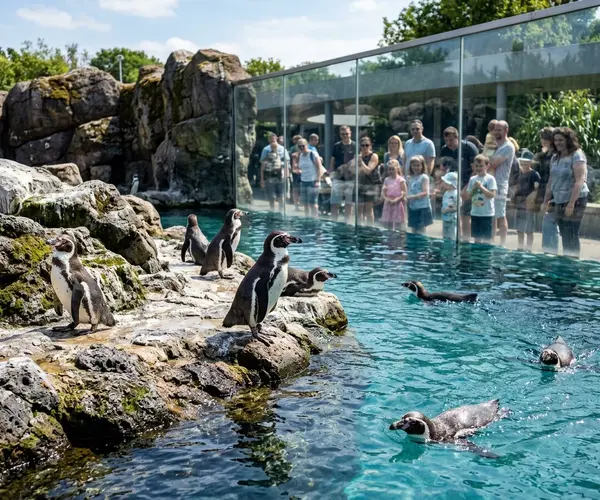
Penguin Beach is one of the most popular exhibits at London Zoo and the first thing many visitors head for. The exhibit occupies a large area near the zoo's main entrance and features a pool of over 1,200 square metres, a sandy beach area and a purpose-built rock landscape designed to mimic the Humboldt penguin's native South American coastal habitat.
The colony consists of several dozen Humboldt penguins, each individually identifiable by their unique spot patterns and coloured wing bands. The birds are active swimmers, and watching them transition from their slightly awkward waddling on land to fluid, rapid movement underwater is one of the exhibit's main draws.
Underwater viewing windows along one side of the pool let you watch the penguins swim at close range. Seeing them underwater is a completely different experience from watching them on the beach. They are fast, agile and surprisingly graceful, darting and turning with a precision that is hard to appreciate from the surface.
Feeding Times
The daily penguin feeds are among the most attended events at the zoo. Keepers hand-feed individual birds with fish, calling them by name and checking on their condition in the process. The feeds serve both as entertainment for visitors and as a husbandry tool, allowing keepers to monitor each bird's appetite, weight and behaviour. Timing your visit to catch these sessions is one of the reasons choosing the right time to visit London Zoo makes such a difference.
During feeding, the keepers give informal talks about Humboldt penguin biology, their conservation status in the wild and the zoo's breeding programme. The sessions typically last around 15 minutes and are included with general admission. They can get crowded, so arriving five to ten minutes early secures a better viewing position along the poolside.
From Lubetkin to Penguin Beach
The story of penguins at London Zoo is closely tied to architecture. In 1934, the zoo opened a penguin pool designed by the architect Berthold Lubetkin and the engineering firm Ove Arup. It was a striking piece of Modernist design, featuring interlocking concrete ramps over a small oval pool. The pool became one of the most famous zoo structures in the world and is now a Grade I listed building.
However, by modern standards the Lubetkin pool was far too small and offered the penguins little environmental enrichment. Animal welfare concerns grew through the 1990s and 2000s. In 2004 the penguins were moved out, and the old pool was left empty as a preserved architectural landmark within the zoo grounds. You can still see it today, standing empty near the centre of the site.
Penguin Beach opened in 2011 as the replacement, offering the birds roughly fifty times more space than the old pool. The design prioritised the birds' welfare over architectural statement, with deep water for swimming, dry beach areas for resting and nesting boxes for breeding.
Humboldt Penguins
Humboldt penguins are native to the coastal regions of Peru and Chile, where they nest in rocky crevices and burrows along the shoreline. They are a medium-sized penguin species, standing around 65 centimetres tall, and are adapted to a temperate rather than polar climate. This makes them well suited to the British weather, and the colony at London Zoo lives outdoors year-round without needing heated indoor facilities.
In the wild, Humboldt penguins are classified as vulnerable. Their populations have declined due to overfishing of their prey species, habitat destruction and the effects of climate events like El Nino on ocean currents and fish stocks. London Zoo is part of an international breeding programme for the species, and chicks born at the zoo contribute to the managed population across European zoos.
Visiting Tips
Penguin Beach is at its liveliest during and immediately after feeding times, when the birds are most active and vocal. Outside feeding times, you will still see penguins swimming, preening and socialising on the beach, but the energy level is lower.
The underwater viewing windows are the highlight for many visitors. They are set low enough for children to use easily and provide the closest views of the penguins in action. On quiet days you can spend as long as you like at the windows without feeling rushed.