The Honest Answer
The short answer to why Stonehenge was built is that we do not know. The people who constructed it lived in a pre-literate society and left no written explanation. Every theory about its purpose is based on archaeological evidence, astronomical observation and informed speculation. It is also entirely possible that the monument served different purposes at different stages of its long history.
An Astronomical Observatory
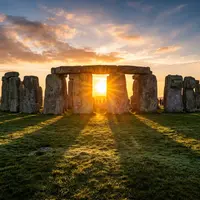
The most widely discussed theory is that Stonehenge functioned as an astronomical observatory or calendar. The monument is aligned so that on the summer solstice, the sun rises over the Heel Stone and its light shines directly into the heart of the monument. On the winter solstice, the sun sets in alignment with the central axis when viewed from the opposite direction.
This alignment is clearly deliberate and demonstrates that the builders had a sophisticated understanding of the sun's movements. You can witness this alignment yourself during the summer solstice at Stonehenge, when the site opens for free public access. Whether Stonehenge was used to track other astronomical events, such as lunar cycles or eclipses, is more speculative. Some researchers have proposed that the stone circle could have been used to predict eclipses, but this remains controversial.
A Recent Calendar Theory
In 2022, a study proposed that the 30 sarsen stones in the main circle could have functioned as a solar calendar, with each stone representing a day in a 30-day month. The 12-month year of 360 days would have been corrected by five intercalary days, similar to calendars used in ancient Egypt. This theory attracted significant attention but also considerable scepticism from other researchers.
A Place of the Dead
Archaeological evidence strongly links Stonehenge to death and burial. Around 150 to 240 cremation burials have been identified within and around the monument, making it the largest known cremation cemetery of its period in Britain. Many of the earliest burials were placed in the Aubrey Holes, the ring of 56 pits just inside the bank.
Analysis of the cremated remains suggests that both men and women were buried at the site, and some of the individuals had spent their early lives in western Britain or Wales. This has led to the suggestion that Stonehenge was a place of special significance for the dead, perhaps a monument to ancestors or a domain of the spirits.
A Healing Site
Geoffrey of Monmouth, writing in the 12th century, recorded a legend that the stones had healing properties. While his account is mythological, some modern researchers have taken the idea seriously. The bluestones, brought from Wales at enormous effort, have been proposed as the key to this theory, since the effort of transporting them suggests they were considered special in some way.
Excavations at nearby Durrington Walls have found evidence of people who had travelled long distances and suffered from illness or injury, which some archaeologists interpret as evidence of pilgrimage to a healing site.
A Ceremonial Gathering Place
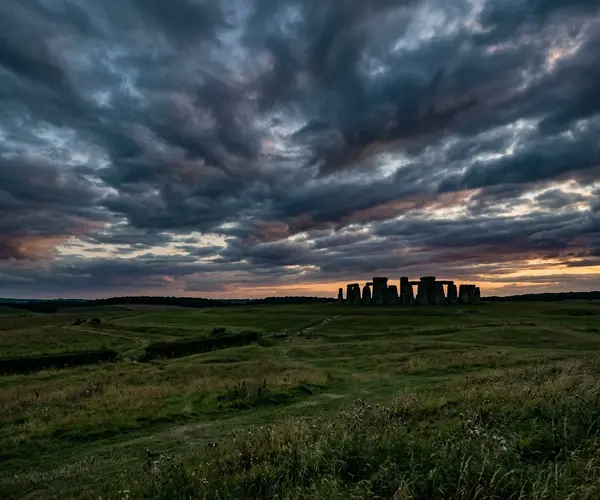
The landscape around Stonehenge is rich with other Neolithic and Bronze Age monuments, including Durrington Walls, the Cursus, Woodhenge and numerous burial mounds. This suggests that Stonehenge was part of a larger ceremonial landscape rather than an isolated monument.
The Avenue, a processional route connecting Stonehenge to the River Avon, may have been used for ritual processions. The theory that Stonehenge was a gathering place for seasonal ceremonies, possibly linked to the solstices, fits well with both the astronomical alignments and the evidence of feasting at Durrington Walls.
The most likely reality is that Stonehenge was many things to many generations, its meaning evolving over the centuries just as the physical monument was rebuilt and rearranged.