Not the Druids
The most persistent myth about Stonehenge is that it was built by the Druids, the priestly class of Celtic society. This idea was first proposed by the antiquarian John Aubrey in the 1640s and popularised by William Stukeley in the 1740s. It captured the public imagination and has proved remarkably difficult to dislodge.
In reality, the Druids belong to the Iron Age, which began in Britain around 800 BC. By that time, Stonehenge had already been standing for at least 1,200 years and was likely no longer in active use. The builders of Stonehenge lived in a much earlier period and belonged to cultures that left no written records. Everything we know about them comes from archaeological evidence.
The Neolithic Builders
The earliest phase of Stonehenge, the circular ditch and bank, was constructed around 3000 BC by people of the late Neolithic period. These were farming communities who had been settled in Britain for over a thousand years. They kept cattle, grew crops and built large communal monuments, including long barrows (burial mounds) and causewayed enclosures.
Recent DNA studies and isotope analysis of human remains found at Stonehenge suggest that some of those buried there had grown up in western Britain or Wales. This fits with the theory that the bluestone connection to Wales was not just about the stones but about the people and communities linked to them.
Transporting the Stones
One of the greatest engineering puzzles is how the builders moved the stones. The bluestones, each weighing between 2 and 4 tonnes, were brought from the Preseli Hills in Pembrokeshire, roughly 150 miles away. Whether they were dragged overland, transported by river and sea, or some combination of both, remains debated. A small number of researchers have argued that glaciers carried the stones closer to the site during earlier ice ages, but most archaeologists favour human transport.
The sarsen stones presented an even greater challenge. These silcrete boulders, sourced from the Marlborough Downs about 25 miles north, weigh between 20 and 35 tonnes each. Moving them required significant organisation, large work parties and considerable engineering knowledge. Experimental archaeology suggests that teams of several hundred people could have dragged the stones on wooden sledges and rollers.
Shaping and Raising
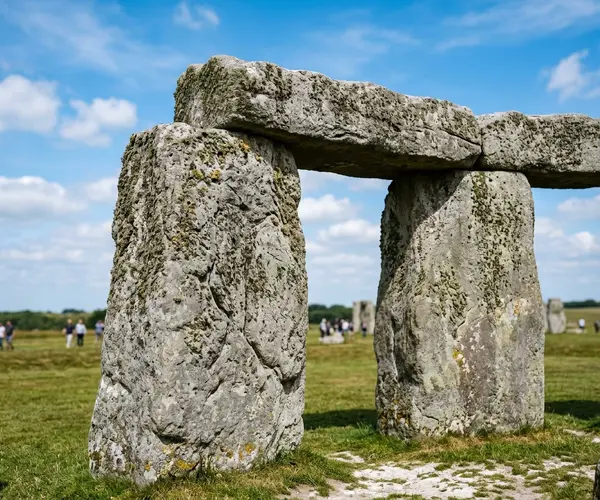
The sarsen stones were carefully shaped using hammer stones made of harder rock. The lintels (the horizontal stones on top) were secured using mortise and tenon joints, a woodworking technique applied to stone. This level of craftsmanship demonstrates that the builders possessed sophisticated skills and planned the monument carefully.
Raising the uprights probably involved digging a hole with one sloped side, sliding the base of the stone into the hole and then levering it upright using timber frames and ropes. The lintels would then have been raised into position, possibly using a timber crib that was built up layer by layer.
A Communal Effort
The scale of work involved in building Stonehenge implies a well-organised society capable of mobilising large numbers of people over extended periods. Understanding how much effort went into the construction naturally leads to the question of why Stonehenge was built in the first place. Durrington Walls, a large settlement about 2 miles from Stonehenge, may have housed some of the workers. Excavations there have revealed the remains of hundreds of houses and enormous quantities of animal bone from feasting, suggesting that the construction of Stonehenge was accompanied by large gatherings and communal meals.