Built in Stages
Stonehenge was not built all at once. Archaeological evidence shows that the monument evolved through several distinct phases of construction, modification and rearrangement over a period of roughly a thousand years. Each phase involved different types of structures and different levels of ambition.
The earliest phase, dating to around 3000 BC, was a circular ditch and bank enclosure, known as a henge. The question of who built Stonehenge is closely tied to these construction phases. This earthwork was about 110 metres in diameter and is still visible today, though much eroded. A ring of 56 pits, called the Aubrey Holes after the 17th-century antiquarian who first identified them, was dug just inside the bank. These may originally have held timber posts or stones.
The Arrival of the Stones
The first stones to arrive at the site were the bluestones, which came from the Preseli Hills in southwest Wales, roughly 150 miles away. These stones, each weighing up to 4 tonnes, were brought to Stonehenge around 2500 BC, though recent research suggests some may have arrived even earlier. How they were transported remains a subject of active debate, with theories ranging from human hauling to glacial movement.
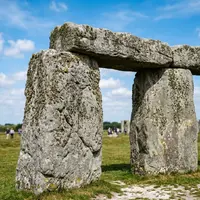
The massive sarsen stones that form the iconic circle and trilithons were erected around 2500 BC. These stones were sourced from the Marlborough Downs, about 25 miles to the north. The largest sarsen, the Heel Stone, weighs approximately 35 tonnes. The engineering required to transport, shape and raise these stones was remarkable for a society without metal tools, wheels or written language.
The Final Arrangements
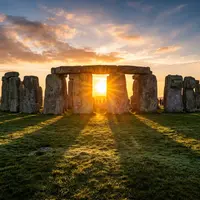
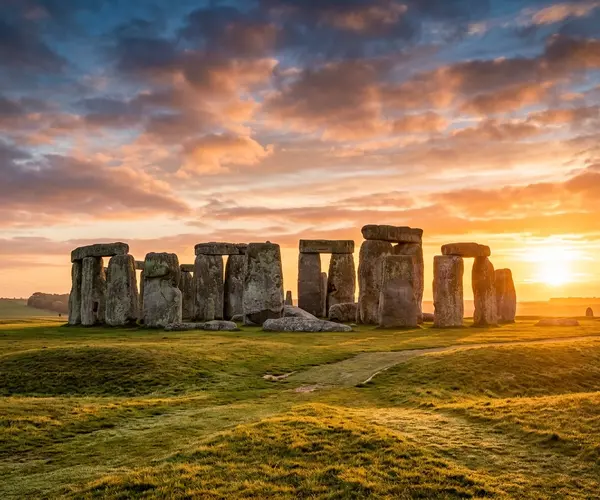
The bluestones were rearranged several times over the following centuries. By around 2000 BC, the monument had reached roughly the form we see today, with the sarsen circle and horseshoe of trilithons framing an inner arrangement of bluestones. Later modifications were relatively minor, and the site appears to have fallen out of active use by around 1600 BC.
Older Than the Pyramids
One fact that surprises many visitors is that the earliest phase of Stonehenge predates the Great Pyramid of Giza, which was built around 2560 BC. While the most recognisable stone structures at Stonehenge are roughly contemporary with the pyramids, the site as a whole has a longer history.
This does not mean the two monuments are comparable in scale or construction method. But it does place Stonehenge in its proper context as one of the oldest surviving monumental structures anywhere in the world, built by people who left no written records and whose lives we can only reconstruct through archaeological evidence.
How We Know the Dates
The dating of Stonehenge relies heavily on radiocarbon dating of organic material found at the site, including cremated human bone from the Aubrey Holes, antler picks used to dig the ditches and charcoal fragments. Advances in radiocarbon calibration have steadily refined the timeline over the past few decades. Archaeological analysis of the stone types and tool marks has also helped establish the sequence of construction phases.
Recent research using geochemical analysis of the sarsen stones, published in 2020, confirmed that most of the large sarsens came from a single source at West Woods near Marlborough, solving a question that had been open for centuries.