The Atrium
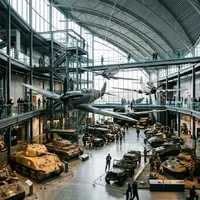
The moment you walk through the front doors of the Imperial War Museum, you are greeted by one of the most dramatic displays in any London museum. The central atrium rises through several floors, and hanging from the ceiling are some of the most iconic machines of twentieth century warfare.
A Supermarine Spitfire, the fighter that became a symbol of the Battle of Britain, is suspended alongside a Harrier jump jet, the vertical take-off aircraft that played a decisive role in the Falklands War. A V2 rocket, the world's first long-range guided ballistic missile, hangs vertically as though frozen in mid-flight. The effect is spectacular and slightly unsettling, which is exactly the point.
The Spitfire
The Spitfire on display is a Mark I, one of the most recognisable aircraft in aviation history. During the summer of 1940, Spitfires and Hurricanes fought the Luftwaffe over southern England in what became known as the Battle of Britain. The Spitfire's elliptical wings and Merlin engine made it one of the finest fighter aircraft of its era.
Seeing one up close, even suspended high above, gives you a sense of how small and fragile these machines were. The pilots who flew them were often barely out of their teens, sitting in a cramped cockpit with a thin sheet of aluminium between them and enemy fire.
The V2 Rocket
The V2 rocket is one of the more chilling objects in the museum. Developed by Nazi Germany under the direction of Wernher von Braun, it was the world's first ballistic missile. From September 1944, V2s were launched against London and other Allied cities. They travelled faster than the speed of sound, which meant you could not hear them coming. The first warning of an attack was the explosion.
Over 1,300 V2s hit England, killing nearly 3,000 people. The technology that created them was later adapted by both American and Soviet space programmes. The rocket hanging in the atrium is a powerful reminder of how military innovation and scientific advancement are often inseparable.
The T-34 Tank
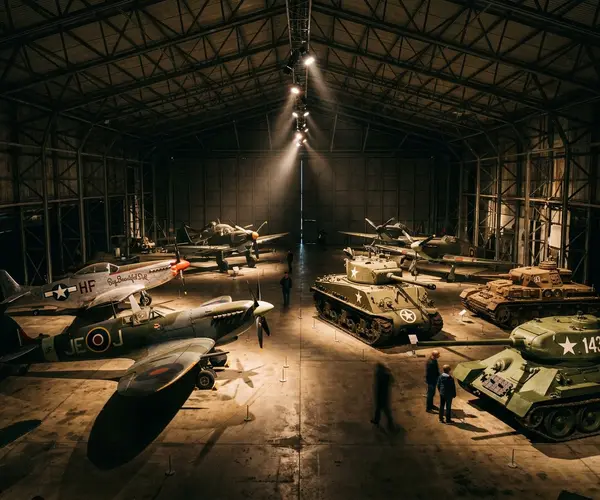
On the ground floor, you can get up close to a Soviet T-34 tank, one of the most important armoured vehicles of the Second World War. The T-34 was produced in enormous numbers and played a crucial role on the Eastern Front. Its combination of firepower, armour, and mobility gave it an advantage over many German tanks, and its relatively simple design meant it could be manufactured quickly in vast quantities.
Other military vehicles and artillery pieces are displayed around the atrium, each with explanatory panels that describe their history and significance. These exhibits give a tangible sense of the scale and machinery of modern warfare.
Beyond the Hardware
While the planes and tanks are the most visually striking exhibits, the museum is careful to connect them to human stories. Information panels explain who operated these machines, what they experienced, and what happened to them. The Spitfire is not just an aircraft but a symbol of the young pilots who risked everything during the Battle of Britain. The V2 is not just a rocket but a weapon that killed thousands of civilians.
This approach is characteristic of the Imperial War Museum. The hardware draws you in, but the human stories are what you remember. The atrium is designed to create a sense of awe, but also to prompt reflection about the real cost of the conflicts these machines represent.