A Bunker Beneath the Government
The Churchill War Rooms sit directly beneath the Treasury building on King Charles Street, just steps from Downing Street and the Houses of Parliament. When the threat of German bombing raids became real in the late 1930s, the government needed a secure location from which to run the war. The basement of the Treasury was chosen, reinforced with a thick concrete slab, and fitted out as a functional command centre.
The rooms became operational on 27 August 1939, just one week before Britain declared war on Germany. From that point until victory in 1945, this cramped underground complex served as the nerve centre of Britain's entire military strategy.
What You Will See Inside
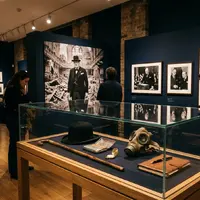
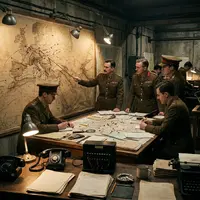
The most striking thing about visiting the War Rooms is how authentic everything feels. When the war ended, the rooms were locked up and left largely untouched. The maps still have their original pins marking troop positions. The clocks show the time zones that mattered during the conflict. Churchill's desk still holds the microphone he used for some of his wartime broadcasts.
The Cabinet Room is where Churchill met with his ministers to make the decisions that shaped the war. The chairs are arranged around the central table exactly as they were during those meetings. You can see the mark on the arm of Churchill's chair where he gripped it during heated discussions.
The Map Room was the operational heart of the complex. It was staffed around the clock from the moment it opened until the day the war ended, never once standing empty during those six years. Officers from the Royal Navy, Army, and Royal Air Force worked side by side, tracking the progress of the war across every theatre of operations.
The Transatlantic Telephone Room
One of the more intriguing spaces is a small room that was labelled as a private toilet for Churchill. In reality, it housed a special scrambler telephone that allowed Churchill to speak directly with President Roosevelt in Washington. This secret communication link was vital to the Allied war effort, and very few people at the time knew it existed.
Life Underground
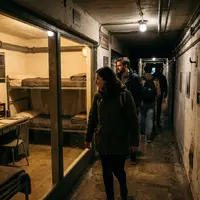
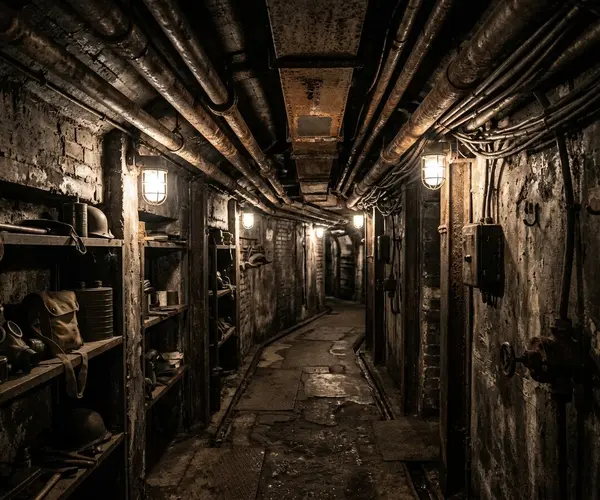
Walking through the corridors gives you a genuine sense of what it was like to work in these conditions. The ceilings are low, the corridors narrow, and the ventilation was basic at best. At its peak, the complex housed about 500 people during shifts, working in conditions that were stuffy, noisy, and tense.
There were basic sleeping quarters, a kitchen, and even a shooting range in one of the corridors. Churchill himself had a small bedroom in the bunker, though he reportedly preferred to sleep at 10 Downing Street or at the nearby No. 10 Annexe whenever possible, much to the frustration of his security team.
Why the War Rooms Matter
The Churchill War Rooms offer something that few museums can match. This is not a recreation or a replica. It is the actual place where some of the most consequential decisions of the twentieth century were made, preserved in a way that makes the history feel immediate and real. Standing in the Cabinet Room, it is easy to imagine the weight of the choices that were made in that space.