The Lifeline
The most impressive feature of the Churchill Museum is the Lifeline, a 15-metre interactive table that stretches the full length of the gallery. It covers every month of Churchill's life, from his birth in 1874 to his death in 1965. You can touch any point on the timeline to bring up documents, photographs, film clips, and audio recordings from that period.
The Lifeline places Churchill's personal story alongside the wider events of the twentieth century, giving you a sense of how his life intersected with history at almost every turn. It is one of the most ambitious interactive displays in any London museum and you could easily spend an hour with it alone.
Personal Artefacts and Belongings
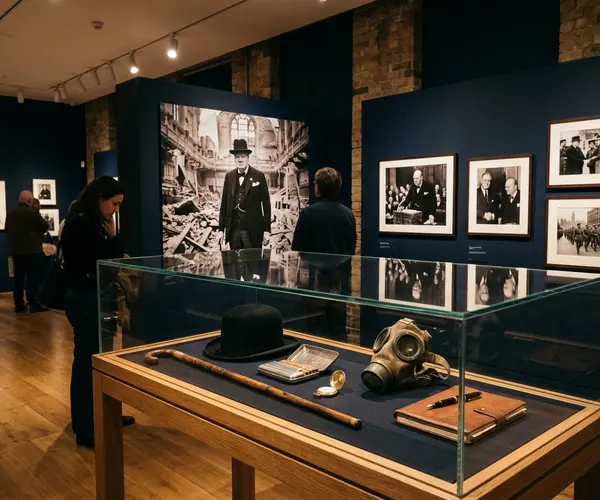
The museum holds a remarkable collection of Churchill's personal items. You can see his famous siren suit, the one-piece garment he wore during air raids and, increasingly, at almost all hours. There are his cigars, his hats, and his monogrammed slippers.
One of the more moving displays features letters he wrote as a young soldier in India and South Africa. These early writings reveal the ambition and restlessness that would define his political career. You can also read correspondence between Churchill and his wife Clementine, which offers a more intimate view of the man behind the public image.
Churchill the Painter
Many visitors are surprised to learn that Churchill was a prolific and genuinely talented painter. He took up painting in 1915 after the disaster of the Gallipoli campaign, when he was removed from the Admiralty and fell into a deep depression. Painting became his therapy, and he produced over 500 works during his lifetime.
The museum displays several of his paintings, mostly landscapes and still lifes rendered in bold, impressionist-influenced colours. He painted scenes from his travels across France, Morocco, and the south of England. The Royal Academy of Arts accepted his work for exhibition, though he submitted it under a pseudonym to ensure it was judged on merit rather than fame.
Speeches and Broadcasts
The Churchill War Rooms museum includes audio recordings of some of Churchill's most famous speeches. You can listen to "We shall fight on the beaches," "Their finest hour," and "Never in the field of human conflict." Hearing these words in his own voice, with the crackle of wartime recording equipment, is a different experience from reading them on a page.
The displays explain how Churchill crafted his speeches, spending hours rehearsing and refining every phrase. He understood the power of language and used it as a weapon during Britain's darkest days. His speechwriting process is documented through handwritten drafts with corrections and annotations in his distinctive red ink.
A Full Life Beyond the War
While the War Rooms upstairs focus on the years between 1939 and 1945, the Churchill Museum covers the full sweep of his 90-year life. You learn about his childhood at Blenheim Palace, his adventures as a war correspondent, his time in the political wilderness during the 1930s, and his return to power in 1951. The museum does not shy away from his more controversial decisions, presenting a rounded portrait rather than a simple hero narrative.