Why London Needed a New Bridge
By the 1870s, the East End of London was growing rapidly. The area east of London Bridge was home to docks, warehouses and a booming population, but there was no river crossing east of London Bridge itself. This meant enormous congestion, with thousands of people and vehicles funnelling across a single bridge every day.
A new crossing was clearly needed, but any bridge east of London Bridge had to allow tall-masted ships to reach the busy wharves and docks upstream. A conventional fixed bridge was not an option. After years of debate and over 50 rejected designs, the City of London Corporation approved a plan for a bascule bridge that could open to let ships through while still carrying road traffic for most of the day. Despite the name, Tower Bridge and London Bridge are completely different structures, a mix-up that catches out visitors to this day.
Design and Construction
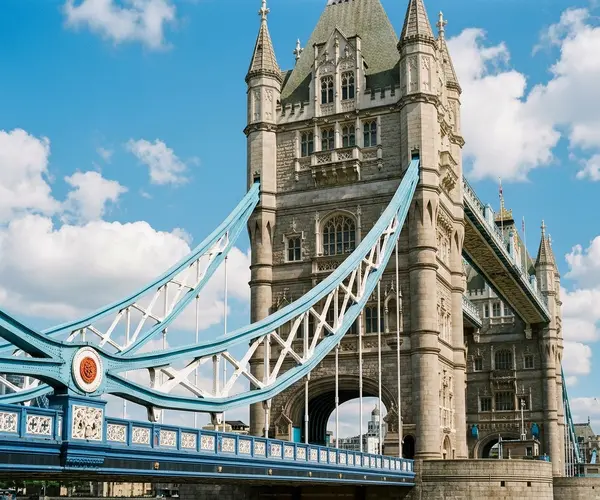
The winning design came from Sir Horace Jones, the City Architect, and Sir John Wolfe Barry, the son of Sir Charles Barry who designed the Houses of Parliament. Jones conceived the distinctive Gothic style of the towers, while Barry engineered the bascule mechanism and the foundations.
Construction began in 1886. The project required over 11,000 tonnes of steel for the framework of the towers and walkways, clad in Cornish granite and Portland stone to give the bridge its distinctive appearance. More than 400 workers were employed on the site at its peak, and the engineering challenges were immense. The foundations had to be sunk deep into the riverbed, and the two massive bascule piers had to support both the weight of the bridge and the forces generated during each lift.
Horace Jones died in 1887, just a year into the construction. He did not live to see Tower Bridge completed. Barry oversaw the remainder of the project, making some modifications to the original designs.
The Original Steam Power
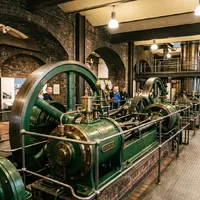
When the bridge opened in 1894, it was powered by steam. Two large steam engines drove pumps that forced pressurised water into hydraulic accumulators. When a bridge lift was needed, the stored hydraulic pressure was released to raise the bascules. The system was remarkably efficient and could open the bridge in under a minute.
The original steam engines and hydraulic machinery were housed in engine rooms on the south side of the bridge. They remained in service for over 80 years until the system was converted to electric hydraulics in 1976. The Victorian engine rooms have been preserved and are now open to visitors as part of the Tower Bridge Exhibition.
The Opening Ceremony
Tower Bridge was officially opened on 30 June 1894 by the Prince of Wales (the future Edward VII) and his wife Alexandra. The ceremony was attended by dignitaries and watched by large crowds along both banks of the river. The bascules were raised and lowered as part of the ceremony, demonstrating the bridge's signature feature to the public for the first time.
Changes Over the Years
The bridge has been modified several times since 1894. The most significant change was the 1976 conversion from steam-powered to electro-hydraulic operation. The original coal-fired boilers and steam engines were retired, and modern electric motors and hydraulic rams took over the job of raising the bascules.
The high-level walkways closed to the public in 1910 due to low footfall and a reputation for attracting pickpockets. They reopened in 1982 as part of a new visitor exhibition. In 2014, a glass floor was installed in the west walkway, adding a modern attraction to the Victorian structure.
The bridge was repainted in its current blue and white colour scheme in 1977 as part of the Queen's Silver Jubilee celebrations. Before that, it had been painted a chocolate brown colour for much of its life.