The Lights of London
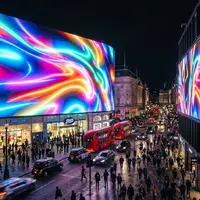
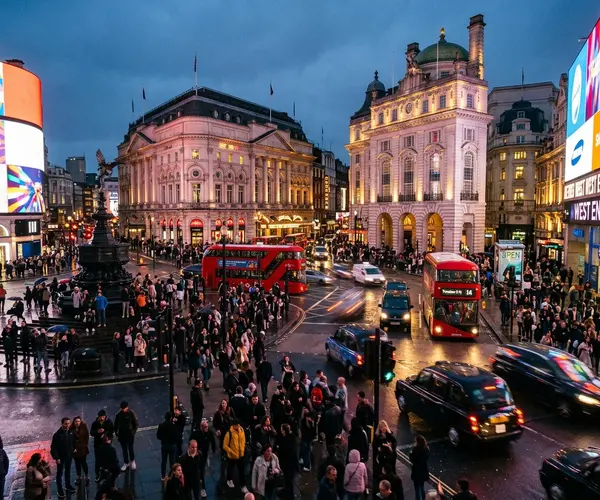
The most immediate reason Piccadilly Circus is famous is the illuminated advertising that dominates its northeastern curve. Electric advertising signs first appeared here in 1908, and they have been a continuous feature (with brief wartime blackouts) ever since. In an era before television and the internet, a brightly lit spectacle in the heart of London was genuinely extraordinary, and Piccadilly Circus became synonymous with modern, commercial London.
Over the decades, the signs evolved from simple electric lettering to neon displays and, most recently, to a single curved LED screen installed in 2017. The technology has changed, but the essential character has not. Piccadilly Circus at night, bathed in the glow of moving images, remains one of London's defining sights.
The Junction of Five Roads
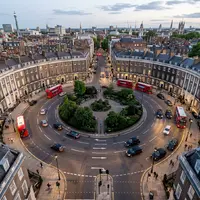
Piccadilly Circus sits at the meeting point of five major streets: Regent Street, Shaftesbury Avenue, Piccadilly, Coventry Street and Glasshouse Street. This made it one of the busiest crossroads in London from the moment it was created in 1819. Before the car, it was choked with horse-drawn traffic. After the car, it became a permanent bottleneck.
The convergence of these roads means that Piccadilly Circus has always been a place people pass through. That visibility is what attracted advertisers in the first place and what keeps the location relevant. An estimated 100 million people see the advertising screens each year.
The Hub of the British Empire
In the early 20th century, Piccadilly Circus was described as "the hub of the British Empire." This was partly marketing, but it reflected a genuine truth. The Circus sat at the centre of London's entertainment district, surrounded by theatres, restaurants and hotels that drew visitors from across the Empire. Shaftesbury Avenue (the heart of Theatreland) runs directly from the Circus, and the major shopping streets of Regent Street and Piccadilly radiate outwards.
During both World Wars, Piccadilly Circus was a gathering point for troops on leave, further cementing its reputation as the symbolic centre of London life.
The Anteros Statue
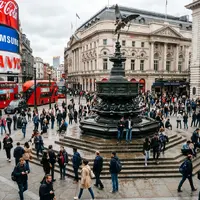
The winged statue above the Shaftesbury Memorial Fountain, universally known as Eros (though actually depicting his twin Anteros), was erected in 1893 and has become one of London's most photographed landmarks. The steps around the fountain serve as an informal meeting point and gathering space, adding a human element to the commercial spectacle of the signs above.
Piccadilly Circus in Popular Culture
The location has appeared in hundreds of films, songs and books. It features in everything from wartime dramas to spy thrillers. The phrase "it's like Piccadilly Circus" entered common English as a way of describing somewhere busy and chaotic.
For tourists, Piccadilly Circus often serves as a starting point for exploring the West End. From here, you are within walking distance of Leicester Square, Covent Garden, Soho, Chinatown, Trafalgar Square and most of London's major theatres.
Why It Endures
Many cities have commercial junctions with bright signs. Times Square in New York, Shibuya Crossing in Tokyo and the Dotonbori district in Osaka all serve a similar function. What distinguishes Piccadilly Circus is the layering of history. The Georgian street layout, the Victorian memorial fountain, the Edwardian advertising tradition and the 21st-century LED screen all coexist in one small space. That accumulation of eras is what makes it feel significant rather than simply busy.