What Does "Circus" Mean?
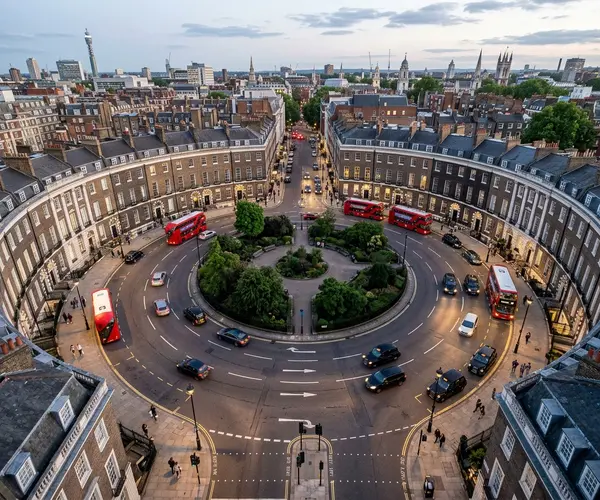
The word "circus" in Piccadilly Circus has nothing to do with clowns, acrobats or big tops. It comes from the Latin word "circus," meaning a ring or circular space. In English town planning, "circus" was used to describe a round or oval open area where several streets converge.
Piccadilly Circus is not the only example in London. Oxford Circus, where Oxford Street crosses Regent Street, uses the same naming convention. In Bath, the Royal Circus (known simply as The Circus) is a famous circular arrangement of Georgian townhouses. The term was widely used by urban planners in the 18th and 19th centuries to describe any significant circular junction.
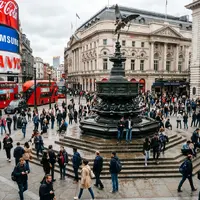
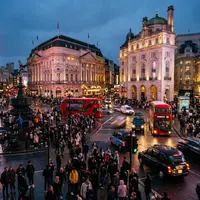
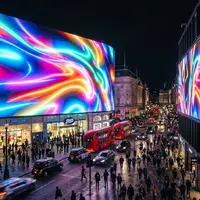
The irony is that Piccadilly Circus is no longer circular. When it was originally created in 1819 as part of John Nash's grand Regent Street development, it was a proper round junction. But the construction of Shaftesbury Avenue in 1886 cut through the eastern side of the circle, turning it into the irregular shape it has today.
Where Does "Piccadilly" Come From?
The name "Piccadilly" has a more colourful origin. It derives from "piccadills" (sometimes spelled "pickadills"), which were stiff, ruffled collars or lace edgings that were fashionable among wealthy men and women in Elizabethan and Jacobean England. Think of the large white ruffs you see in portraits of people from the late 1500s and early 1600s.
A tailor named Robert Baker made a fortune selling piccadills and other fashionable accessories during the early 17th century. With his profits, he bought land on the outskirts of London (which was then open countryside) and built a large house. Neighbours and locals mockingly called the property "Piccadilly Hall" because of the source of Baker's wealth, and the name stuck.
Over time, the name transferred from the house to the surrounding area, then to the road that ran past it (Piccadilly), and eventually to the circular junction at its eastern end (Piccadilly Circus).
The Creation of the Circus
Piccadilly Circus was created in 1819 when the architect John Nash designed Regent Street as a grand processional route connecting Carlton House (the Prince Regent's residence) to Regent's Park. The point where Regent Street crossed the existing road called Piccadilly needed a formal junction, and Nash designed a circus for the purpose.
Nash's original design was symmetrical and elegant, with matching facades curving around a true circle. It was this convergence of roads and its resulting visibility that would eventually make the Circus one of London's most famous locations. The junction worked as intended for several decades. But Victorian London's rapid growth demanded new roads, and when Shaftesbury Avenue was driven through in 1886 to improve traffic flow and clear slum housing, the neat circle was permanently broken.
Other London "Circuses"
Piccadilly Circus and Oxford Circus are the best-known examples, but the naming convention was once more widespread. Many of London's smaller circuses have been renamed or absorbed into larger road schemes over the centuries. The term survives mainly in these two prominent locations, serving as a reminder of the Georgian and Regency-era approach to city planning.
A Name That Confuses Visitors
The name Piccadilly Circus causes genuine confusion for international visitors. Some expect to find a circus performance venue. Others assume "circus" is a uniquely British term with no clear meaning. Understanding that it simply means "circular junction named after a 17th-century collar maker" makes the name both logical and unexpectedly entertaining.