Old Royal Naval College
Christopher Wren's baroque masterpiece in Greenwich — home to the Painted Hall, a stunning chapel and UNESCO World Heritage grounds

Christopher Wren's baroque masterpiece in Greenwich — home to the Painted Hall, a stunning chapel and UNESCO World Heritage grounds
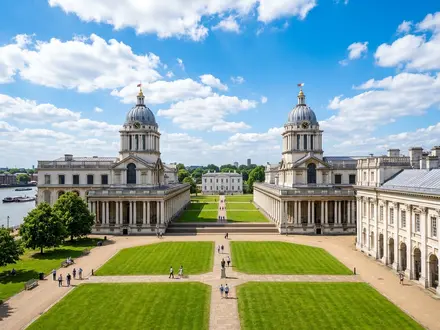
The Old Royal Naval College is the centrepiece of Maritime Greenwich, a UNESCO World Heritage Site and one of Europe's finest baroque ensembles. Designed by Christopher Wren in the 1690s for retired sailors, its twin-domed buildings frame a celebrated view from the Thames to the Queen's House.
The interiors hold two unmissable spaces — the Painted Hall, often called Britain's Sistine Chapel, and a neoclassical chapel rebuilt by James Stuart after a fire in 1779. Both are breathtaking and catch most visitors by surprise.
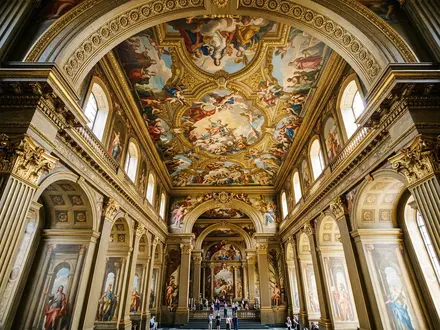
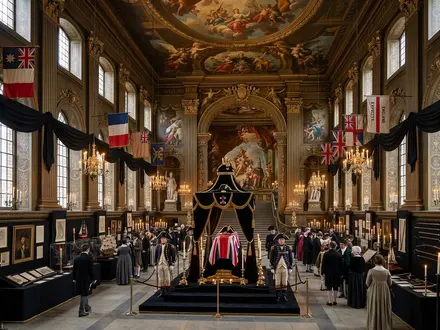
The Painted Hall is the single most impressive interior in Greenwich and one of the greatest decorative schemes in Britain. Sir James Thornhill began painting in 1707 and did not finish until 1726 — 19 years covering the ceiling, walls and upper hall with allegorical scenes glorifying William and Mary and Britain's naval dominance.
The lower hall ceiling depicts William and Mary enthroned among the virtues, while the far wall shows George I arriving in a riot of colour and classical symbolism. A £8.5 million restoration completed in 2019 revealed details invisible for generations. Visitors can view the hall from floor level or book a ceiling tour to see Thornhill's brushwork up close.
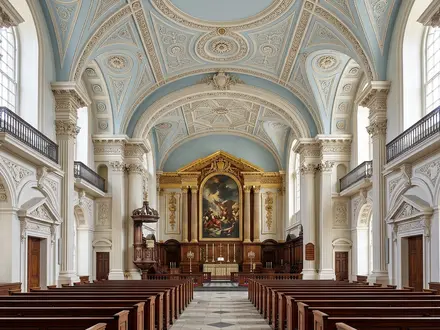
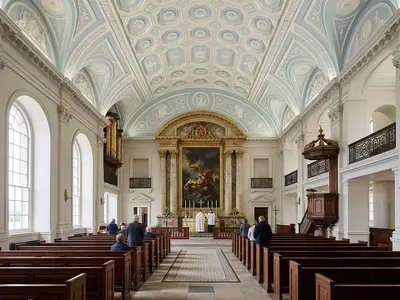
The Chapel of St Peter and St Paul was rebuilt after a fire in 1779 and is one of London's finest neoclassical interiors. James 'Athenian' Stuart designed the pale blue-and-white plasterwork, and the altarpiece by Benjamin West depicts the shipwreck of St Paul on Malta. The chapel is often overlooked by visitors who head straight for the Painted Hall.
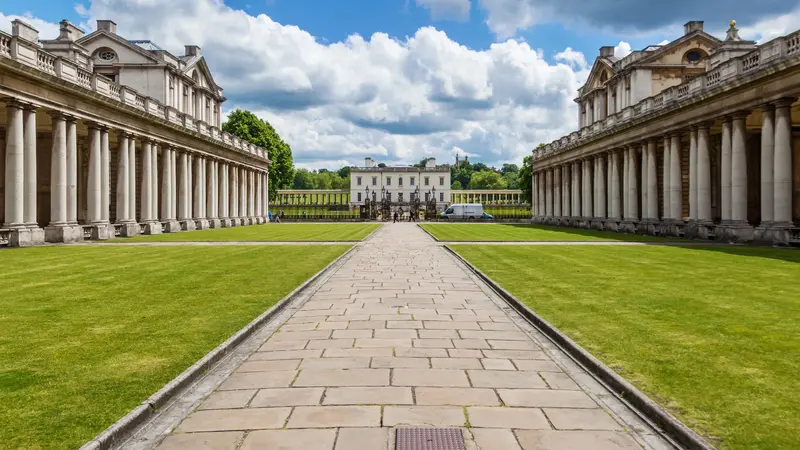
Wren's grounds are a destination in their own right. The symmetrical courtyards and colonnades frame one of London's most perfectly composed views — the Queen's House centred between the twin domes, with Greenwich Park rising behind. The grounds are open daily from early morning until late evening.
The site began as the Palace of Placentia, birthplace of Henry VIII and Elizabeth I. After the Restoration, Charles II commissioned John Webb to build a new palace, but only the King Charles Block was completed before funds ran out.
In 1694 Queen Mary II decreed the site should become the Royal Hospital for Seamen, and Christopher Wren was appointed architect. Wren, Nicholas Hawksmoor and Sir John Vanbrugh worked on the buildings over the following decades. The hospital housed retired sailors until 1869, when it became the Royal Naval College for officer training. The Navy left in 1998, and today the site is shared by the University of Greenwich, Trinity Laban Conservatoire and the charity that manages the visitor experience.
The grounds and chapel are free to enter — only the Painted Hall requires a ticket, and children under 16 enter free
Most visitors head straight to the Painted Hall and skip the chapel entirely. Visit the chapel first while it is quiet — it is free and genuinely beautiful.
The Painted Hall is best lit by natural light in the morning. Afternoon visits can feel darker, particularly in winter when the hall relies more on artificial lighting.
If you are on a tight budget, the grounds, colonnades and chapel are entirely free. You can spend an enjoyable hour without buying a Painted Hall ticket.
The Cutty Sark is a two-minute walk north, and Greenwich Park with the Royal Observatory is five minutes south. All three fit comfortably into a half-day Greenwich visit.
The site is one of London's busiest filming locations. Parts of the grounds or interiors are occasionally closed for productions — check the ORNC website before visiting.

London Travel Writer · 12+ years covering UK attractions and tourism
Last reviewed: March 5, 2026