A Ceiling to Rival the Sistine Chapel
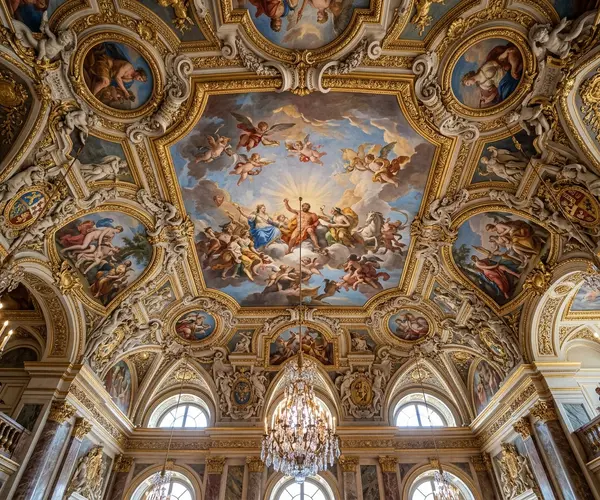
The Painted Hall at the Old Royal Naval College in Greenwich is one of the most spectacular painted interiors in Europe. Sir James Thornhill covered every surface of the ceiling, walls and upper hall with an elaborate scheme of allegorical paintings celebrating British maritime power, the Protestant succession and the triumph of peace and liberty.
The work took 19 years to complete, from 1707 to 1726. Thornhill was paid by the square yard, which may explain the extraordinary ambition of the scheme. The ceiling alone would be remarkable, but the walls, vestibule and upper hall are equally densely painted, creating an immersive experience that overwhelms the senses.
What the Paintings Show
The main ceiling of the Lower Hall depicts William III and Mary II enthroned in glory, surrounded by allegorical figures representing the virtues and the four seasons. William is shown trampling tyranny underfoot, a reference to the Glorious Revolution of 1688 that brought him to power.
The Upper Hall ceiling shows Queen Anne, who succeeded William, surrounded by figures representing the arts, sciences and British naval might. The walls below are filled with architectural illusions, creating the impression of columns, arches and galleries that do not actually exist. Thornhill's skill at trompe l'oeil painting is extraordinary, and from certain angles the flat walls appear to be three-dimensional structures.
Hidden Details
Thornhill painted himself into the scheme, standing in a doorway in the Lower Hall with his hand outstretched, palm upward, in a gesture traditionally interpreted as requesting payment. He also included portraits of real figures from the period, including the astronomer John Flamsteed holding a diagram of the solar system.
The Recent Restoration
The Painted Hall underwent a major two-year conservation project completed in 2019. Centuries of candle soot, coal dust and grime were carefully removed from the painted surfaces, revealing colours that had not been seen for generations. The restoration brought back vivid blues, reds and golds that had been dulled to near-monochrome.
The project also introduced a new raised walkway at ceiling level, allowing visitors to examine the paintings at close range for the first time. From the gallery, you can see individual brushstrokes and details that are invisible from the floor below, including tiny figures, facial expressions and the texture of Thornhill's paint.
The Building's History
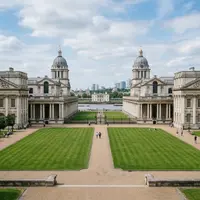
The Painted Hall was originally designed as a dining hall for the Royal Hospital for Seamen, the institution for retired sailors established by Queen Mary II in 1694. The building was designed by Sir Christopher Wren and Nicholas Hawksmoor. However, the hall proved too grand for everyday dining, and the pensioners reportedly preferred plainer surroundings. It was used instead for ceremonial purposes.
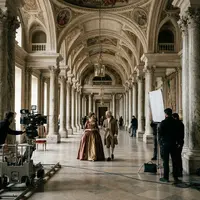
In 1806, the body of Lord Nelson lay in state in the Painted Hall after the Battle of Trafalgar, before his funeral at St Paul's Cathedral. The hall's grandeur has also made it one of Britain's most popular filming locations, appearing in productions from Pirates of the Caribbean to The Crown. This connection to Nelson adds another layer of meaning to a space already dense with naval symbolism.
Visiting the Painted Hall
The Painted Hall is open daily and charges a small admission fee, with concessions available. Audio guides are included, and the ceiling walkway tour provides the most memorable experience. Allow at least 45 minutes to appreciate the scale and detail of Thornhill's achievement.