A Devastating Start
HMS Belfast's war began just weeks after the conflict started, and it nearly ended there too. On 21 November 1939, while sailing in the Firth of Forth in Scotland, she struck a German magnetic mine. The explosion broke her back, causing severe structural damage that put her out of the war for almost three years.
The mine detonated directly beneath the ship, lifting her bodily out of the water. The force was so great that it broke the keel, fractured machinery mountings deep inside the hull and injured 46 crew members. Several men suffered broken legs simply from the shock of the explosion transmitted through the deck plates.
The damage was so extensive that many thought she would be scrapped. Instead, the Admiralty decided to repair and modernise her, a process that took until November 1942. When she emerged from the shipyard, she was a significantly improved warship with additional armour, upgraded radar and better anti-aircraft armament.
Arctic Convoys
After her return to service, HMS Belfast was assigned to the Arctic convoy routes, escorting supply ships carrying war materials from Britain to the Soviet Union. These convoys sailed through some of the most dangerous and inhospitable waters in the world, threatened by German submarines, surface raiders, bombers and the brutal Arctic weather itself.
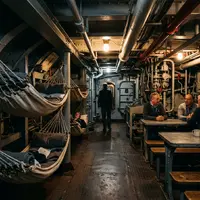
The convoys ran north around occupied Norway, through waters patrolled by U-boats and within range of German aircraft based on Norwegian airfields. The cold was extreme. Sea spray froze on the decks and superstructure, adding dangerous weight to the ships and making conditions aboard miserable. Despite these hazards, the convoys delivered millions of tonnes of supplies that helped sustain the Soviet war effort on the Eastern Front.
HMS Belfast served as part of the covering forces for these convoys, her role being to protect the merchant ships from attack by German surface warships based in the Norwegian fjords.
The Battle of North Cape
The defining moment of HMS Belfast's war came on 26 December 1943 at the Battle of North Cape, the last major engagement between big-gun warships in European waters. The German battlecruiser Scharnhorst had sailed from a Norwegian fjord to attack convoy JW 55B, and British naval forces including HMS Belfast were sent to intercept her.
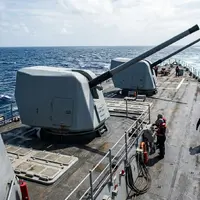
HMS Belfast played a crucial role in the battle. Her radar first detected the Scharnhorst at a range of approximately 25 miles, and she helped shadow the German ship through the Arctic darkness. Belfast's twelve 6-inch guns opened fire during the initial engagement, and she used her radar to illuminate the target for other British ships.
The Scharnhorst was eventually overwhelmed by the combined firepower of the British force, which included the battleship HMS Duke of York. After hours of fighting in freezing seas, the Scharnhorst sank with the loss of 1,932 of her crew. Only 36 survivors were pulled from the water. The battle effectively ended the threat posed by German heavy surface ships to the Arctic convoys.
D-Day
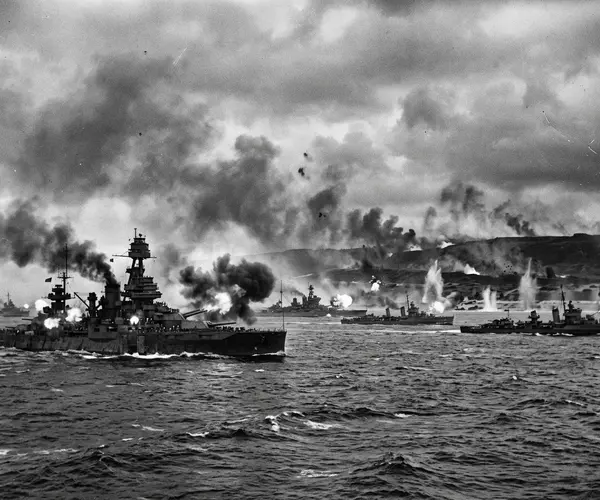
On 6 June 1944, HMS Belfast was one of the warships providing naval gunfire support for the Allied landings in Normandy. She was stationed off Gold and Juno beaches, firing her 6-inch guns at German defensive positions, gun batteries and strong points inland.
The bombardment began in the early hours of the morning, before the first landing craft reached the beaches. Belfast's guns targeted specific positions identified by intelligence, helping to suppress the defences that the troops would face as they came ashore. She continued to provide fire support for several weeks after D-Day, engaging targets as requested by ground forces advancing inland.
Her involvement in D-Day connected her to the single largest amphibious operation in military history and gave her a role in one of the war's most consequential events.
The Broader Service Record
Beyond these headline actions, HMS Belfast spent much of the war on duties that were vital but less dramatic. Convoy escort, patrol work and the routine business of maintaining a naval presence in contested waters occupied the majority of her operational time. Like most warships, her war was characterised by long periods of watchfulness punctuated by intense moments of action.