A Light Cruiser with Heavy Firepower
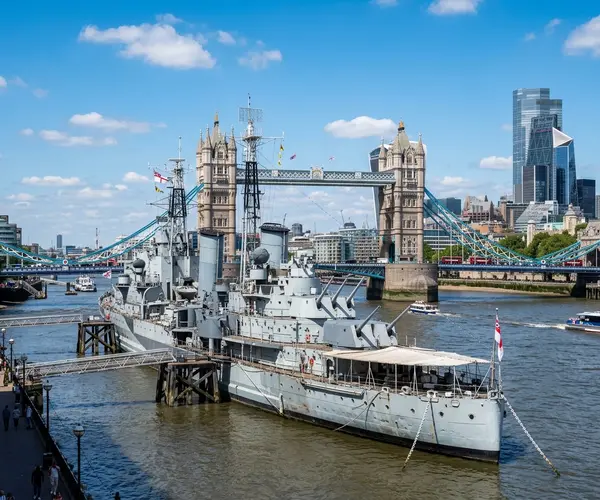
HMS Belfast is classified as a light cruiser, a designation that can be misleading. The "light" refers to the calibre of her main guns rather than the size of the ship. At 187 metres long and displacing over 11,500 tonnes when fully loaded, she was a substantial warship by any measure and remains one of the largest preserved vessels of her era anywhere in Europe.
She belongs to the Town class of cruisers, a group of ten ships built for the Royal Navy in the late 1930s. The class was named after British towns and cities, and HMS Belfast was the second ship to bear the name of Northern Ireland's capital. The Town-class cruisers were designed to be fast, well-armed and capable of operating across the world's oceans in a range of roles from convoy escort to shore bombardment.
Built in Belfast
HMS Belfast was constructed at the Harland and Wolff shipyard in Belfast, the same yard famous for building the Titanic. She was laid down in December 1936 and launched on St Patrick's Day, 17 March 1938. The launch was performed by Anne Chamberlain, wife of the then Prime Minister Neville Chamberlain.
The shipyard workers who built her gave the vessel a particular significance because she carried the name of their city. When she slid down the slipway into Belfast Lough, she was the largest ship the yard had built since the great liners of the early 20th century and represented a major contract for the local workforce.
Design and Specifications
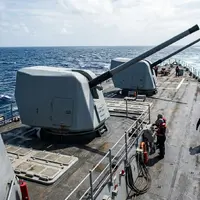
The Town-class cruisers were designed in response to the growing threat from Japanese and German cruisers in the 1930s. HMS Belfast was armed with twelve 6-inch guns arranged in four triple turrets, giving her a formidable broadside capability. She could also carry anti-aircraft guns and torpedo tubes, making her versatile enough to take on threats from sea, air and underwater.
Her four Admiralty three-drum boilers and four Parsons geared turbines gave her a top speed of 32.5 knots, roughly 37 miles per hour. That speed, combined with a range of over 8,000 nautical miles, meant she could patrol vast stretches of ocean without refuelling.
The ship's armour belt, up to 4.5 inches thick in places, protected the vital machinery and magazine spaces from shellfire. While not as heavily armoured as a battleship, she carried enough protection to survive hits from the guns of similar-sized enemy vessels.
What Makes Her Special
HMS Belfast is the last surviving example of the big-gun cruisers that formed the backbone of the Royal Navy's surface fleet during the Second World War. Larger ships like battleships and aircraft carriers have been preserved elsewhere, but the cruiser type, which did so much of the actual fighting, is poorly represented in museum ships worldwide.
Her preservation is significant because the Town-class cruisers were involved in virtually every major naval campaign of the war. They escorted Arctic convoys through some of the most dangerous waters in the world, bombarded enemy positions during amphibious landings and fought surface actions against enemy warships. HMS Belfast participated in all of these roles, from Arctic convoys to D-Day, making her history representative of the broader cruiser story.
A Ship with a City's Name
The relationship between HMS Belfast and the city of Belfast has remained strong throughout the ship's life. During her active service, crews included many men from Northern Ireland who felt a personal connection to a ship bearing their city's name. Today, the ship's permanent berth on the Thames is matched by continued links to Belfast, and the vessel serves as a floating reminder of the shipbuilding heritage that once defined the city.