The Main Armament
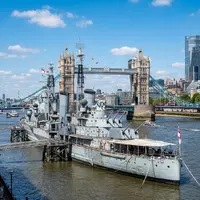
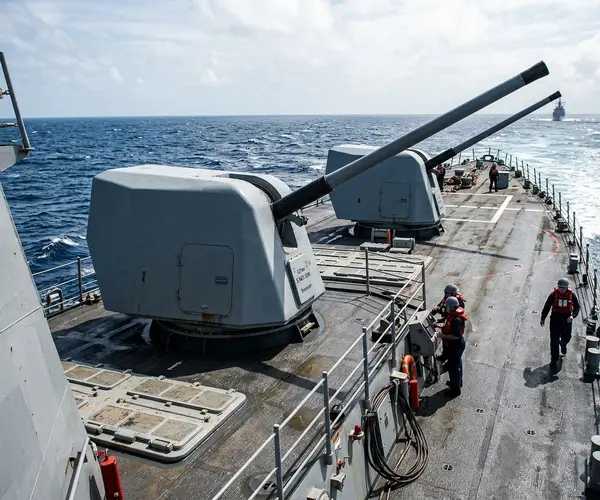
The primary weapons of HMS Belfast are her twelve 6-inch (152mm) BL Mark XXIII guns, arranged in four triple turrets. Two turrets sit forward of the bridge (designated A and B turrets) and two are positioned aft (X and Y turrets). This arrangement gave the ship the ability to bring all twelve guns to bear on targets on either side, delivering devastating broadsides.
Each gun could fire a shell weighing over 50 kilograms to a maximum range of approximately 14 miles. At shorter ranges, the accuracy was remarkable for the era. A well-trained turret crew could achieve a rate of fire of up to 8 rounds per minute per gun, meaning the ship could theoretically put out nearly 100 shells per minute from her main battery alone.
The turrets themselves were heavily armoured to protect the gun crews from enemy fire and splinter damage. Each turret required a crew of around 27 men to operate, handling everything from loading the shells and propellant charges to training the guns on target and managing the complex hydraulic machinery that turned and elevated the barrels.
Anti-Aircraft Armament
In addition to her main guns, HMS Belfast carried a significant number of anti-aircraft weapons. The threat from enemy aircraft grew enormously during the Second World War, and the ship's anti-aircraft fit was upgraded several times during her service life.
By the end of the war, she carried eight 4-inch high-angle guns in four twin mountings, designed to engage aircraft at medium and long range. These were supplemented by numerous Bofors 40mm guns and Oerlikon 20mm cannons for close-range air defence. The Bofors and Oerlikons were positioned around the superstructure and on platforms along the ship's sides, giving broad arcs of fire to counter attacks from any direction.
The 4-inch guns could also be used against surface targets, providing additional firepower during shore bombardment or surface actions. This versatility was typical of warship design in the period, where every weapon system needed to serve multiple roles.
Where the Guns Are Aimed Today
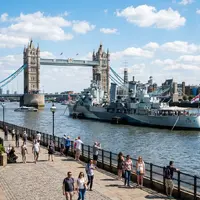
One of the most frequently mentioned facts about HMS Belfast is that her main guns are currently trained on the Scratchwood Services (now London Gateway services) on the M1 motorway, approximately 12 miles north of the ship's berth on the Thames. This is not a random choice. The guns are set to the bearing and elevation they would have used during the Normandy bombardment, and the service station happens to sit at the equivalent range.
The detail serves as a vivid illustration of the guns' range and the distances at which warships could engage targets during the Second World War. When visitors stand beside the turrets and learn that their shells could reach a point 12 miles away, the destructive power of the ship becomes tangible in a way that statistics alone cannot convey.
Below the Turrets
The guns visible on deck are only part of the weapon system. Below each turret, extending several decks down into the ship, are the shell rooms and magazines where ammunition was stored. A complex system of hoists and handling rooms moved shells and propellant charges from these deep storage spaces up to the guns at speed.
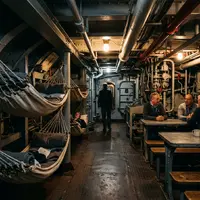
Visitors to HMS Belfast can explore these lower compartments and follow the path that each round of ammunition took from the magazine to the barrel. The tight spaces, steep ladders and heavy mechanical equipment give a powerful impression of what it was like to work in these areas during combat, when the noise, heat and physical demands were extreme.
The combination of the turrets on deck and the ammunition supply chain below them shows that the main armament was not just a set of guns but an integrated system that required hundreds of men working in coordination to function effectively.