The Threat of the Scrapyard
HMS Belfast was decommissioned from the Royal Navy in 1963 after a career that spanned the Second World War and the Korean War. Like hundreds of other warships that had outlived their military usefulness, she was placed in reserve and seemed destined for the breaker's yard.
By the late 1960s, the Ministry of Defence was actively planning to sell her for scrap. The fate of warships after they leave service is usually straightforward. They are stripped of anything valuable and then broken up for their steel. Very few survive this process, and by the time Belfast's future was being decided, almost every other major warship from the Second World War had already been scrapped or sunk as a target.
The Campaign to Save Her
The campaign to preserve HMS Belfast was led by Rear Admiral Sir Morgan Morgan-Giles, who had served in the Royal Navy during the war and recognised that Belfast represented a vanishing piece of naval history. He formed the HMS Belfast Trust in 1967 to raise funds and lobby the government for the ship's preservation.
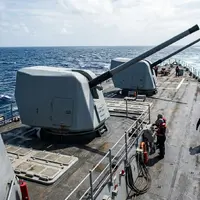
The argument for saving her was compelling. She was the last surviving example of the big-gun Town-class light cruisers that had been the workhorses of the Royal Navy during the Second World War. Her service record, encompassing Arctic convoys, the Battle of North Cape, D-Day and the Korean War, gave her a breadth of historical significance that few other ships could match.
The campaign faced significant obstacles. The cost of maintaining a 11,500-tonne warship was considerable, and there was no guarantee that the public would visit in sufficient numbers to justify the expense. Several government departments were sceptical, and finding a suitable permanent berth in London required lengthy negotiations.
Why London Was Chosen
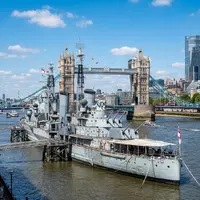
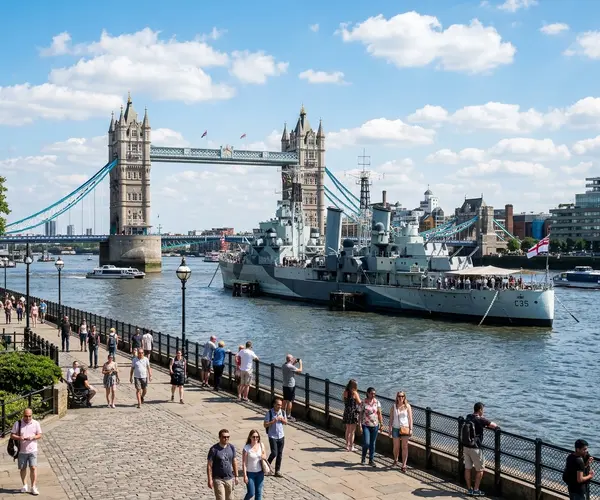
The decision to moor HMS Belfast on the Thames in central London was driven by practical and symbolic considerations. London offered the largest potential audience of any location in the country, and placing the ship within sight of Tower Bridge gave her a prominent position that would attract passing visitors as well as those making a deliberate trip.
The Thames also had a strong naval connection. The river had been the launching point for countless naval expeditions over the centuries, and the Pool of London, where Belfast is moored, had been the heart of London's port for hundreds of years. Placing a warship here felt natural in a way that a berth in a provincial port might not have.
The specific berth between Tower Bridge and London Bridge was negotiated with the Port of London Authority. The ship was moved to her permanent position in October 1971, and she has remained there ever since, becoming as much a part of the London riverside as the bridges and buildings around her.
Part of the Imperial War Museum
In 1978, HMS Belfast became a branch of the Imperial War Museum, which took over responsibility for her maintenance, conservation and public programme. This connection to one of the country's major national museums gave the ship long-term institutional support and ensured that her story would be told within the broader context of 20th-century conflict.
The Imperial War Museum's stewardship has included extensive conservation work to maintain the ship's structure, which faces constant challenges from the corrosive effects of river water, tidal movements and the weather. Keeping a steel warship in good condition is an ongoing project, and the museum has invested significantly in the ship's preservation over the decades.
A Living Memorial
HMS Belfast serves a dual purpose. She is a museum that tells the story of life at sea during wartime, and she is a memorial to all those who served in the Royal Navy and other naval forces. The ship carries memorial plaques and holds regular commemorative events, connecting the vessel to the human stories of those who sailed in her and in ships like her.
Her presence on the Thames also serves as a visible reminder of Britain's naval history in a city where that history might otherwise be overlooked. London is full of memorials and museums, but HMS Belfast is unique in offering visitors the chance to step aboard a real warship and experience the spaces where men lived and fought. That combination of accessibility, authenticity and central location is why she remains one of London's most visited attractions more than fifty years after she was saved from the scrapyard.