Volk's Electric Railway
The world's oldest operating electric railway — a scenic mile along Brighton seafront since 1883
The world's oldest operating electric railway — a scenic mile along Brighton seafront since 1883
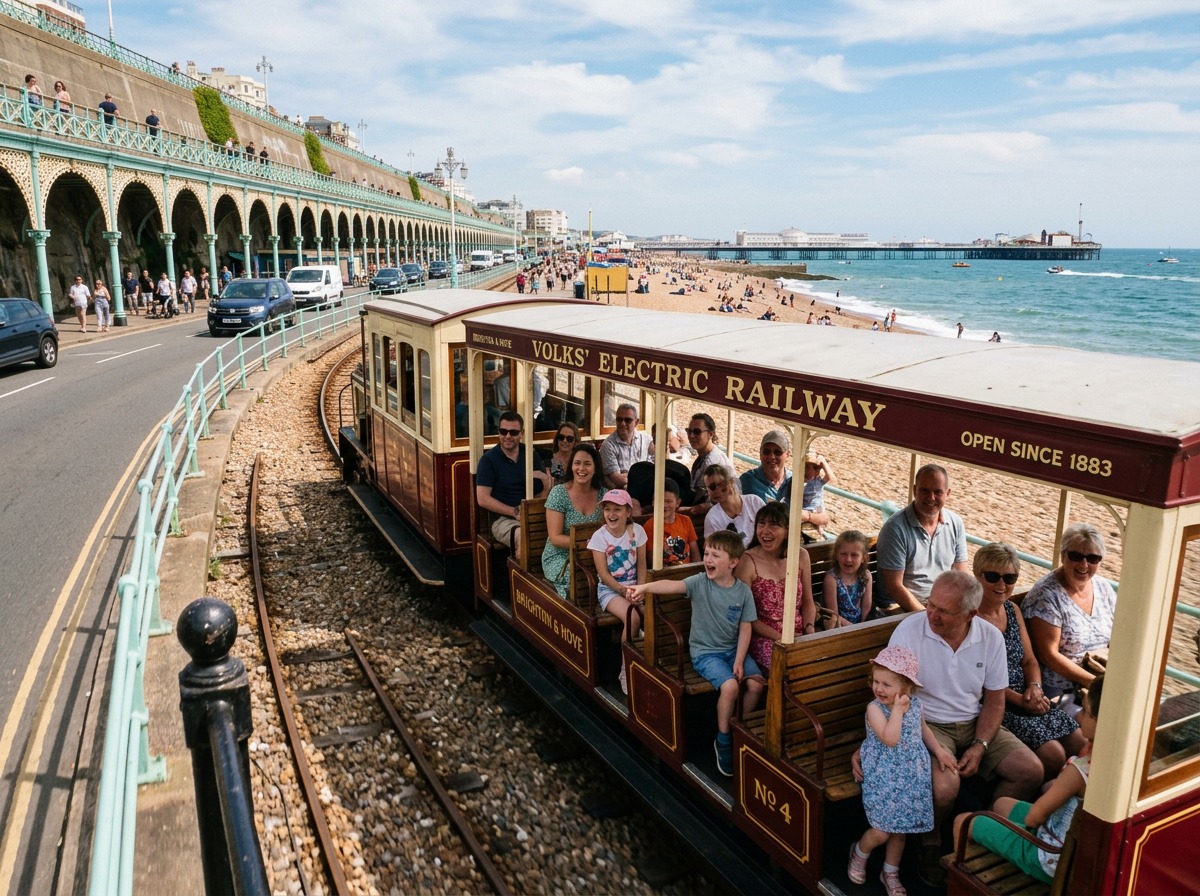
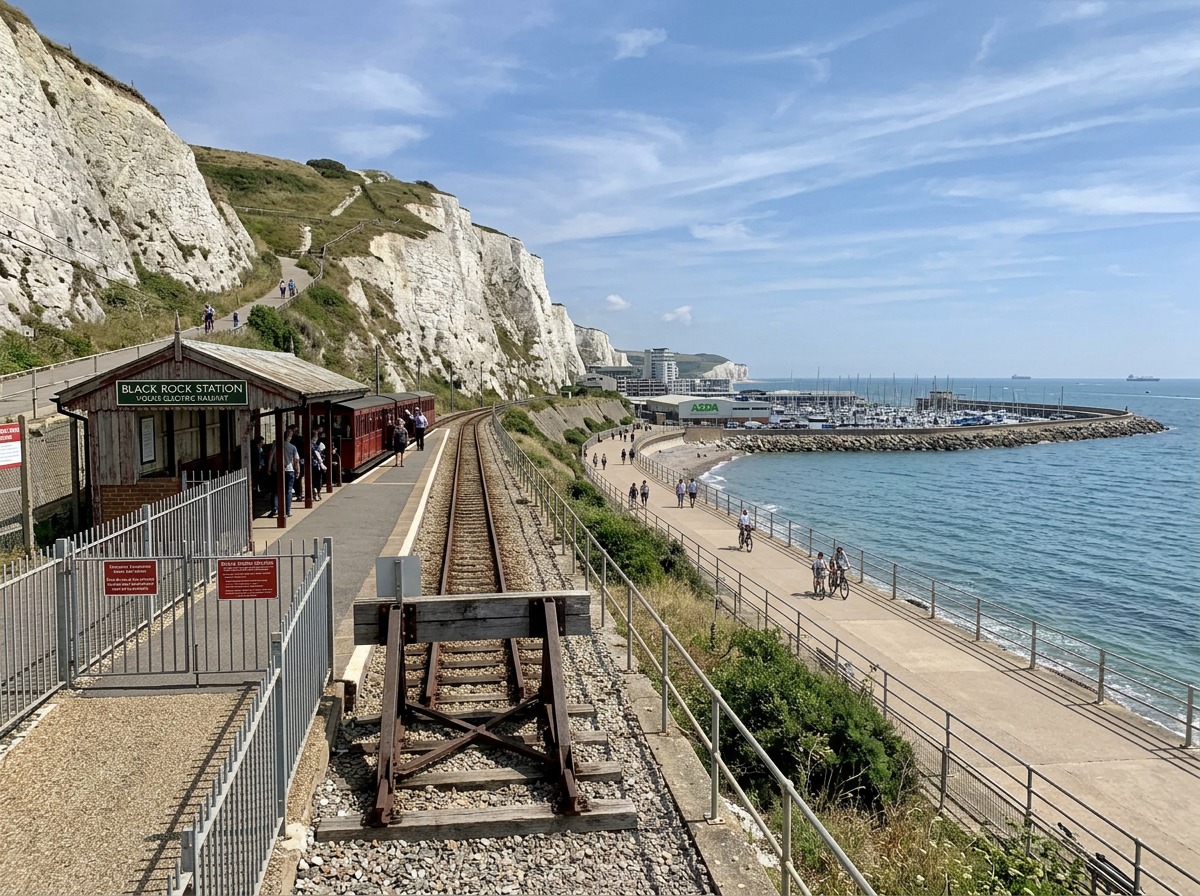
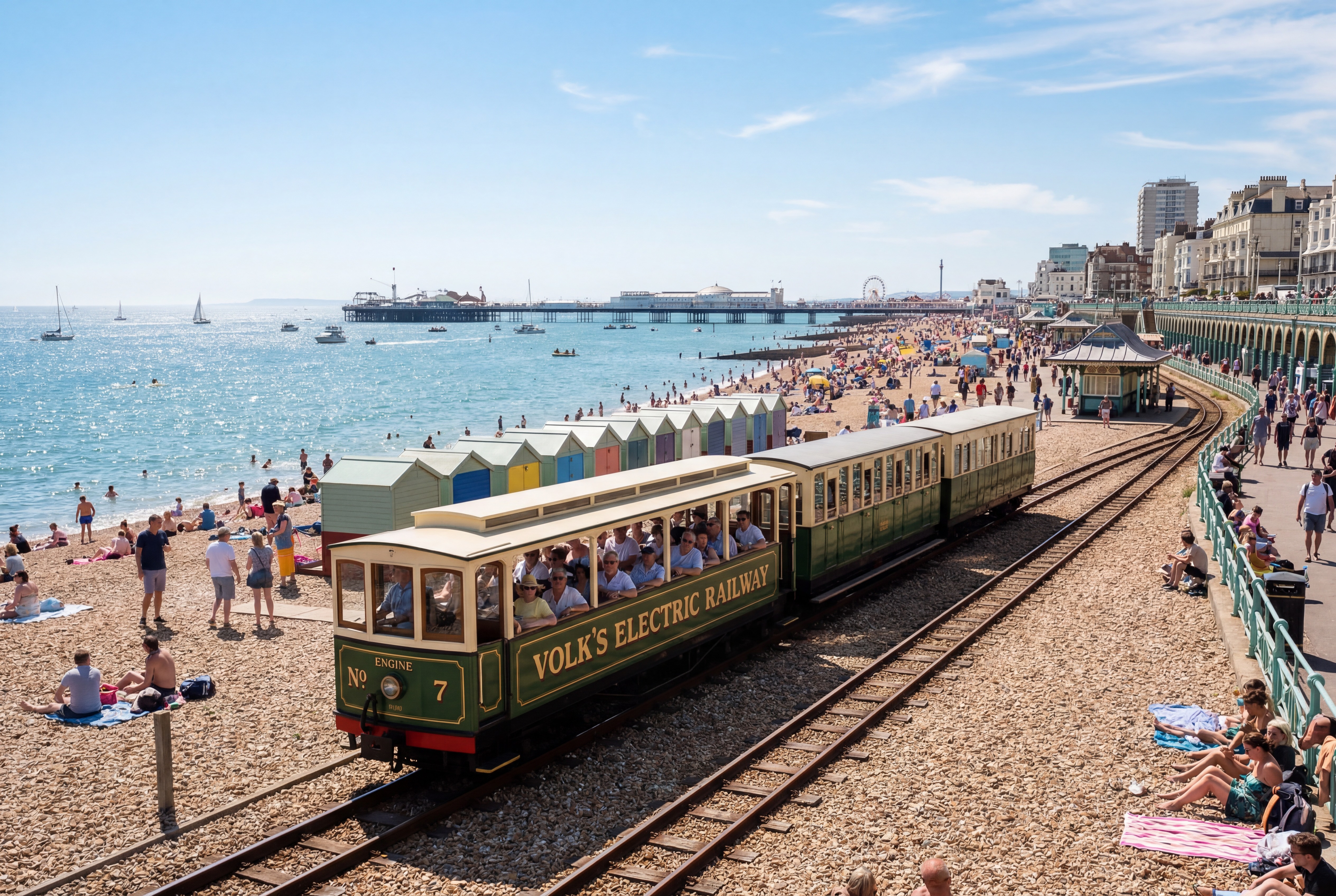
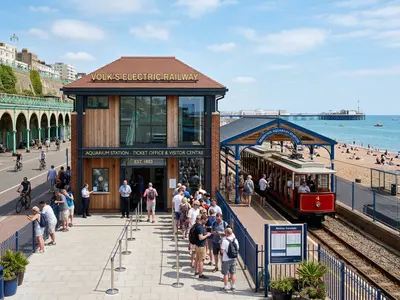
Volk's Electric Railway is the oldest operating electric railway in the world, running along Brighton's seafront since 4 August 1883. Built by the inventor and electrical engineer Magnus Volk, the narrow-gauge line carries passengers one mile between Aquarium Station near Brighton Palace Pier and Black Rock Station close to Brighton Marina, with an intermediate stop at Halfway.
The journey takes around twelve minutes in each direction and hugs the top of the beach, offering unbroken views across the English Channel. The railway operates on a 2 ft 8.5 in gauge with 110 V DC power supplied through a third rail, and its small open-sided carriages have changed remarkably little in character since the Victorian era.
Volk's Electric Railway holds a unique place in transport history as the oldest operating electric railway on the planet. On 4 August 1883, the German-born Brighton resident Magnus Volk opened a short stretch of electrified track along the seafront between the Royal Aquarium and the Chain Pier. That original line was just a quarter of a mile long, built to a 2 ft gauge and powered at 50 volts DC through the running rails. It was intended as a temporary summer novelty, but proved so popular that Volk extended it within a year.
By April 1884 the line had been lengthened to half a mile, regauged to 2 ft 8.5 inches and re-electrified at a higher voltage. Over the following decades it was extended further east, and today the railway runs one mile between Aquarium Station near Brighton Palace Pier and Black Rock Station close to Brighton Marina, with a depot and intermediate stop at Halfway. The gauge and third-rail 110 V DC power supply have remained essentially unchanged since the 1880s, giving passengers a genuine connection to the dawn of electric traction.
The experience is refreshingly simple. You buy a ticket at whichever station you board — no advance booking needed — and take a seat in one of the small open-sided carriages. The ride between Aquarium and Black Rock takes around twelve minutes in each direction, running along the top of the shingle beach with the sea on one side and the arches of Madeira Drive on the other.
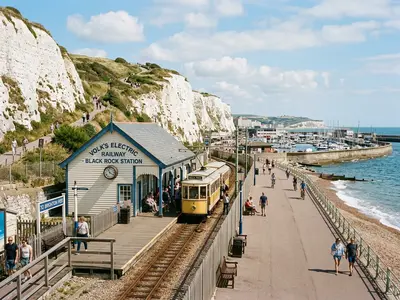
On a clear day the views extend across the English Channel, and looking east you can see the white chalk cliffs stretching towards Rottingdean and beyond. The trains are not fast — they trundle at a walking pace that matches the relaxed atmosphere of the seafront — but that is entirely the point. A return ticket gives you unlimited travel for the day, so you can hop on and off at Halfway to explore the adventure golf course and cafes, or continue to Black Rock and walk along the undercliff path.
Magnus Volk was born in Brighton in 1851, the son of a German clockmaker. He was a prolific inventor and an early champion of electrical technology: in 1879 he installed Brighton's first telephone line, and he became the first person in the town to light his home with electric power. The seafront railway was his most enduring creation, but not his most ambitious. In 1896 he opened the Brighton and Rottingdean Seashore Electric Railway, a bizarre contraption that ran through the sea on legs and was nicknamed the Daddy Long Legs. It was destroyed by a storm in 1896 and never rebuilt, but models and photographs survive in the Aquarium Station exhibition.
Volk operated the railway until his death in 1937, after which Brighton Corporation took it over. Today it is owned and run by Brighton and Hove City Council with the support of the Volk's Electric Railway Association (VERA), a volunteer group that helps maintain the rolling stock and preserve the railway's heritage.
The railway operates seasonally from April to September, with trains running every fifteen minutes throughout the day. Monday, Thursday and Friday services start at 10:15am, Tuesday and Wednesday at 11:15am, and weekends at 10:15am with an extra hour of running until 6:15pm. The line also runs for special events outside the main season — check the website for Christmas and half-term services.
Aquarium Station was completely rebuilt in 2016-2017 and now has a visitor centre with historical displays, a cafe, toilets including disabled and baby-changing facilities. Halfway Station has public toilets and the Jungle Rumble cafe with outdoor seating. Black Rock Station has public and disabled toilets. All three stations are accessible by wheelchair, though wheelchairs must be folded to board the train. Let the cashier know if you need extra time boarding and the staff will be happy to help.
Brighton mainline station is a 15 to 20 minute walk from Aquarium Station, or you can catch a bus along the seafront. Free parking is available along Madeira Drive, and Brighton Marina offers a large free car park near Black Rock Station. A return ticket costs just £6.70 for adults and £4.20 for children, making this one of the most affordable heritage railway experiences in the south of England.
Tickets are purchased at the station on the day of travel. No advance booking is required. A return ticket is valid for unlimited travel on the day of purchase. Dogs travel free. The railway accepts both cash and card payments
A return ticket lets you ride as many times as you like on the day of purchase. Hop on and off at Halfway or ride the full line both ways for the price of one return.
The rebuilt visitor centre at Aquarium Station has free displays on Magnus Volk and the railway's history. Allow ten minutes before or after your ride to look around.
Get off at Black Rock and walk east along the undercliff path towards Rottingdean for chalk cliff views and rock pools. Catch the bus back or retrace your steps to the train.
The railway only runs from April to September with occasional special events outside the main season. Check the website before visiting to confirm running days and times.
Black Rock Station is a short walk from Brighton Marina with its restaurants, cinema, bowling and waterfront shops. Ride to Black Rock, explore the marina, then catch the train back.

London Travel Writer · 12+ years covering UK attractions and tourism
Last reviewed: March 10, 2026