The View Directly Below
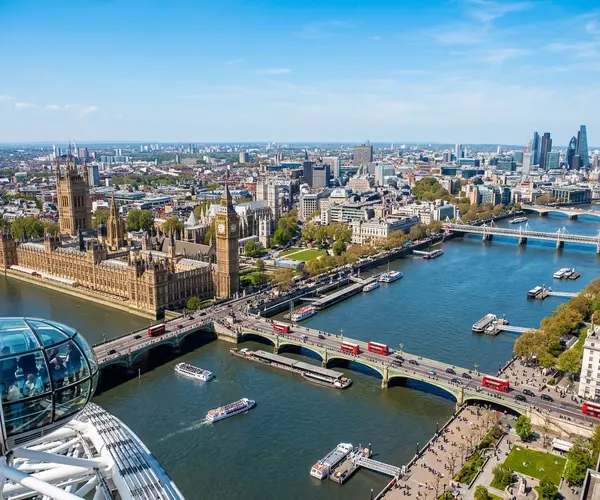
Standing inside one of the capsules on the London Eye, the first things you notice are the landmarks closest to the wheel. The Houses of Parliament and Big Ben sit almost directly across the Thames, so close you can make out architectural details on the facade. Westminster Bridge stretches out below, and Whitehall runs north toward Trafalgar Square.
On the same side of the river, the London Aquarium and the old County Hall building are visible at the base of the wheel. Looking along the South Bank, you can follow the Thames Path past the Royal Festival Hall toward Waterloo Bridge and beyond.
Major Landmarks by Direction
North and East
Looking north and east from the top of the rotation, the City of London's skyline dominates. The Shard, at 310 metres, is the tallest building visible and easy to spot to the east. St Paul's Cathedral sits behind a cluster of modern office towers, its dome still clearly recognisable from this height. Tower Bridge and the Tower of London are visible further along the river bend.
The Gherkin, the Walkie Talkie and the Cheesegrater are all identifiable in the City cluster. On very clear days, the Queen Elizabeth Olympic Park in Stratford is visible in the far east.
West and South-West
Buckingham Palace sits roughly 1.5km to the west, surrounded by the green expanse of St James's Park and Green Park. The Mall runs in a straight line from the palace toward Admiralty Arch, which is visible near Trafalgar Square.
Further west, Hyde Park and Kensington Gardens form a large green rectangle. The Royal Albert Hall and the Natural History Museum area are harder to pick out individually but the neighbourhood is recognisable by its layout.
North-West
The BT Tower is a useful reference point to the north-west, standing tall above the Fitzrovia rooftops. On clear days, Wembley Stadium's distinctive arch is visible on the horizon, approximately 13km away. Regent's Park and the London Zoo area appear as another green patch in the mid-distance.
How Far Can You Really See?
The commonly quoted figure is 40km, which would take your view as far as Windsor Castle to the west. At 135 metres tall, the London Eye provides a vantage point that makes this range plausible. In practice, achieving that range requires exceptional conditions. Low humidity, no haze, and ideally a day after rain has cleared the air are the key factors.
Most visitors on an average day will see clearly for 15 to 20km, which still covers an enormous area of London and its outskirts. On a hazy summer afternoon, visibility might drop to 8 to 10km, which still includes all the central London landmarks but loses the distant horizon.
Best Conditions for Views
Winter mornings after overnight frost tend to produce the clearest air. The cold temperature reduces atmospheric moisture, and early light casts long shadows that make buildings stand out sharply. Autumn days following a weather front are another reliable option.
Summer, despite being the most popular season, often delivers the haziest conditions. Warm air holds more moisture, and pollution levels tend to peak, creating a milky quality to distant views.
What You Might Miss
Some landmarks are surprisingly hard to spot despite being famous. The London Dungeon and Sea Life London Aquarium are both at ground level near the Eye itself, making them invisible from above. Covent Garden's market building blends into the surrounding rooftops. And despite being enormous, the O2 Arena in Greenwich can be tricky to find without knowing exactly where to look to the south-east.
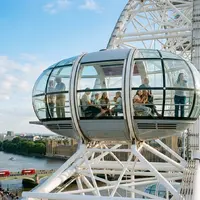
Each capsule has information boards showing the landmarks in each direction with their distances, which helps enormously when trying to identify what you are looking at.
Timing Your Visit for the Best Views
Early morning slots tend to have softer light and fewer crowds, making it easier to move around the capsule and look in every direction. Late afternoon brings golden light from the west, which illuminates the City of London skyline beautifully. The hour before sunset combines good visibility with dramatic colour in the sky.
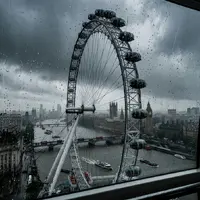
Overcast days are not necessarily a waste. Cloud cover can create an atmospheric, moody panorama, and you still see all the nearby landmarks clearly. Rain, however, does significantly reduce both visibility and enjoyment.