The London Eye Was the First Giant Observation Wheel
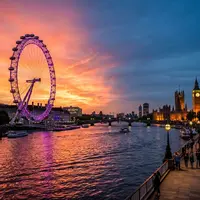
When the London Eye opened on the South Bank of the Thames in March 2000, it stood 135 metres tall and was the largest observation wheel ever constructed. Designed by architects David Marks and Julia Barfield, it was originally planned as a temporary structure for the millennium celebrations. Its popularity ensured it became permanent.
Before the London Eye, the concept of a giant observation wheel barely existed in modern form. The original Ferris wheel built for the 1893 Chicago World's Fair stood at 80.4 metres. For over a century after that, no wheel came close to matching it in ambition. The London Eye changed the game entirely, proving that a massive observation wheel could become a city's defining landmark and a viable long-term attraction.
When Did the London Eye Lose Its Record?
The London Eye held the title of world's tallest observation wheel for six years. The Star of Nanchang in China took the record in 2006, and since then several wheels have pushed the height further.
| Observation Wheel | Location | Height | Year Opened | Years as Tallest |
|---|---|---|---|---|
| London Eye | London, UK | 135m | 2000 | 6 years |
| Star of Nanchang | Nanchang, China | 160m | 2006 | 2 years |
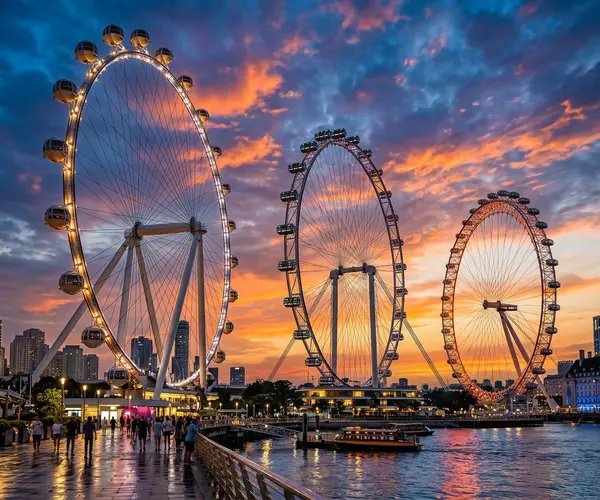
| Singapore Flyer | Singapore | 165m | 2008 | 6 years |
| High Roller | Las Vegas, USA | 167.6m | 2014 | 7 years |
| Ain Dubai | Dubai, UAE | 250m | 2021 | Current holder |
The Ain Dubai is the current record holder and it is significantly larger than anything built before it. At 250 metres, it stands nearly twice the height of the London Eye. Located on Bluewaters Island in the Dubai Marina area, it carries 48 capsules, each holding up to 40 passengers.
Why the London Eye Still Matters
Raw height is only part of the story. Despite being overtaken four times since 2006, the London Eye remains one of the most visited observation wheels in the world. It attracts over 3 million visitors per year and is consistently ranked among London's top five attractions.
Location and Setting
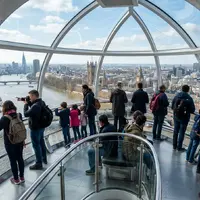
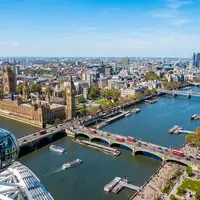
The London Eye's setting is arguably unmatched by any of its taller rivals. It sits directly on the Thames, facing the Houses of Parliament, Big Ben and Westminster Bridge. The views take in Buckingham Palace, St Paul's Cathedral, The Shard and the entire sweep of central London. No other major observation wheel has this density of world-famous landmarks within its sightline. Our detailed London Eye vs The Shard comparison breaks down how the two viewing experiences differ.
The High Roller in Las Vegas overlooks the Strip and the Nevada desert. The Singapore Flyer offers views of Marina Bay and the Strait of Malacca. The Ain Dubai faces the Marina skyline and the Arabian Gulf. All impressive, but none offer the historical depth of the London Eye's panorama.
Architectural Influence
The London Eye pioneered several features that became standard in observation wheel design. Its externally mounted, enclosed capsules were a departure from the traditional hanging gondola. The motorised gimbal system that keeps each capsule level during rotation was also an innovation. Every major observation wheel built since 2000 has adopted some version of these design principles.
The Future of Giant Observation Wheels
Several wheels taller than the London Eye have been proposed or are under development around the world. Projects have been announced in Moscow, New York, Beijing and other cities, though many planned wheels have stalled or been cancelled due to engineering challenges and financing difficulties.
The Moscow wheel, initially announced at 220 metres, was postponed indefinitely. A 190-metre wheel planned for New York's Staten Island was approved but never built. The pattern suggests that while the technology to build taller wheels exists, finding the right combination of location, funding and demand is the real challenge.
The London Eye succeeded because it was built in the right city, on the right stretch of riverbank, at the right moment. Its record-breaking height was part of the initial appeal, but 25 years later it thrives because of what you see from the top rather than how high you go to see it.