Mountfitchet Castle
A reconstructed Norman motte and bailey castle and village — the only wooden fortress rebuilt on its original 1066 site

A reconstructed Norman motte and bailey castle and village — the only wooden fortress rebuilt on its original 1066 site
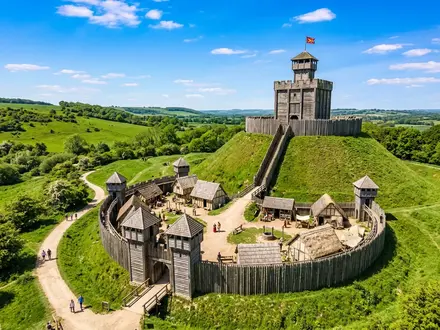
Mountfitchet Castle is the only reconstructed Norman motte and bailey castle standing on its original site anywhere in the world. Built on the hilltop where Robert Gernon raised his timber fortress after the Norman Conquest of 1066, the castle and village were painstakingly rebuilt from 1980 using English oak, Norfolk reed and authentic wattle and daub techniques guided by leading historians and archaeologists.
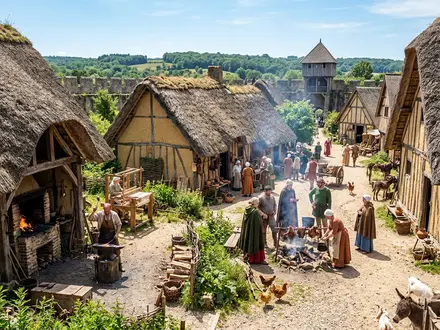
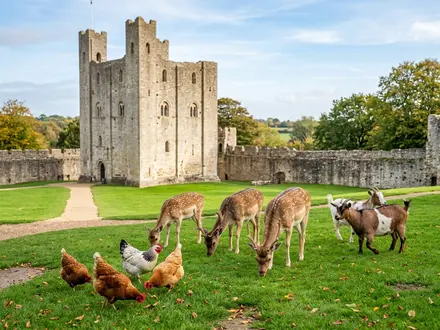
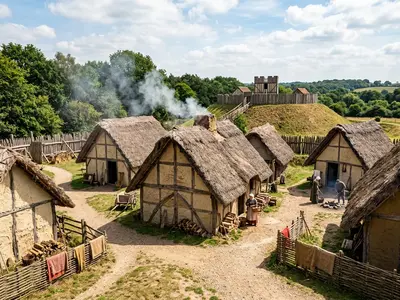
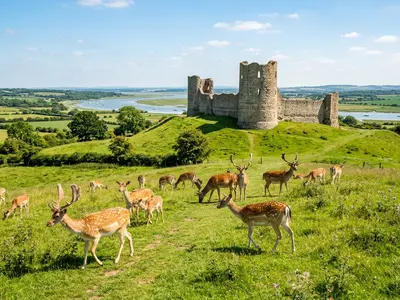
Visitors walk through a living recreation of 11th-century England across ten acres of Essex countryside. Roaming deer, goats and peacocks wander freely among thatched village houses, a working forge, siege weapons and the timber palisade walls of the castle. Log fires burn in the huts, a church bell tolls across the grounds, and the views from the motte stretch across the rolling fields of northwest Essex.
The story of Mountfitchet Castle begins in 1066, when William the Conqueror's ally Robert Gernon was granted lands in what is now Stansted Mountfitchet. Gernon raised a timber motte and bailey fortress on a hilltop that had already seen Iron Age, Roman, Saxon and Viking occupation, making it one of the most continuously settled sites in Essex. The Montfitchet family, who took their name from the castle, held the barony for generations and eventually upgraded the timber defences to stone.
The castle's downfall came in 1215. Richard de Montfitchet sided with the rebel barons who forced King John to seal Magna Carta at Runnymede, and when the king turned against his opponents, Mountfitchet Castle was besieged and razed. For over 750 years the ruins lay hidden beneath woodland and undergrowth, the earthworks slowly merging with the Essex landscape. It was not until 1975 that the landowner, Alan Goldsmith, conceived the idea of rebuilding the castle. After protracted planning battles, work began in 1980, with historians and archaeologists guiding every stage of the reconstruction. The castle and Norman village opened to the public in 1985, and today it stands as the only wooden motte and bailey fortress rebuilt on its original site anywhere in the world.
The experience begins at the base of the motte, where a path climbs through the defensive earthworks to the timber palisade walls above. The reconstructed gatehouse, watchtowers and keep are built from English oak sourced in Suffolk, assembled using period-accurate joinery techniques without modern fixings. Inside the bailey, the scene opens out into a complete Norman village of more than twenty thatched buildings. Each has been furnished and equipped to represent a different aspect of 11th-century life — the brewhouse with its vats, the bakery with its clay oven, the armoury with racks of replica weapons, and the church with its tolling bell.
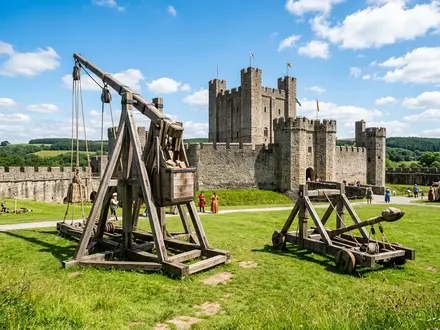
The attention to material authenticity is striking. The wattle and daub walls were constructed using the traditional recipe of pigs manure, straw and horsehair, packed onto a lattice of woven hazel. Roofs are thatched with Norfolk reed and wheat straw, using techniques that have barely changed in a thousand years. Throughout the grounds, full-size siege weapons — trebuchets, catapults, battering rams — demonstrate the military technology of the Norman period. The trebuchet is fired at scheduled times, drawing crowds of visitors to watch the counterweight mechanism launch its payload across the site. Children can try on real chainmail, lift swords and mount wooden horses for jousting practice.
Mountfitchet Castle is open daily from mid-March to mid-November, with gates opening at 10am and last admission at 3.45pm. The site is entirely outdoors, so dress for the weather and wear sturdy footwear — the motte climb and village paths can be muddy after rain. Allow two to three hours to explore the castle and village thoroughly, longer if you also visit the House on the Hill Toy Museum and the Dinosaur Encounters experience, both located within the same complex and included in the admission price.
Getting there is straightforward. Stansted Mountfitchet station, served by Greater Anglia from London Liverpool Street in around 40 minutes, is a five-minute walk from the entrance. By car, the M11 junction 8 puts you within minutes of the village, and free parking is available on site. The castle sits just four miles from Stansted Airport, making it an easy addition to any Essex day trip. Nearby, the village itself has pubs, cafes and an independent high street, while the medieval market town of Bishop's Stortford is a short drive away for further refreshments.
Admission includes entry to Mountfitchet Castle and the Dinosaur Encounters experience. Children under 3 enter free. Group rates available for parties of 15 or more
The castle site is ten acres of outdoor terrain including the steep motte climb and unpaved village paths. After rain the ground can be muddy. Wellies or walking boots are sensible.
The trebuchet demonstration draws large crowds. Check the day's schedule at the entrance and position yourself near the siege weapons area with time to spare for the best view.
The deer, goats and chickens are friendly and love being hand-fed. Small bags of feed are available to buy on site. Younger children find this a particular highlight.
The House on the Hill Toy Museum within the complex houses one of the largest collections of toys and games in Britain. It is included in the admission price.
The castle is open daily from mid-March to mid-November only. It closes entirely for winter. Always check the website for exact opening and closing dates before travelling.

London Travel Writer · 12+ years covering UK attractions and tourism
Last reviewed: March 10, 2026