History
The maze at Hampton Court Palace was planted around 1700 as part of the gardens laid out for William III. It was designed by George London and Henry Wise, the leading garden designers of the period, and was intended as a fashionable garden feature for the royal court. Hedge mazes were popular among European aristocracy at the time, but Hampton Court's is the only one from that era that has survived continuously in its original location.
The maze was originally planted in hornbeam, a dense deciduous hedge plant. Over the centuries, much of the hornbeam was gradually replaced with yew, which is evergreen and provides a solid visual barrier year-round. Some hornbeam sections remain, and you can spot the difference in winter when the hornbeam loses its leaves while the yew stays green.
Size and Layout
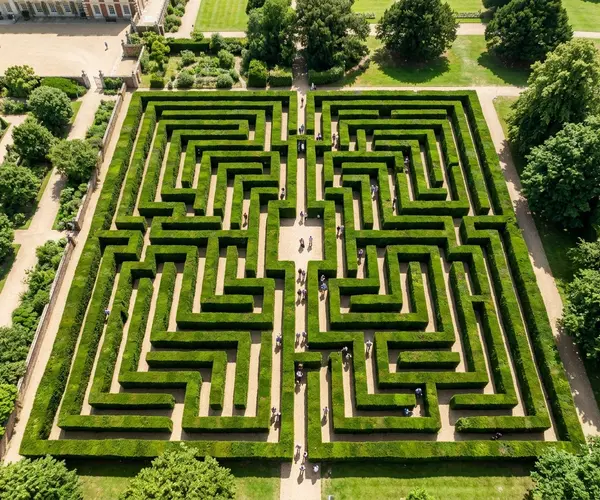
The maze covers approximately a third of an acre, which sounds small but feels considerably larger when you are inside it. The hedges are around 1.8 metres tall, which is high enough to block the view for most adults and completely encloses the paths. The total length of the paths is roughly half a mile (800 metres), winding through a trapezoidal shape.
The layout is what maze designers call a "multicursal" design, meaning there are multiple path choices and dead ends rather than a single winding route. This makes it a genuine puzzle rather than a simple labyrinth. The goal is to reach the centre, which contains a small open area with a bench and a tree, and then find your way back out.
Most visitors complete the maze in around 20 minutes. Confident navigators who use a systematic approach (turning consistently left or consistently right at every junction) can often finish in under ten minutes. Some visitors, particularly young children, can spend considerably longer and enjoy every minute of it.
The Famous Trick
There is a longstanding belief that you can solve the Hampton Court Maze by simply keeping your hand on the left wall and following it continuously. This works in many simple mazes, but Hampton Court's design includes "islands" in the path network that are not connected to the outer wall. This means the left-hand rule does not guarantee you will reach the centre, and you may end up walking in circles around one of these islands.
In practice, the maze is not especially difficult. It is designed to be fun rather than genuinely challenging, and the hedges are maintained to keep the paths clear and walkable. Staff are positioned at the centre and can offer hints or directions to anyone who becomes frustrated or anxious.
Literary Fame
The maze achieved widespread fame through Jerome K. Jerome's 1889 comic novel "Three Men in a Boat," in which the character Harris confidently leads a large group into the maze, promising to guide them through using a map. He proceeds to get hopelessly lost, gathering more and more confused visitors in his wake, until the entire group has to be rescued by a keeper. The passage remains one of the most quoted descriptions of the maze and captures the mix of amusement and mild panic that it can still produce today.
Visiting the Maze
The maze is located in the gardens to the north of the palace, near the Wilderness area. It is included with palace admission but can also be accessed separately with a maze-only ticket. It is open daily during palace opening hours, weather permitting.
The maze is fully outdoors and unpaved, so it can become muddy after rain. Pushchairs can navigate it but may find some of the narrower turns awkward. The paths are flat throughout, making it accessible for most visitors, though the lack of an overhead view can be disorienting for anyone who finds enclosed spaces uncomfortable.
On busy days, particularly summer weekends and school holidays, the maze can feel crowded with groups moving in different directions. Early morning or late afternoon visits tend to be quieter and allow a more atmospheric experience.