Wolsey's Palace
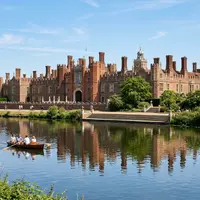
Hampton Court Palace was not originally Henry VIII's creation. It was built from 1515 by Cardinal Thomas Wolsey, who was then Lord Chancellor and the most powerful man in England after the king. Wolsey leased the site from the Knights Hospitaller and transformed it into one of the grandest residences in the country, rivalling the king's own palaces in scale and luxury.
Wolsey entertained on a spectacular scale at Hampton Court, maintaining a household of nearly 500 people. The palace had over 280 guest rooms, its own brewery, bakehouse, and extensive gardens. This magnificence was both Wolsey's strength and ultimately his undoing. A subject living more grandly than the king was playing a dangerous game.
Henry Takes Over
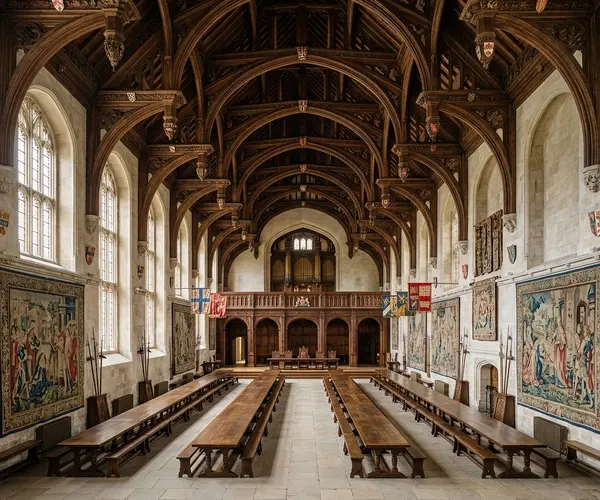
When Wolsey fell from favour in 1529 after failing to secure Henry's divorce from Catherine of Aragon, the king seized Hampton Court along with most of Wolsey's other properties. Henry immediately began expanding and remodelling the palace to suit his own tastes and needs. He spent enormous sums over the next decade, adding the Great Hall with its magnificent hammerbeam roof, a new chapel, tennis courts, bowling alleys and a tiltyard for jousting.
The kitchens were expanded to a vast complex capable of feeding the 800 or more members of the Tudor court. They covered an area of over 3,000 square metres and included separate rooms for roasting, boiling, pastry-making and the preparation of food for the king's own table. These kitchens survive today and are one of the most fascinating parts of the palace to visit.
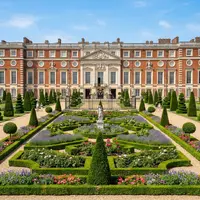
Henry also commissioned the astronomical clock that still hangs in Clock Court, a 15-foot gilded dial showing the time, tides, moon phases and zodiac. He transformed the gardens, creating the first formal pleasure gardens on the site and establishing a hunting park in the surrounding countryside. The palace became his preferred residence for much of his reign, and he returned to it repeatedly throughout the 1530s and 1540s.
Anne Boleyn and Jane Seymour
Hampton Court was closely connected to several of Henry's marriages. He brought Anne Boleyn to the palace during their courtship, and after their marriage in 1533, their intertwined initials were carved into the Great Hall decorations. Following Anne's execution in 1536, workmen hastily replaced her initials, though some were missed and can still be spotted today by sharp-eyed visitors.
Jane Seymour, Henry's third wife, has the deepest connection to Hampton Court. It was here that she gave birth to Prince Edward on 12 October 1537, finally providing Henry with the male heir he had spent two decades pursuing. The celebrations were immense, but Jane fell ill shortly after the birth. She died at Hampton Court on 24 October 1537, just twelve days after Edward's birth.
Henry was reportedly devastated by Jane's death. She is often described as his favourite wife, the only one who gave him a son and the only one beside whom he chose to be buried at Windsor Castle.
Catherine Howard
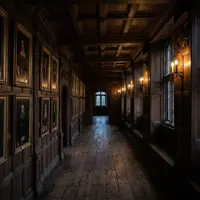
Henry's fifth wife, Catherine Howard, also has a dramatic connection to Hampton Court. In 1541, Archbishop Cranmer presented Henry with evidence of Catherine's alleged infidelity. According to tradition, when Catherine learned she was to be arrested, she broke free from her guards and ran through what is now known as the Haunted Gallery, screaming for Henry to hear her pleas. She was dragged back before she could reach him.
Whether this specific incident happened as described is debated by historians, but the Haunted Gallery has carried the name ever since, and visitors still report hearing unexplained sounds in that part of the palace. Catherine Howard's ghost is just one of several supernatural stories associated with the building — our guide to whether Hampton Court is haunted covers them all.
Henry's Legacy at Hampton Court
Much of what visitors see at Hampton Court today bears Henry's stamp. The Great Hall, with its soaring hammerbeam roof and tapestries, is the centrepiece of the Tudor palace. The Chapel Royal, the kitchens, the wine cellar and the basic layout of the courtyards all date from Henry's rebuilding programme. Later monarchs, particularly William III and Mary II, added the Baroque eastern wing in the 1690s, but the Tudor half of the palace remains the part most closely associated with its most famous resident.
Henry owned over 60 properties during his reign, but Hampton Court was the one he returned to most often and spent most lavishly on. It remains his palace in the public imagination, and walking through the Tudor rooms is one of the most vivid encounters with his world that survives anywhere in England.