A Living History of Garden Design
The gardens at Hampton Court Palace represent nearly five centuries of English gardening, from the Tudor period to the present day. Unlike many historic gardens that have been repeatedly redesigned, Hampton Court preserves distinct areas from different eras, making it one of the most historically layered garden landscapes in Britain.
Walking through the 60 acres, you move from the formal geometry of the Baroque parterre gardens laid out for William III to features that predate him, including areas shaped during Henry VIII's transformation of the palace, and on to the wilder informality of the Wilderness area, and from the intimate enclosure of the Tudor Knot Garden to the sweeping views of the Long Water canal stretching into the distance. Each section tells a different chapter in the story of how the English understood and shaped their gardens.
The Privy Garden
The Privy Garden is the most meticulously restored area of the grounds. Originally the private garden of the monarch, it was laid out in its current form for William III in 1702, designed by Daniel Marot. By the 20th century, the original planting had been lost, but a major restoration completed in 1995 returned the garden to its early 18th-century design based on detailed archaeological and documentary evidence.
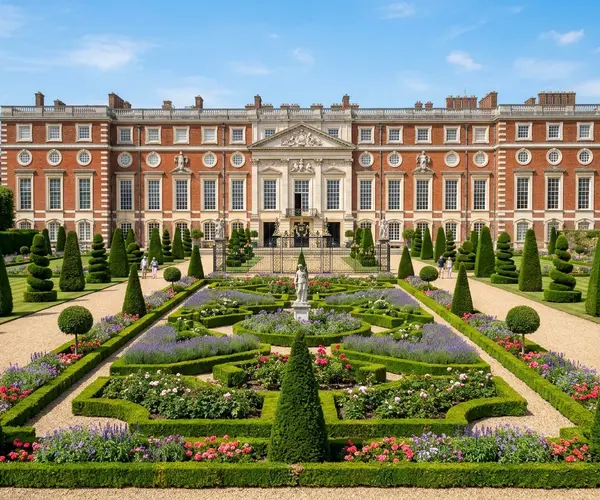
The result is a stunning formal garden with symmetrical beds of box hedging, clipped yews, herbaceous plantings and gravel paths. The garden is enclosed by a magnificent wrought iron screen by Jean Tijou at the river end, framing views of the Thames. The Privy Garden gives visitors one of the most accurate impressions of a royal Baroque garden to be found anywhere in Britain.
The Great Vine
The Great Vine is one of Hampton Court's most remarkable features. Planted in 1768 by Lancelot "Capability" Brown, who was the royal gardener at the time, it is the oldest and largest productive grapevine in the world. The vine is a Black Hamburg variety and its trunk has grown to an enormous girth, with branches extending through a dedicated glasshouse.
The vine still produces a crop of grapes each year, typically harvested in September. The grapes are sold to visitors in small bunches, and they sell out almost immediately. The vine's root system extends beneath the garden for a considerable distance, and its annual pruning and care is a specialist task carried out by the palace's garden team.
The glasshouse is open to visitors and is free to enter. Seeing the vine is a memorable experience simply because of its age and scale. The twisted trunk and enormous branches are unlike anything you will see in a normal garden.
The Wilderness
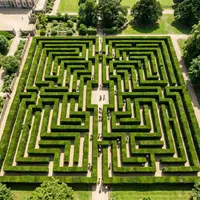
The Wilderness is the most informal area of the gardens, located to the north of the palace near the maze. In spring it is carpeted with daffodils and bluebells, creating one of the most photographed scenes at Hampton Court. The area includes mature trees, meadow grass and winding paths that feel more like a country park than a palace garden.
The Wilderness was originally laid out as a formal garden in William III's time, but it has been allowed to naturalise over the centuries into its current relaxed state. The contrast with the manicured Privy Garden is striking and deliberate, giving visitors a range of garden atmospheres within a single site.
The Formal Gardens
The East Front of the palace faces the Great Fountain Garden, a semicircular parterre originally designed for William III and restored to something close to its original layout. The central fountain and radiating pathways create a grand approach to the Baroque east wing, and the garden is flanked by the Long Water, a canal that stretches over half a mile into the distance.
On the south side, the Pond Gardens occupy a sunken area near the Banqueting House. These were originally Tudor fish ponds and are now planted as a formal garden with herbaceous beds and topiary. The Knot Garden nearby recreates a Tudor-style pattern garden using low hedging and herbs, giving a sense of what the earliest Hampton Court gardens may have looked like.
Free Access
One of the best features of Hampton Court's gardens is that much of the grounds are free to walk year-round without purchasing palace admission. The Wilderness, the Home Park, the riverside walks and the approaches to the palace are all freely accessible. The Privy Garden and some enclosed areas require a palace ticket, but a substantial and beautiful portion of the 60 acres can be enjoyed at no cost.
This makes the gardens a popular destination for local walkers, runners and families, as well as day-trippers who want to enjoy the grounds without committing to a full palace visit.