Built for Henry VIII
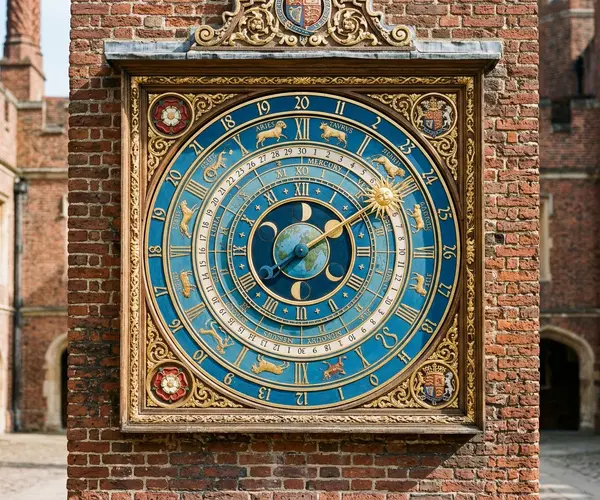
The clock was commissioned by Henry VIII as a showpiece of Tudor magnificence. It was designed by Nicholas Kratzer, a Bavarian mathematician who held the title "Deviser of the King's Horloges", and built by the French clockmaker Nicholas Oursian. It hangs on the gatehouse between Base Court and the inner courtyard, known as Anne Boleyn's Gateway. The courtyard below was renamed Clock Court in its honour.
What It Shows
Three copper dials revolve at different speeds behind the ornate gilded frame. Between them they display the hour of the day on a 24-hour dial, the month and date, the quarter of the year, the signs of the zodiac, the phases of the moon and the position of the sun.
The most practical reading was the time of high water at London Bridge. The preferred route to Hampton Court from London was by barge along the Thames, and the narrow arches of old London Bridge created dangerous rapids. Knowing when the tide turned was essential for safe passage.
The Sun Goes Round the Earth
One detail catches every visitor's eye. A small globe at the centre of the dial represents the earth, and a golden sun travels around it on a pointer. The clock shows the sun orbiting the earth because it was built 13 years before Copernicus published his heliocentric theory. In 1540, the geocentric model was still accepted wisdom.
Nearly Five Centuries of Service
The clock has been through several restorations. In 1711, William Herbert simplified the face and removed the astronomical dials. They were rediscovered and refitted in 1879. The most recent restoration was completed in 2008 by the Cumbria Clock Company, returning the mechanism to full working order in time for the 500th anniversary of Henry VIII's accession.
It is one of the oldest working astronomical clocks in the world still mounted in its original position, and visitors to Hampton Court can see it ticking away in Clock Court exactly where it has hung since the Tudor court gathered beneath it.