Cliveden
A grand National Trust estate above the Thames — 376 acres of formal gardens, woodland and political scandal
A grand National Trust estate above the Thames — 376 acres of formal gardens, woodland and political scandal
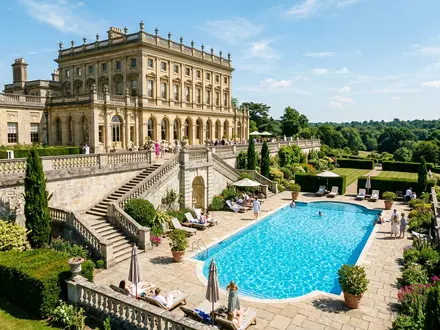
In July 1961, Secretary of State for War John Profumo met Christine Keeler at the swimming pool here while she tried to cover herself with a towel. That weekend encounter triggered the political scandal that brought down Harold Macmillan's government. The pool is still there, set into the terrace below the Italianate mansion that has hosted princes, dukes and prime ministers since 1666.
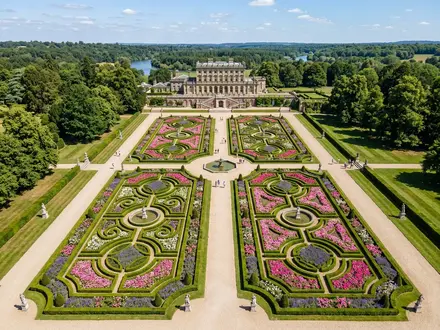
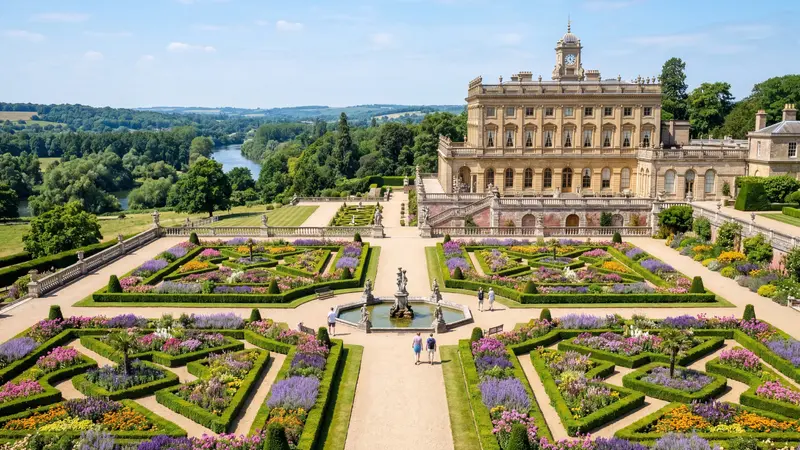
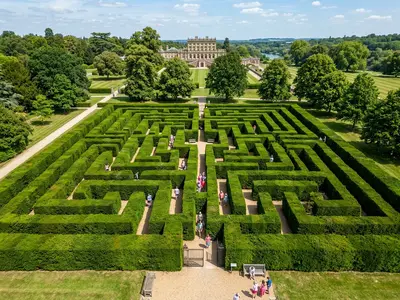
Beyond the scandal, Cliveden offers 376 acres of Grade I listed gardens and woodland above the Thames. The geometric parterre blazes with seasonal colour, a yew maze covers half an acre, and the Water Garden hides among exotic planting. Guided house tours run three days a week between March and October.
The first house at Cliveden was built in 1666 by the 2nd Duke of Buckingham as a hunting lodge and retreat for entertaining his mistress, the Countess of Shrewsbury. It burned down in 1795. A second house, designed by William Burn, rose on the same clifftop site in 1824 but met the same fate in 1849. The present mansion was completed in 1851 by Sir Charles Barry — architect of the Houses of Parliament — for the 2nd Duke of Sutherland, in a bold Italianate style with a nine-bay facade and a clock tower modelled on a Roman campanile.
The estate passed to the Astor family in 1893 when William Waldorf Astor bought it for his son. Under Nancy Astor, Cliveden became the centre of the so-called "Cliveden Set" during the 1920s and 1930s — a gathering of politicians, diplomats and intellectuals whose alleged sympathies with appeasement drew fierce criticism. The Astors gave the estate to the National Trust in 1942, though they continued living in the house until 1966.
The parterre is the centrepiece — a vast geometric garden designed by head gardener John Fleming in 1855, planted with around 30,000 bedding plants in spring and summer. Beyond it, the Long Garden leads past Italian statuary and the Rose Garden, which holds some 850 roses planted in a design by Sir Geoffrey Jellicoe for the 3rd Lord Astor.
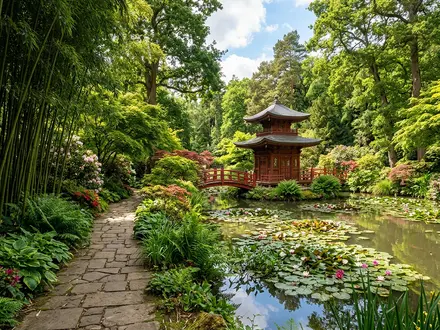
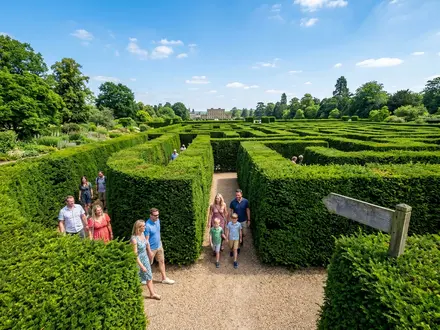
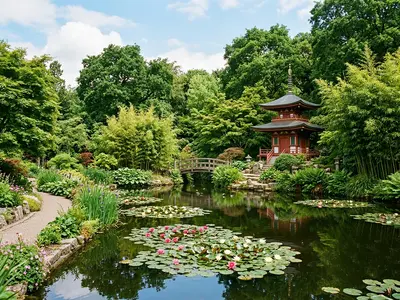
The Water Garden offers a change of pace, with its oriental-inspired pond, water lilies and winding paths through bamboo and exotic planting. Children gravitate to the yew maze, which covers half an acre and contains over 1,000 trees. For walkers, miles of woodland trails lead through ancient beech and oak to viewpoints high above the Thames. Boating on the river is available from late March, and the Conservatory Cafe serves hot food overlooking the parterre.
Cliveden sits above the Thames between Taplow and Cookham, roughly an hour from central London by car or train. The Elizabeth Line and GWR services to Taplow make it reasonably accessible by public transport, though the final stretch requires a taxi. Free parking is included with admission.
Guided house tours run on Mondays, Tuesdays and Thursdays from March to October, starting every ten minutes between 11am and 12:30pm. Tickets are issued from the Information Centre on a first-come, first-served basis — arrive by mid-morning during summer to be sure of a slot. The gardens alone justify the visit, so a house tour is a bonus rather than essential. Allow three to four hours for the gardens, maze and woodland walks, longer if you plan to eat at the cafe or take a boat on the river.
Under 5s free. House tour tickets are free with garden admission and issued on a first-come, first-served basis from the Information Centre
House tours run Mon, Tue and Thu from March to October. Tickets are issued from the Information Centre at 11am on a first-come basis and often go quickly in summer.
The estate covers 376 acres with steep woodland paths and uneven ground near the river. Walking boots or sturdy shoes are advisable, especially after rain.
Most visitors head straight for the parterre. Start with the Water Garden and maze while they are quiet, then circle back to the formal gardens later in the day.
A riverside path connects Cliveden to the village of Cookham, home to the Stanley Spencer Gallery. The walk takes about 45 minutes each way through lovely scenery.
Windsor Castle is just 8 miles south and makes an excellent pairing for a full day out. Both are manageable in a single day if you start early at Cliveden.

London Travel Writer · 12+ years covering UK attractions and tourism
Last reviewed: March 9, 2026