South Downs National Park
England's newest national park — 628 square miles of chalk downland, ancient woodland and dramatic white cliffs from Winchester to Eastbourne


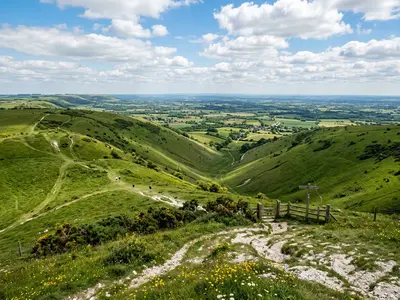
England's newest national park — 628 square miles of chalk downland, ancient woodland and dramatic white cliffs from Winchester to Eastbourne
Designated in 2010, the South Downs is England's newest national park and its most visited, drawing roughly 39 million visitors a year to 628 square miles of rolling chalk downland between Winchester and Eastbourne. The park holds the Seven Sisters cliffs, Beachy Head — Britain's tallest chalk sea cliff at 162 metres — and an International Dark Sky Reserve named after astronomer Sir Patrick Moore.
Walkers have over 2,000 miles of public rights of way to explore, including the 100-mile South Downs Way, the only National Trail contained entirely within a national park. Beyond the ridgeline paths, you will find Iron Age hill forts, medieval villages, working vineyards and lowland heaths that shelter every native reptile and amphibian species in the country.
The South Downs stretch 87 miles across Hampshire, West Sussex and East Sussex, forming a broad chalk ridge that runs from the cathedral city of Winchester to the dramatic sea cliffs at Eastbourne. The landscape was shaped by millions of years of geological activity — the chalk was laid down as sediment on a shallow seabed during the Cretaceous period, then uplifted and eroded into the rolling hills visible today.
Campaigning for national park status began in the 1940s, but it took until 31 March 2010 for the South Downs to be formally designated — making it England's newest and, by visitor numbers, most popular national park. Around 120,000 people live within the park boundary, alongside working farms, vineyards and some of the richest chalk grassland habitat in western Europe. Woolmer Forest, in the park's Hampshire section, is the only place in Britain where all twelve native reptile and amphibian species coexist.
The Seven Sisters cliffs are the headline attraction for many visitors. This series of seven undulating chalk peaks between Cuckmere Haven and Birling Gap offers a cliff-top walk of roughly four miles, with Beachy Head — Britain's tallest chalk cliff at 162 metres — standing at the eastern end. The walk from Seaford to Eastbourne via Birling Gap is one of the finest coastal routes in the country.
Inland, Devil's Dyke is the largest dry valley in Britain, stretching nearly a mile across the Downs north of Brighton with views extending up to 30 miles across the Weald. The South Downs Way runs the full length of the park along the ridgeline, covering 100 miles from Winchester to Eastbourne. Day walkers can pick up shorter circular routes from stations such as Amberley, Southease and Petersfield.
Since 2016 the park has held International Dark Sky Reserve status, named after the late astronomer Sir Patrick Moore. Bignor Hill and the area around Butser Hill are among the darkest sites, where on clear nights the Milky Way and thousands of stars are visible without binoculars.
The park is remarkably accessible from London. Trains from Waterloo reach Petersfield in just over an hour, while services from Victoria reach Lewes in around 68 minutes. From these gateway stations, bus networks and signed footpaths lead directly onto the Downs. The Discovery bus ticket offers unlimited day travel across the park area.
Drivers should note that car parking at popular sites such as Birling Gap, Devil's Dyke and Seven Sisters Country Park can fill quickly on summer weekends — arriving before 10am or visiting midweek avoids the worst congestion. The South Downs Centre in Midhurst serves as the main visitor hub, with free entry, maps, route suggestions and knowledgeable staff. Several National Trust properties sit within or adjacent to the park, including Petworth House and Monk's House at Rodmell.
The national park itself is entirely free to access — charges apply only for car parking at specific sites and some visitor attractions within the park
Petersfield, Amberley and Southease stations all sit within the park with signed trails leading directly onto the Downs. No bus connection or car needed.
The car park at Seven Sisters Country Park fills by mid-morning on summer weekends. Aim to arrive before 9am or take the bus from Eastbourne or Seaford instead.
The chalk ridgeline is exposed with little shade or shelter. There are few places to buy supplies between villages, so bring water and suncream even on mild days.
The annual Dark Skies Festival runs each February with guided stargazing events. Outside the festival, Bignor Hill and Butser Hill are the best spots for clear night skies.
Mobile signal is patchy across much of the Downs. Download OS Maps or the South Downs Way app offline before setting out, especially for longer ridge walks.

London Travel Writer · 12+ years covering UK attractions and tourism
Last reviewed: June 2, 2026