Greenwich Park
183-acre Royal Park with hilltop views of Canary Wharf and the Thames, home to the Royal Observatory, Prime Meridian line and open access year-round
183-acre Royal Park with hilltop views of Canary Wharf and the Thames, home to the Royal Observatory, Prime Meridian line and open access year-round
Greenwich Park is 183 acres of hillside parkland and sweeping river views on the south bank of the Thames — the oldest enclosed Royal Park in Britain, fenced by Humphrey, Duke of Gloucester, in 1433.
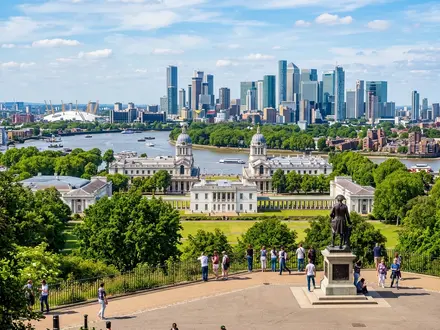
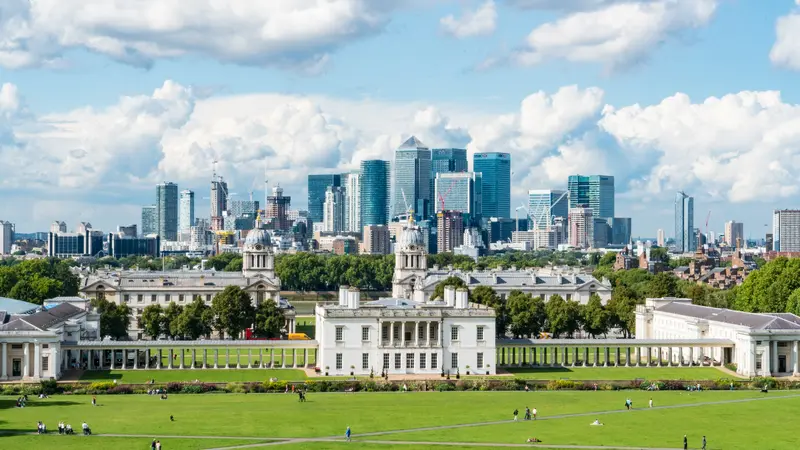
Stand on the hilltop and London unfolds below: the towers of Canary Wharf, the curve of the river, the dome of the Old Royal Naval College. The Royal Observatory sits behind you and the Prime Meridian runs beneath your feet. The gates are open every day of the year.
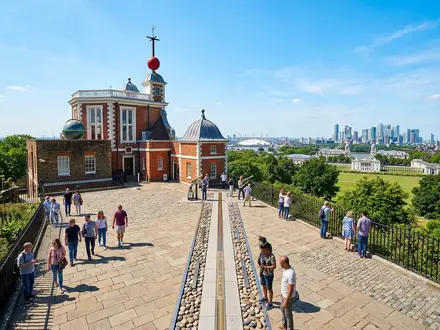
The Royal Observatory sits at the crest of the hill, founded by Charles II in 1675 to advance navigation at sea. Flamsteed House, designed by Christopher Wren, was Britain's first purpose-built scientific research facility, and the work done here — mapping star positions and refining longitude measurement — shaped maritime navigation for centuries.
The Prime Meridian runs through the Observatory courtyard, where visitors stand astride the brass strip dividing the hemispheres. The time ball atop Flamsteed House has dropped at 1pm every day since 1833, and the Peter Harrison Planetarium shows digital star programmes throughout the day.
The broad hilltop beside the statue of General James Wolfe is the reason most visitors climb through the park. The panorama takes in the Queen's House below — a Palladian villa commissioned by Inigo Jones in 1616 and completed in 1635 — flanked by the twin domes of the Old Royal Naval College, with the Thames and Canary Wharf filling the horizon.
The Naval College is a UNESCO World Heritage Site alongside the Observatory and the National Maritime Museum. The Painted Hall inside, decorated by Sir James Thornhill between 1707 and 1726, has been called Britain's Sistine Chapel.
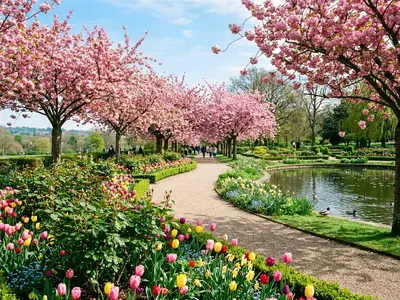
The upper level holds a formal flower garden, rose garden, duck pond and an avenue of cherry trees that draws crowds during spring blossom. A herb garden and bandstand add to the cultivated hilltop, contrasting the wilder slopes below.
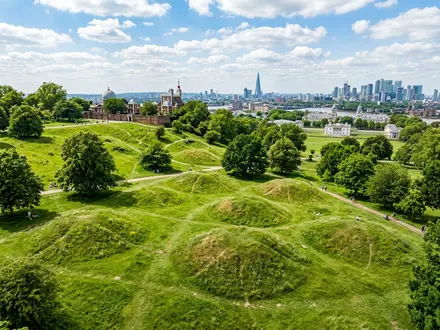
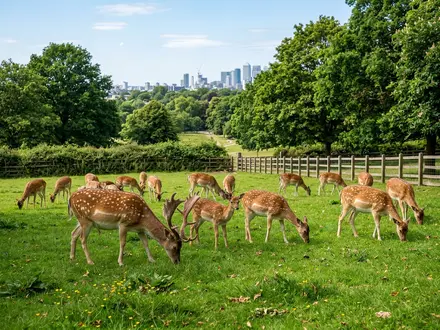
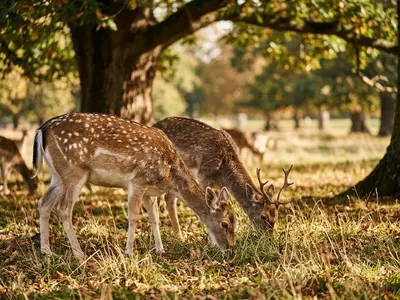
The deer enclosure near Blackheath Gate continues a tradition started by Henry VIII. Fallow deer graze within view of the path, and the wider grounds include ancient sweet chestnut trees planted in the 17th century along avenues laid out by André Le Nôtre for Charles II. The park also holds one of England's best-preserved Anglo-Saxon barrow cemeteries — 31 mounds on the western slopes, dating from the 6th to 8th century.
Greenwich Park itself is completely free — charges apply only for the Royal Observatory and Planetarium, which are managed by Royal Museums Greenwich
Head straight uphill from the Cutty Sark DLR entrance to catch the panoramic view before the crowds build. Early morning light is best for photographs looking north towards Canary Wharf.
The Prime Meridian line continues outside the Observatory walls through the park. You can stand on the line in the grass without paying admission. The green laser beam marking the Meridian is visible after dark.
The avenue of cherry trees near the flower garden is one of London's best blossom spots in mid-April. Arrive on a weekday morning to avoid the weekend crowds.
The National Maritime Museum and the Queen's House at the foot of the hill are both free. Allow an extra hour to see Turner's paintings and the Great Map in the Maritime Museum.
The river bus from central London to Greenwich Pier is a scenic alternative to the DLR. Services run from Westminster, Embankment and Tower piers and the journey takes about 30 minutes.

London Travel Writer · 12+ years covering UK attractions and tourism
Last reviewed: March 5, 2026