The Keyhole View
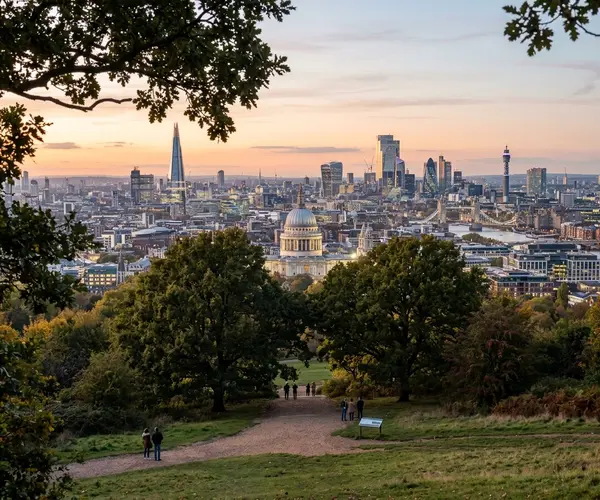
Standing on King Henry's Mound in Richmond Park, you can look through a narrow gap in the trees and see the dome of St Paul's Cathedral, 10 miles away across the London skyline. It is a view that seems impossible. The cathedral is a tiny white shape framed by branches, distant and yet unmistakable.
The gap in the trees is deliberately maintained. The hedgerow that flanks the viewing corridor is clipped to preserve the sightline, and a telescope mounted on the mound helps visitors pick out the cathedral. On clear days, the dome is visible to the naked eye. On hazy days, the telescope brings it into sharp focus.
A Protected View
This sightline is one of London's protected vistas, a set of views deemed so important that planning regulations prevent any building from being constructed in their path. The protection of the view from King Henry's Mound was formalised in 1991 as part of the London View Management Framework, but the tradition of preserving it goes back much further.
The view corridor stretches in a straight line from the mound through the park, across the Thames, over Twickenham, Isleworth, and Syon Park, through Kew, across the river again, and onwards through the western suburbs of London to the City. Along this entire route, no building may be tall enough to block the sightline. This has influenced planning decisions across a wide swathe of west and central London.
The Henry VIII Connection
The mound is named after Henry VIII, and the most popular story is that he stood here in May 1536 waiting for a signal from the Tower of London to confirm the execution of Anne Boleyn. According to legend, when the signal came, he rode to visit Jane Seymour, whom he married the following day.
Historians treat this story with considerable scepticism. There is no contemporary evidence that Henry was at Richmond Park on the day of Anne Boleyn's execution, and the distance from the mound to the Tower of London would make any visual signal extremely difficult to see. The mound itself may be a prehistoric burial barrow that was later associated with the king's name. Whatever the truth, the legend has become inseparable from the place.
The Setting
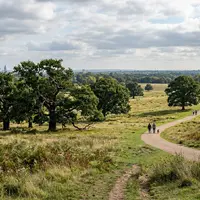
King Henry's Mound sits within the grounds of Pembroke Lodge, a Georgian mansion in the western section of Richmond Park that now operates as a cafe and events venue. The mound is in the gardens behind the lodge, accessible to all park visitors without charge.
The area around Pembroke Lodge is one of the highest points in the park, and the views extend well beyond the St Paul's sightline. From the terrace, you can look south over the Thames Valley towards Hampton Court and the hills of Surrey. On clear days, Windsor Castle is visible to the west. The combination of the formal gardens, the historic lodge, and these far-reaching views makes this one of the most rewarding corners of the park.
Visiting the Mound
The mound is easy to find if you know where to look. Follow signs to Pembroke Lodge from any of the park's gates, or cycle the park's roads and Tamsin Trail to reach it more quickly. Once there, walk through the gardens to the raised mound behind the lodge. A small sign indicates the viewing point and a mounted telescope is available.
The best conditions for seeing St Paul's are clear, cold days, particularly in winter when the air is crisper and the trees in the viewing corridor are bare. Summer visits can be hazier, though the telescope usually allows you to pick out the dome even on less clear days. Early morning tends to offer better visibility than afternoon, when heat haze can obscure distant views.
The experience of standing in a royal deer park and looking through a gap in ancient trees to see a cathedral 10 miles away is one of those moments that captures something essential about London. It is a city of layers, surprises, and hidden connections, and this small mound in Richmond Park reveals one of its most remarkable.