London's Largest Park
Richmond Park is vast by any standard, but its size is particularly remarkable given its location. At 2,500 acres, it is more than seven times the size of Hyde Park and more than three times the size of Hampstead Heath. The entire City of London, the square mile that forms the historic heart of the capital, would fit inside it with room to spare.
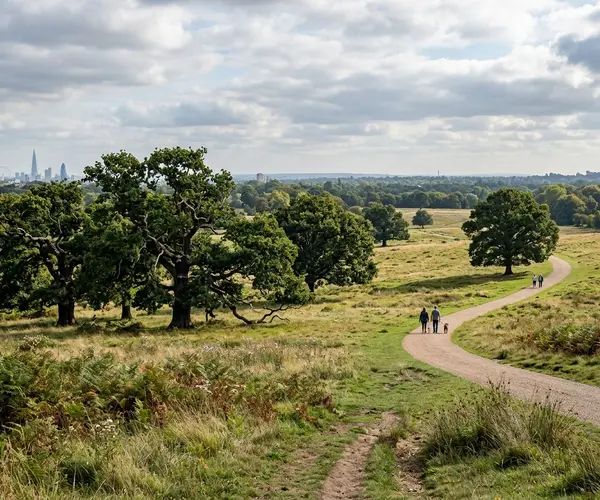
The park's perimeter stretches for approximately 7.5 miles, and walking the full circuit takes around three hours. Within those boundaries lies a landscape of open grassland, ancient woodland, ornamental gardens, ponds, and hills that feels genuinely wild. On a quiet weekday morning, it is easy to forget that you are surrounded by one of the world's largest cities.
Why It Is So Large
Richmond Park's size is a product of its history. In 1637, Charles I enclosed the area as a royal hunting ground, combining several existing farms and estates into a single vast park. The eight-mile wall he built around it still stands and still defines the park's boundaries. Unlike many royal estates that were later sold off or developed, Richmond Park has remained intact and largely unchanged for nearly four centuries.
The park's designation as a National Nature Reserve and a Site of Special Scientific Interest provides additional protection. These designations recognise the ecological importance of its ancient grasslands and veteran oak trees, many of which are over 500 years old.
Comparing Size
To appreciate how large Richmond Park is, it helps to compare it with other well-known green spaces. Central Park in New York covers 843 acres, making Richmond Park nearly three times its size. The Bois de Boulogne in Paris covers 2,090 acres, so Richmond Park is larger than even that famous Parisian park.
Among London's parks, the hierarchy is clear. Richmond Park leads at 2,500 acres, followed by Bushy Park at 1,100 acres, Regent's Park at 395 acres, and Hyde Park at 350 acres. The combined area of all the other Royal Parks in London does not match the size of Richmond Park alone.
What Fills the Space
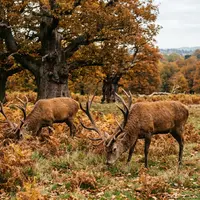
The park's 2,500 acres are not uniform grassland. The landscape is surprisingly varied. Open plains of acid grassland, where the deer herds graze, are broken up by stands of ancient oak and beech woodland. The Isabella Plantation is a 40-acre woodland garden famous for its azaleas and rhododendrons. Pen Ponds sit in the centre of the park, attracting herons, cormorants, and other waterfowl.
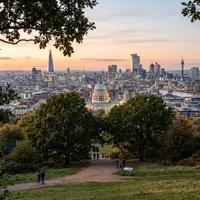
The park has several hills, including King Henry's Mound with its protected sightline to St Paul's Cathedral, and Poet's Corner with views over the Thames Valley towards Windsor. These elevated points give a sense of the park's enormous extent and its position within the wider London landscape.
Exploring the Full Park
With 2,500 acres to explore, most visitors only see a fraction of Richmond Park in a single visit. The areas near the main car parks and gates tend to be busiest, while the more distant corners of the park can feel genuinely remote.
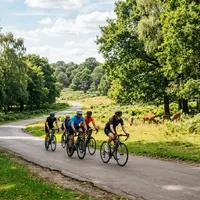
The Tamsin Trail, a 7-mile shared-use path that follows the perimeter of the park, is the best way to appreciate the full scale. Walking the trail takes around three hours. Cycling it takes about an hour. Along the way you pass through open grassland, woodland, and alongside the park wall, with constantly changing views and a good chance of encountering deer along every stretch.
For those who prefer to explore on foot without following a set route, the park rewards wandering. The network of paths and open grassland means you can set off in any direction and find something worth seeing. Ancient trees, hidden ponds, unexpected views, and encounters with deer are all part of the experience of getting happily lost in London's largest park.