Morden Hall Park
A 125-acre National Trust parkland on the River Wandle — snuff mills, wetlands and a rose garden in south London


A 125-acre National Trust parkland on the River Wandle — snuff mills, wetlands and a rose garden in south London
Morden Hall Park covers 125 acres of riverside parkland along the River Wandle, just a five-minute walk from Morden Underground station. Gifted to the National Trust in 1941 by Gilliat Edward Hatfeild, the estate retains its two nineteenth-century snuff mills, a restored waterwheel and a two-and-a-half-acre rose garden planted with around 45 Edwardian varieties.
Beyond the formal gardens, a boardwalk winds through wetlands where kingfishers, herons and little egrets feed along the Wandle. Tree-lined avenues cross open meadows, a natural play area keeps younger visitors busy, and the restored Stable Yard houses a cafe, second-hand bookshop and exhibition space.
The estate at Morden has roots stretching back nearly a millennium. The manor of Mordone appears in the Domesday Book of 1086, when the marshy fields along the River Wandle belonged to Westminster Abbey. After the Dissolution of the Monasteries in 1536, the land passed through several hands before Richard Garth purchased it in 1554. The Garth family held the manor for over three centuries, building the snuff mills that would define the estate's industrial character.
Snuff — finely ground tobacco inhaled through the nose — was big business in Georgian and Victorian Britain, and the Wandle's reliable flow provided the power to grind it. The Garth family built two water-powered mills around 1750 and 1830, leasing them to commercial operators. Production continued until 1922, and the conserved waterwheel in the western mill still stands as a reminder of the industry that once made the Wandle one of the most productive rivers in England.
In 1872 the estate passed to the Hatfeild family. Gilliat Edward Hatfeild planted the rose garden around 1920 and, upon his death in 1941, bequeathed the entire 125-acre estate to the National Trust with the stipulation that public access remain free.
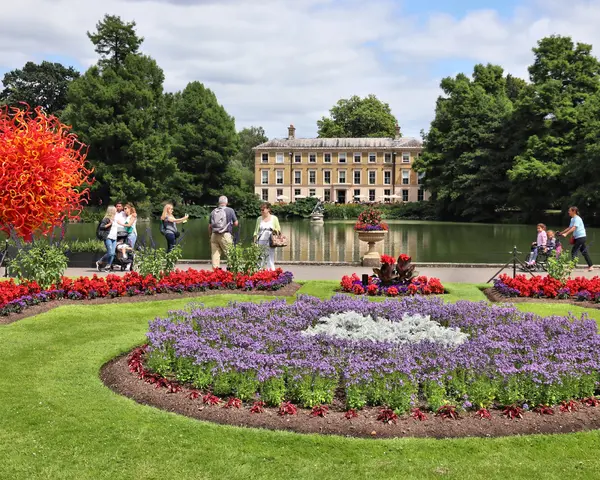
The rose garden is the centrepiece for many visitors, particularly between mid-June and mid-July when its fifty formal beds are in full bloom. The surrounding pergola walk offers shade and structure, and the Edwardian varieties grown here are rarely seen in modern gardens.
Beyond the roses, the wetlands boardwalk at the northern end of the park provides a quiet escape. Opened in 2017, the timber walkway leads to a viewing platform overlooking channels where kingfishers, grey herons and little egrets are regularly spotted. Green parakeets — now an established south London presence — screech through the tree canopy above.
The River Wandle itself splits into several channels as it passes through the park, crossed by ornate Victorian bridges. Tree-lined avenues connect open meadows with patches of ancient woodland, and the natural play area near the Stable Yard gives younger children space to climb and explore. The park sits midway along the 14-mile Wandle Trail running from Croydon to Wandsworth, making it a natural stopping point for walkers and cyclists.
The restored Stable Yard is the social heart of the park, housing a dog-friendly cafe serving light lunches and cakes, a second-hand bookshop and a small exhibition space. The National Trust garden centre, set in the old walled kitchen garden, stocks plants, tools and seasonal gifts.
Morden Hall itself — a Georgian building set behind the main lawns — is not open to the public but forms an attractive backdrop to the parkland. For those arriving by Tube, the short walk from Morden station passes through suburban streets before opening suddenly onto the green expanse of the park. Nearby, Deen City Farm is a ten-minute walk along the Wandle Trail, offering a free family outing that pairs well with a morning in the park.
Entry to the park and gardens is free for everyone — car parking charges apply for non-National Trust members
The walk from Morden station takes just five minutes. Follow Aberconway Road south and you will arrive at the park entrance on Morden Hall Road without needing a bus.
The Edwardian roses peak between mid-June and mid-July. Arrive on a weekday morning for the quietest experience and the best light for photographs.
Wildlife is most active in the early morning. The boardwalk viewing platform is the best spot for kingfishers and herons before the park gets busy.
The park sits midway along the 14-mile Wandle Trail. Walk south to Deen City Farm or north towards Wandsworth for a longer riverside outing at no cost.
The open meadows and riverside benches make excellent picnic spots. The cafe in the Stable Yard is an alternative, but it can queue on sunny weekends.

London Travel Writer · 12+ years covering UK attractions and tourism
Last reviewed: March 9, 2026